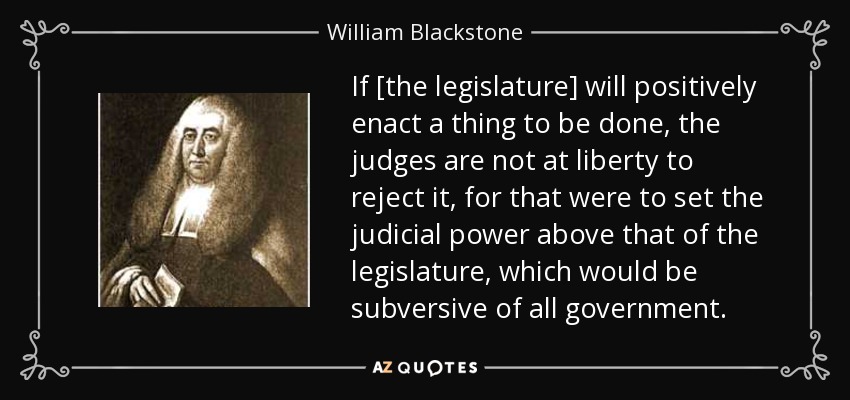
If [the legislature] will positively enact a thing to be done, the judges are not at liberty to reject it, for that were to set the judicial power above that of the legislature, which would be subversive of all government.
No legislative, administrative or judicial activity in the Hong Kong SAR is allowed to contradict the Basic Law, let alone to go against the Basic Law.
The idea that there aren't mistakes made constantly in the judicial system is too obvious even to need to mention.
I have many things to say. My every right, constitutional, civil, political and judicial has been tramped upon. I have not only had no jury of my peers, but I have had no jury at all.
I intend to go right on appointing highly qualified individuals of the highest personal integrity to the bench, individuals who understand the danger of short-circuiting the electoral process and disenfranchising the people through judicial activism.
To be effective, judicial administration must not be leaden-footed.
The indispensible judicial requisite is intellectual humility.
For the highest exercise of judicial duty is to subordinate one's personal pulls and one's private views to the law of which we are all guaradians - those impersonal convictions that made a society a civilized community, and not the victims of personal rule.
Anarchists generally make use if the word "State" to mean all the collection of institutions, political, legislative, judicial, military, financial, etc., by means of which management of their own affairs, the guidance of their personal conduct, and the care of ensuring their own safety are taken from the people and confided to certain individuals, and these, whether by usurpation or delegation, are invested with the right to make laws over and for all, and to constrain the public to respect them, making use of the collective force of the community to this end.
It is of course true that any kind of judicial legislation is objectionable on the score of the limited interests which a Court can represent, yet there are wrongs which in fact legislatures cannot be brought to take an interest in, at least not until the Courts have acted.
Legislative enactments proceed from men carrying their views a long time back; while judicial decisions are made off hand.
But it is recognized that punishment for the abuse of the liberty accorded to the press is essential to the protection of the public, and that the common law rules that subject the libeler to responsibility for the public offense, as well as for the private injury, are not abolished by the protection extended in our constitutions. The law of criminal libel rests upon that secure foundation. There is also the conceded authority of courts to punish for contempt when publications directly tend to prevent the proper discharge of judicial functions.
Courts are the mere instruments of the law, and can will nothing. When they are said to exercise a discretion, it is a mere legal discretion, a discretion to be exercised in discerning the course prescribed by law; and, when that is discerned, it is the duty of the Court to follow it. Judicial power is never exericised for the purpose of giving effect to the will of the Judge; always for the purpose of giving effect to the will of the Legislature; or, in other words, to the will of the law.
Not every defeat of authority is a gain for individual freedom, nor every judicial rescue of a convict a victory for liberty.
Of course, such judicial misconstruction theoretically can be cured by constitutional amendment. But the period of gestation of a constitutional amendment, or of any law reform, is reckoned in decades usually; in years, at least. And, after all, as the Court itself asserted in overruling the minimum-wage cases, it may not be the Constitution that was at fault.
Active liberty is particularly at risk when law restricts speech directly related to the shaping of public opinion, for example, speech that takes place in areas related to politics and policy-making by elected officials. That special risk justifies especially strong pro-speech judicial presumptions. It also justifies careful review whenever the speech in question seeks to shape public opinion, particularly if that opinion in turn will affect the political process and the kind of society in which we live.
To play with baubles is our ambition, not to deal with grave questions in a spirit of serious energy. But while we are playing with baubles, with our Legislative Councils, our Simultaneous Examinations, our ingenious schemes for separating the judicial from the executive functions, - while we, I say, are finessing about trifles, the waters of the great deep are being stirred and that surging chaos of the primitive man over which our civilised societies are superimposed on a thin crust of convention, is being strangely and ominously agitated.
Much of the Constitution is remarkably simple and straightforward - certainly as compared to the convoluted reasoning of judges and law professors discussing what is called 'Constitutional law,' much of which has no basis in that document....The real question [for judicial nominees] is whether that nominee will follow the law or succumb to the lure of 'a living constitution,' 'evolving standards' and other lofty words meaning judicial power to reshape the law to suit their own personal preferences.
We will submit legislation to the United States Senate which will...authorize the Congress to undertake judicial review of those signing statements with the view to having the president's acts declared unconstitutional.
There is a difference between constitutional government and judicial dictatorship, and I think it's time we remembered that our Constitution was not put together in order to establish the sovereignty of the judges, it was framed in order to guarantee the sovereignty of the people.
As an exercise of raw judicial power, the Court perhaps has authority to do what it does today; but, in my view, its judgment is an improvident and extravagant exercise of the power of judicial review that the Constitution extends to this Court.
The first ten amendments were proposed and adopted largely because of fear that Government might unduly interfere with prized individual liberties. The people wanted and demanded a Bill of Rights written into their Constitution. The amendments embodying the Bill of Rights were intended to curb all branches of the Federal Government in the fields touched by the amendments-Legislative, Executive, and Judicial.
With Republicans in control of the Senate for the first time since Barack Obama took office, the president may find it harder to appoint left-wing lawyers to judgeships. Whether he compromises on some of his nominees, including any to the Supreme Court, may depend on the willingness of the new Republican majority to engage the president on judicial philosophy.
I think judicial temperament is a willingness to step back from your own committed views of the correct jurisprudential approach and evaluate those views in terms of your role as a judge. It's the difference between being a judge and being a law professor.
A judicial activist is a judge who interprets the Constitution to mean what it would have said if he, instead of the Founding Fathers, had written it.
Follow AzQuotes on Facebook, Twitter and Google+. Every day we present the best quotes! Improve yourself, find your inspiration, share with friends
or simply: