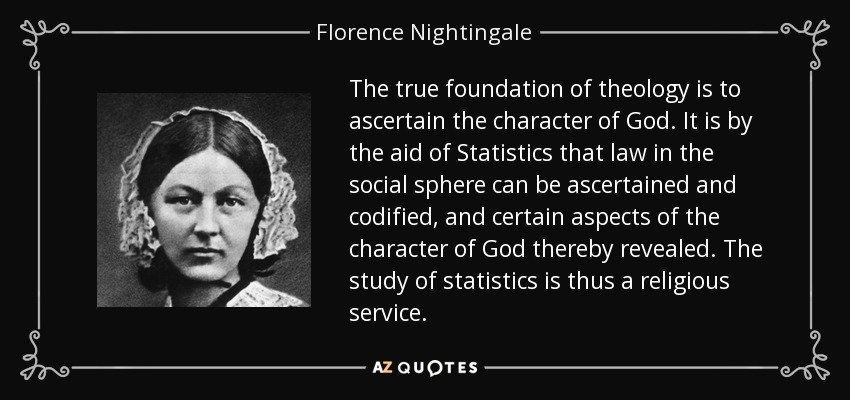
The true foundation of theology is to ascertain the character of God. It is by the aid of Statistics that law in the social sphere can be ascertained and codified, and certain aspects of the character of God thereby revealed. The study of statistics is thus a religious service.
From all we have learnt about the structure of living matter, we must be prepared to find it working in a manner that cannot be reduced to the ordinary laws of physics. And that not on the ground that there is any 'new force' or what not, directing the behaviour of the single atoms within a living organism, but because the construction is different from anything we have yet tested in the physical laboratory.
Science corrects the old creeds, sweeps away, with every new perception, our infantile catechisms, and necessitates a faith commensurate with the grander orbits and universal laws which it discloses yet it does not surprise the moral sentiment that was older and awaited expectant these larger insights.
What chemists took from Dalton was not new experimental laws but a new way of practicing chemistry (he himself called it the 'new system of chemical philosophy'), and this proved so rapidly fruitful that only a few of the older chemists in France and Britain were able to resist it.
Appeal. In law, to put the dice into the box for another throw.
Research is industrial prospecting. The oil prospectors use every scientific means to find new paying wells. Oil is found by each one of a number of methods. My own group of men are prospecting in a different field, using every possible scientific means. We believe there are still things left to be discovered. We have only stumbled upon a few barrels of physical laws from the great pool of knowledge. Some day we are going to hit a gusher.
We are very lucky to be living in an age in which we are still making discoveries. It is like the discovery of America-you only discover it once. The age in which we live is the age in which we are discovering the fundamental laws of nature, and that day will never come again. It is very exciting, it is marvelous, but this excitement will have to go.
The basic thesis of gestalt theory might be formulated thus: there are contexts in which what is happening in the whole cannot be deduced from the characteristics of the separate pieces, but conversely; what happens to a part of the whole is, in clearcut cases, determined by the laws of the inner structure of its whole.
Science, in its ultimate ideal, consists of a set of propositions arranged in a hierarchy, the lowest level of the hierarchy being concerned with particular facts, and the highest with some general law, governing everything in the universe. The various levels in the hierarchy have a two-fold logical connection, travelling one up, one down; the upward connection proceeds by induction, the downward by deduction.
How fortunate for civilization, that Beethoven, Michelangelo, Galileo and Faraday were not required by law to attend schools where their total personalities would have been operated upon to make them learn acceptable ways of participating as members of "the group."
'Tis a short sight to limit our faith in laws to those of gravity, of chemistry, of botany, and so forth. Those laws do not stop where our eyes lose them, but push the same geometry and chemistry up into the invisible plane of social and rational life, so that, look where we will, in a boy's game, or in the strifes of races, a perfect reaction, a perpetual judgment keeps watch and ward.
Science is the knowledge of constant things, not merely of passing events, and is properly less the knowledge of general laws than of existing facts.
The purpose of science is to develop, without prejudice or preconception of any kind, a knowledge of the facts, the laws, and the processes of nature. The even more important task of religion, on the other hand, is to develop the consciences, the ideals, and the aspirations of mankind.
To unfold the secret laws and relations of those high faculties of thought by which all beyond the merely perceptive knowledge of the world and of ourselves is attained or matured, is a object which does not stand in need of commendation to a rational mind.
There is nothing which Nature so clearly reveals, and upon which science so strongly insists, as the universal reign of law, absolute, universal, invariable law... Not one jot or tittle of the laws of Nature are unfulfilled. I do not believe it is possible to state this fact too strongly... Everything happens according to law, and, since law is the expression of Divine will, everything happens according to Divine will, i.e. is in some sense ordained, decreed.
Parkinson's Law is a purely scientific discovery, inapplicable except in theory to the politics of the day. It is not the business of the botanist to eradicate the weeds. Enough for him if he can tell us just how fast they grow.
Sir Arthur Eddington deduces religion from the fact that atoms do not obey the laws of mathematics. Sir James Jeans deduces it from the fact that they do.
It is childish to rest in the discovery of mere coincidences, or of partial and extraneous laws.
Amid all the revolutions of the globe, the economy of Nature has been uniform, ... and her laws are the only things that have resisted the general movement. The rivers and the rocks, the seas and the continents, have been changed in all their parts; but the laws which direct those changes, and the rules to which they are subject, have remained invariably the same.
These principles have given me a way of explaining naturally the union or rather the mutual agreement [conformité] of the soul and the organic body. The soul follows its own laws, and the body likewise follows its own laws; and they agree with each other in virtue of the pre-established harmony between all substances, since they are all representations of one and the same universe.
This fundamental discovery that all bodies owe their origin to arrangements of single initial corpuscular type is the beacon that lights the history of the universe to our eyes. In its own way, matter obeyed from the beginning that great law of biology to which we shall have to recur time and time again, the law of "complexification."
Could Hamlet have been written by a committee, or the "Mona Lisa" painted by a club? Could the New Testament have been composed as a conference report? Creative ideas do not spring from groups. They spring from individuals. The divine spark leaps from the finger of God to the finger of Adam, whether it takes ultimate shape in a law of physics or a law of the land, a poem or a policy, a sonata or a mechanical computer.
I know that certain minds would regard as audacious the idea of relating the laws which preside over the play of our organs to those laws which govern inanimate bodies; but, although novel, this truth is none the less incontestable. To hold that the phenomena of life are entirely distinct from the general phenomena of nature is to commit a grave error, it is to oppose the continued progress of science.
The laws and conditions of the production of wealth partake of the character of physical truths. There is nothing optional or arbitrary in them ... It is not so with the Distribution of Wealth. That is a matter of human institution solely. The things once there, mankind, individually or collectively, can do with them as they like.
Let reverence for the laws . . . become the political religion of the nation.
Follow AzQuotes on Facebook, Twitter and Google+. Every day we present the best quotes! Improve yourself, find your inspiration, share with friends
or simply: