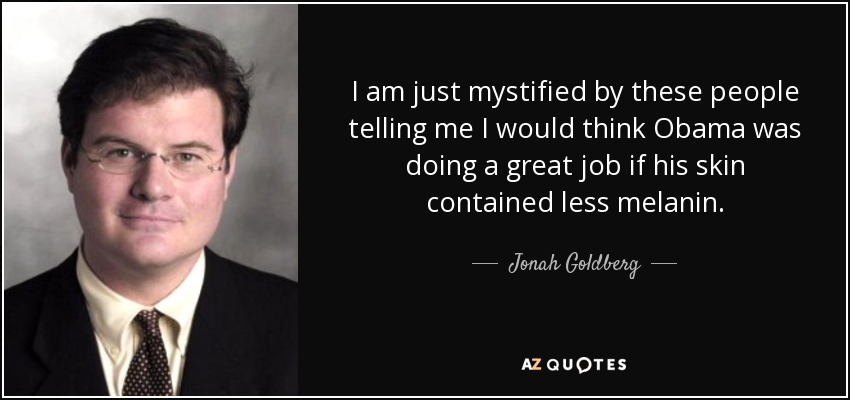
I am just mystified by these people telling me I would think Obama was doing a great job if his skin contained less melanin.
The organized labor movement as it is constituted today is as much a concomitant of a capitalist economy as is capital. Organized labor is predicated upon the basic premise of collective bargaining between employers and employees. This premise can obtain only for an employer-employee type of society. If the labor movement is to maintain its own identity and security, it must of necessity protect that kind of society.
The central problem of our age is not liberalism or modernism, nor the old Roman Catholicism or the new Roman Catholicism, nor the threat of communism, nor even the threat of rationalism and the monolithic consensus which surrounds us. All these are dangerous but not the primary threat. The real problem is this: the church of the Lord Jesus Christ, individually corporately, tending to do the Lord’s work in the power of the flesh rather than of the Spirit. The central problem is always in the midst of the people of God, not in the circumstances surrounding them.
When wealth is centralized, the people are dispersed. When wealth is distributed, the people are brought together.
Let me issue and control a nation's money and I care not who writes the laws.
We hold from God the gift which includes all others. This gift is life - physical, intellectual, and moral life.
But though Usury is in itself immoral, and justly condemned by every ethical code, its chief and worst defect in the particular case we are now examining, the growth of Capitalism and its increasing proletariat, is the centralization of irresponsible control over the lives of men: the putting power over the proletariat into the hands of a few who can direct the loans of currency and credit without which that proletariat could not be fed and clothed and maintained in work.
Communism worked honestly by officials devoid of human frailties and devoted to nothing but the good of its slaves, would have certain manifest material advantages as compared with a proletarian wage-system where millions live in semi-starvation, and many millions more in permanent dread thereof. But even if it were administered thus Communism would only produce its benefits through imposing slavery.
Consider in what way the industrial system developed upon capitalist lines. Why were a few rich men put with such ease into possession of the new methods? Why was it normal and natural in their eyes and in that of contemporary society that those who produced the new wealth with the new machinery should be proletarian and dispossessed?
Political freedom without economic freedom is almost worthless, and it is because the modern proletariat has the one kind of freedom without the other that its rebellion is now threatening the very structure of the modern world.
When liberty destroys order the hunger for order will destroy liberty.
The inevitable consequence of poverty is dependence.
I don't believe in a law to prevent a man from getting rich; it would do more harm than good. So while we do not propose any war upon capital, we do wish to allow the humblest man an equal chance to get rich with everybody else.
Modern liberalism has many roots. One of the most important is the ideas of a man described by an American critic as 'his satanic free-trade majesty John Stuart Mill' and revered by others.
Liberalism and Western-style democracy have not been able to help realize the ideals of humanity. Today these two concepts have failed. Those with insight can already hear the sounds of the shattering and fall of the ideology and thoughts of the liberal democratic systems.
Here is the prime condition of success: Concentrate your energy, thought and capital exclusively upon the business in which you are engaged. Having begun on one line, resolve to fight it out on that line, to lead in it, adopt every improvement, have the best machinery, and know the most about it.
There is a contradiction between market liberalism and political liberalism. The market liberals (e.g., social conservatives) of today want family values, less government, and maintain the traditions of society (at least in America's case). However, we must face the cultural contradiction of capitalism: the progress of capitalism, which necessitates a consumer culture, undermines the values which render capitalism possible
Political democracy cannot flourish under all economic conditions. Democracy requires an economic system which supports the political ideals of liberty and equality for all. Men cannot exercise freedom in the political sphere when they are deprived of it in the economic sphere.
Radicals, on the other hand, want to advance from the jungle of laissez-faire capitalism to a world worthy of the name of human civilization. They hope for a future where the means of economic production will be owned by all of the people instead of just a comparative handful. They feel that this minority control of production facilities is injurious to the large masses of people not only because of economic monopolies but because the political power inherent in this form of centralized economy does not augur for an ever expanding democratic way of life.
Behold our refutation of the error. It is not based on documents of faith, but on the reasons and statements of the philosophers themselves. If then anyone there be who, boastfully taking pride in his supposed wisdom, wishes to challenge what we have written, let him not do it in some corner nor before children who are powerless to decide on such difficult matters. Let him reply openly if he dare. He shall find me there confronting him, and not only my negligible self, but many another whose study is truth.
Jefferson, though the secret vote was still unknown at the time had at least a foreboding of how dangerous it might be to allow the people to share a public power without providing them at the same time with more public space than the ballot box and with more opportunity to make their voices heard in public than on election day. What he perceived to be the mortal danger to the republic was that the Constitution had given all power to the citizens, without giving them the opportunity of being citizens and of acting as citizens.
But life cannot maintain itself alone. The Creator of life has entrusted us with the responsibility of preserving, developing, and perfecting it. In order that we may accomplish this, He has provided us with a collection of marvelous faculties. And He has put us in the midst of a variety of natural resources. By the application of our faculties to these natural resources we convert them into products, and use them. The process is necessary in order that life may run its appointed course.
Property should be in a general sense common, but as a general rule private... In well-ordered states, although every man has his own property, some things he will place at the disposal of his friends, while of others he shares the use of them.
For suppose that every tool we had could perform its task, either at our bidding or itself perceiving the need, and if-like the statues made by Dædalus or the tripods of Hephæstus, of which the poet says that "self-moved they enter the assembly of the gods" - shuttles in a loom could fly to and fro and a plectrum play a lyre all self-moved, then master-craftsmen would have no need of servants nor masters of slaves.
We must speak first about the division of land and about those who cultivate it: who should they be and what kind of person? We do not agree with those who have said that property should be communally owned, but we do believe that there should be a friendly arrangement for its common use, and that none of the citizens should be without means of support.
Follow AzQuotes on Facebook, Twitter and Google+. Every day we present the best quotes! Improve yourself, find your inspiration, share with friends
or simply: