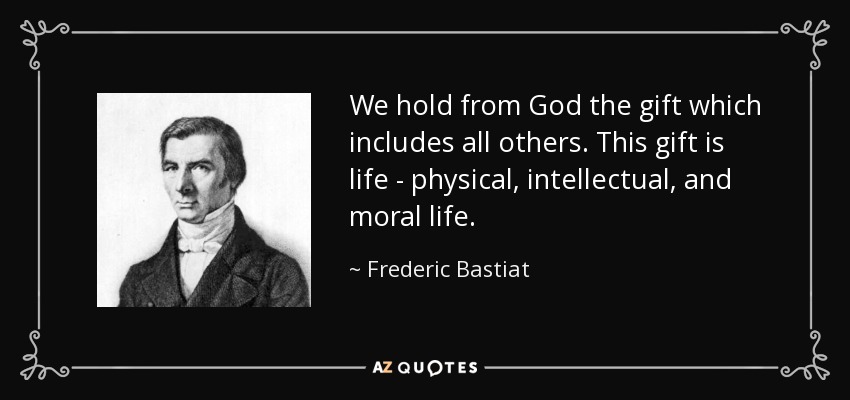
We hold from God the gift which includes all others. This gift is life - physical, intellectual, and moral life.
Though I believe in liberalism, I find it difficult to believe in liberals.
Political rule is so natural and necessary to the human race that it cannot be withdrawn without destroying nature itself; for the nature of man is such that he is a social animal.
But though Usury is in itself immoral, and justly condemned by every ethical code, its chief and worst defect in the particular case we are now examining, the growth of Capitalism and its increasing proletariat, is the centralization of irresponsible control over the lives of men: the putting power over the proletariat into the hands of a few who can direct the loans of currency and credit without which that proletariat could not be fed and clothed and maintained in work.
Capitalism had arisen through the misuse and exaggeration of certain rights, notably the right of property - the basis of economic freedom - and the right of contract, which is one of the main functions of economic freedom. Therefore, even under Capitalism, so long as the old principles were remembered it was possible to recall the principles whereby Society had once been sane and well ordered.
... But as a Godless greed pursued its career from excess to excess, it provoked a sort of twin hostile brother, equally Godless, born in the same atmosphere of utter disregard for the foundational virtues of humility and charity. This hostile twin brother of Capitalism was destined to be called Communism, and is today setting out to murder its elder.
The country needs and, unless I mistake its temper, the country demands bold, persistent experimentation. It is common sense to take a method and try it; if it fails, admit it frankly and try another. But above all, try something. The millions who are in want will not stand by silently forever while the things to satisfy their needs are within easy reach.
Consider in what way the industrial system developed upon capitalist lines. Why were a few rich men put with such ease into possession of the new methods? Why was it normal and natural in their eyes and in that of contemporary society that those who produced the new wealth with the new machinery should be proletarian and dispossessed?
Political freedom without economic freedom is almost worthless, and it is because the modern proletariat has the one kind of freedom without the other that its rebellion is now threatening the very structure of the modern world.
Economic freedom is in our eyes a good. It is among the highest of temporal goods because it is necessary to the highest life of society through the dignity of man and through the multiplicity of his action, in which multiplicity is life. Through well-divided property alone can the units of society react upon the State. Through it alone can a public opinion flourish. Only where the bulk of the cells are healthy can the whole organism thrive.
It is therefore our business to restore economic freedom through the restoration of the only institution under which it flourishes, which institution is Property. The problem before us is, how to restore Property so that it shall be, as it was not so long ago, a general institution.
...it happens that society is saved as often as the circle of its ruling class is narrowed, as often as a more exclusive interest asserts itself over the general. Every demand for the most simple bourgeois financial reform, for the most ordinary liberalism, for the most commonplace republicanism, for the flattest democracy is forthwith punished as an assault upon society and is branded as Socialism.
Even if the wealth and power be well distributed throughout a community, its members will not be happy unless they are inwardly so, and obviously where the distribution is bad, where the few have a vast superfluity and the many are consumed by anxiety or want, or where a few controllers can exercise their will over the many, society has failed, even though its total wealth and power be increased.
In the same way the eminence attaching to the mere possession of great wealth disappoints us nine times out of ten, especially if the wealth has been accumulated rapidly. For great wealth is accumulated rapidly by cunning or chance, or a mixture of the two. Cunning has nothing to do with high qualities; it is rather a presumption against them; while chance has nothing to do with them either. Therefore it is that men are always complaining after meeting So-and-so, that he seemed to be astonishingly stupid, though he made a million in ten years and started as a pauper.
It is Mind which determines the change of Society, and it was because the mind at work was a Catholic mind that the slave became a serf and was on his way to becoming a peasant and a fully free man-a man free economically as well as politically. The whole spirit of the Church was for small property, and that spirit was slowly, instinctively, working for the establishment of small property throughout Christendom.
Let us then repeat and firmly fix this main point: the evil, the root evil, of that to which the term Capitalism has come to be applied, is neither its functioning for profit nor its dependence upon legally protected private property; but the presence of a Proletariat, that is of men possessing political freedom, but dispossessed of economic freedom, and existing in such large numbers in any community as to determine the tone of all that community.
Ownership by delegation is a contradiction in terms. When men say, for instance (by a false metaphor), that each member of the public should feel himself an owner of public property-such as a Town Park-and should therefore respect it as his own, they are saying something which all our experience proves to be completely false. No man feels of public property that it is his own; no man will treat it with the care of the affection of a thing which is his own.
Slowly but certainly the proletarian, by every political reform which secures his well-being under new rules of insurance, of State control in education, of State medicine and the rest, is developing into the slave, leaving the rich man apart and free. All industrial civilization is clearly moving towards the re-establishment of the Servile State.
The larger the unit of capital present, the easier the transaction called emission of credit. Centralized lending of this kind (which is today universal) actively promotes the absorption of the small man by the great, the reduction of small property owners to a proletarian condition.
The Reformation has been called in a biting epigram "a rising of the rich against the poor."
The restoration of property would be a complicated, arduous and presumably a lengthy business; the transformation of a Capitalist Society into a Communist one needs nothing but the extension of existing conditions.
The smaller man approaching our modern banking system, which controls all issue of credit and therefore pretty well all our industrial and commercial activities, is not what the controllers of that credit call "interesting." He borrows with difficulty and upon high terms, and must pledge security out of all proportion to that which his richer rival has to put down.
The very large units of production and exchange have access to credit on a large scale, sometimes without any cover at all, merely upon the prospect of their success, and always upon terms far easier than are open to their smaller rivals. It is perhaps on this line of easier credit that large capital today does most harm to small capital, drives it out and ruins it.
The society of Christendom and especially of Western Christendom up to the explosion, which we call the Reformation, had been a society of owners: a Proprietarial Society. It was one in which there remained strong bonds between one class and another, and in which there was a hierarchy of superior and inferior, but not, in the main, a distinction between a restricted body of possessors and a main body of destitute at the mercy of the possessors, such as our society has become.
The worship of the nation has been able to make men tolerate under its authority what they could never have tolerated from princes: a submission to rule, which, through sumptuary laws on food and drink, through conscription, through a cast-iron system of compulsory instruction for all on State ordered lines, and through a State examination at the gate of every profession, has almost killed the citizen's power to react upon that which controls him, and has almost destroyed that variety which is the mark of life.
Follow AzQuotes on Facebook, Twitter and Google+. Every day we present the best quotes! Improve yourself, find your inspiration, share with friends
or simply: