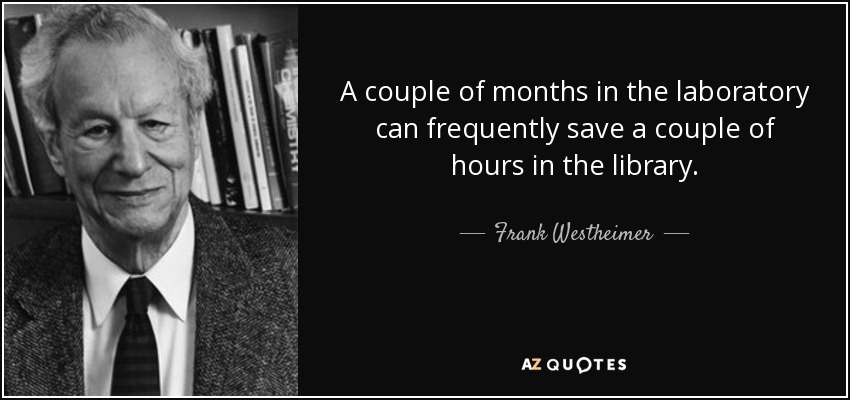
A couple of months in the laboratory can frequently save a couple of hours in the library.
Without the local library in my neighborhood, I don’t think I would have grown up to be a writer or a teacher.
If you can't find an answer at the mall or the library, what does that say about the world?
Libraries are sexual dream factories. The langour brings it on.
Every time a shaman dies, it is as if a library burned down.
As a child I spent a lot of time at the library.
At this time on a weekday morning, the library was refuge to the retired, the unemployed, and the unemployable. ... 'I'm not always this gabby,' the librarian said. 'It's just so nice to talk to someone who isn't constructing a conspiracy theory or watching videos of home accidents on YouTube.
If minds are truly alive they will seek out books, for books are the human race recounting its memorable experiences, confronting its problems, searching for solutions, drawing the blueprints of it futures.
He that revels in a well-chosen library, has innumerable dishes, and all of admirable flavour.
Love of reading enables a man to exchange the weary hours, which come to every one, for hours of delight.
You must linger among a limited number of master-thinkers, and digest their works, if you would derive ideas which shall win firm hold in your mind.
The style of an author is a faithful copy of his mind.
Reading is seeing by proxy.
Libraries offer, for free, the wisdom of the ages--and sages--and, simply put, there's something for everyone inside.
The Bible became the book of books, but it is not one document. It is a mystical library of interwoven texts by unknown authors who wrote and edited at different times with widely divergent aims. This sacred work of so many epochs and so many hands contains some facts of provable history, some stories of unprovable myth, some poetry of soaring beauty, and many passages of unintelligible, perhaps coded, perhaps simply mistranslated, mystery. Most of it is written not to recount events but to promote a higher truth—the relationship of one people and their God.
Someday it will dawn on man that woman does not read the wonderful books with which he has filled his libraries, and though she may well admire his marvelous works of art in museums she herself will rarely create, only copy.
Most young dealers of the Silicon Chip Era regard a reference library as merely a waste of space. Old Timers on the West Coast seem to retain a fondness for reference books that goes beyond the practical. Everything there is to know about a given volume may be only a click away, but there are still a few of us who'd rather have the book than the click. A bookman's love of books is a love of books, not merely of the information in them.
I cannot think of a day in my life when the library didn’t exert a potent attraction for me, offering a sense of the specialness of each individual’s curiosity and his or her quest to satisfy it.
The founding of libraries was like constructing more public granaries, amassing reserves against a spiritual winter which by certain signs, in spite of myself, I see ahead.
I remember as a young child, during one of my frequent trips to the local library, spending hours looking at book after book trying in vain to find one that had my name on it. Because there were so many books in the library, with so many different names on them, I’d assumed that one of them — somewhere — had to be mine. I didn’t understand at the time that a person’s name appears on a book because he or she wrote it. Now that I’m twenty-six I know better. If I were ever going to find my book one day, I was going to have to write it.
The library will endure; it is the universe... We walk the corridors, searching the shelves and rearranging them, looking for lines of meaning amid leagues of cacophony and incoherence, reading the history of the past and of the future, collecting our thoughts and collecting the thoughts of others, and every so often glimpsing mirrors, in which we may recognize creatures of the information.
Now, public libraries are most admirable institutions, but they have one irritating custom. They want their books back.
The public library is a center of public happiness first, of public education next.
Brian Myers takes a fresh approach. He largely ignores what the regime tells the outside world about itself, but concentrates instead on what North Koreans themselves are supposed to believe, paying special attention to the North Korean narratives and mass culture, including movies and television shows. (...) There are few books that can give the world a peek into the Hermit Kingdom. The Cleanest Race provides a reason to care about how those in North Korea see themselves and the West. It is possibly the best addition to that small library.
Whole libraries can be filled with the papers written about cancer and its causes, but the contents of these papers fit on one little library visiting card.
Follow AzQuotes on Facebook, Twitter and Google+. Every day we present the best quotes! Improve yourself, find your inspiration, share with friends
or simply: