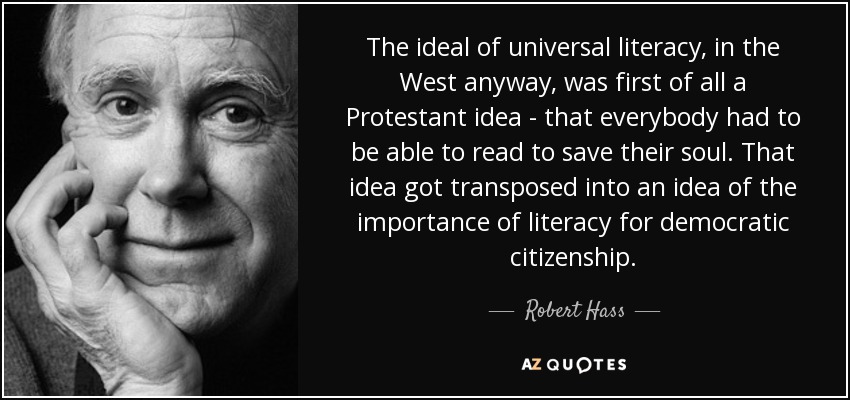
The ideal of universal literacy, in the West anyway, was first of all a Protestant idea - that everybody had to be able to read to save their soul. That idea got transposed into an idea of the importance of literacy for democratic citizenship.
South Korea from a country that had relatively little primary education became close to universal literacy in the course of 25, 30 years, in a way trying to replicate what Japan had done earlier. They were learning to some extent from the Japanese experience too. So I think, in a sense, the East Asians were following a path, which all other countries including South Asia could follow but chose not too.
There is considerable evidence that women's education and literacy tend to reduce the mortality rates of children
Education spurs growth and unlocks potential. After all, a single year of primary education creates a 10 to 20 percent increase in a woman's wages later in life. Education lowers the risk of disease and decreases the likelihood that a child will fall into violence and crime. And a child born to a literate mother is 50 percent more likely to survive past age five. No country has achieved sustained growth without at least 40 percent literacy for its adults.
For people who are coming out of an oral tradition, it is very exciting to get into reading and writing and it is quite interesting how frequently people want to write their own story. Sometimes it is straight history - this is how we came about, how our town was created, a lot of that kind of effort, as soon as literacy came. The first thing you wanted to do was to put something down about who you are or how you are related to you neighbors. Then the next stage would be the stories, the cultural part of the story: this is the kind of world our ancestors made or aspired to.
Scientific literacy is an intellectual vaccine against the claims of charlatans who would exploit ignorance.
They seemed to be quiet types, the women and men in rubber-soled shoes. Their favorite word, after literacy, was privacy--for their patrons and themselves.
Take the year a country first reaches 50% literacy and add one or two generations to allow the idea to sink in and, democracy, more or less automatically, appears.
Educators, long disturbed by schoolchildren's lagging scores in math and reading, are realizing there is a different and more alarming deficiency: emotional literacy. And while laudable efforts are being made to raise academic standards, this new and troubling deficiency is not being addressed in the standard school curriculum. As one Brooklyn teacher put it, the present emphasis in schools suggests that "we care more about how well schoolchildren can read and write than whether they'll be alive next week."
Literacy, written language is a very late acquisition in terms of human evolution.
When people talk to me about the digital divide, I think of it not so much about who has access to what technology as about who knows how to create and express themselves in the new language of the screen. If students aren't taught the language of sound and images, shouldn't they be considered as illiterate as if they left college without being able to read and write?
Science literacy is the artery through which the solutions of tomorrow's problems flow.
Enthusiasm is contagious. Start an epidemic.
Knowledge is power. Information is liberating. Education is the premise of progress, in every society, in every family.
A basic language-literacy of Nature is falling from us. And what is being lost along with this literacy is something perhaps even more valuable: a kind of language-magic, the power that certain words possess to enchant our imaginative relations with Nature and landscape.
Creativity is the new literacy
Participatory culture shifts the focus of literacy from one of individual expression to community involvement.
Learn your language well and command it well, and you will have the first component to life.
When I discovered libraries, it was like having Christmas every day.
A library should be like a pair of open arms.
What can I say? Librarians rule.
Reading is like breathing in and writing is like breathing out, and storytelling is what links both: it is the soul of literacy. The most powerful tool that we have to strengthen literacy is often the most underused and overlooked, and that is a child's own stories.
Video games provide an easy lead-in to computer literacy. They can get you thinking like a video game designer and can even lead to designing since many games come with software to modify the game or redesign it.
Not enough of our society is trained how to understand and interpret quantitative information. This activity is a centerpiece of science literacy to which we should all strive-the future health, wealth, and security of our democracy depend on it. Until that is achieved, we are at risk of making under-informed decisions that affect ourselves, our communities, our country, and even the world.
With words at your disposal, you can see more clearly. Finding the words is another step in learning to see.
Follow AzQuotes on Facebook, Twitter and Google+. Every day we present the best quotes! Improve yourself, find your inspiration, share with friends
or simply: