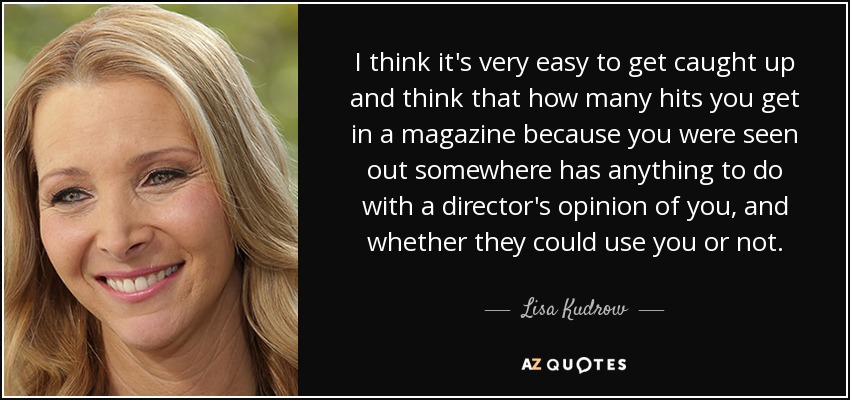
I think it's very easy to get caught up and think that how many hits you get in a magazine because you were seen out somewhere has anything to do with a director's opinion of you, and whether they could use you or not.
While poetry was less professionalized than it is now, I still had this urge to win prizes and see my work in magazines, to get an "A," as though poetry could be graded. I wish I had been more patient and less frantic about getting published.
Sometimes I'm writing for magazines on assignment, but the university has to be patient with me. I mean, during the ten-week periods that I have a class, I'm there every Thursday night or whatever it is, but sometimes that's all I'm there, because I'm somewhere else the rest of the time.
A People Magazine article in 1982 referred to him as the late Abe Vigoda. The very-much-alive Vigoda placed an ad in Variety with him in a coffin holding a copy of People Magazine.
I don't read the "letters" section of Time magazine. I think it's just my habit as a reader. I don't read comments on stories, in general.
We've never had a giant circulation. And we've always been a magazine for writers and for sophisticated readers. We've never had to run stories that would appeal to a million people. And what you end up with is a kind of tradition that might have staying power - the cockroach after armageddon.
Just in terms of being able to be a professional artist, but also it's nice to not have to dread introductions. "What you do for a living?" It used to be easier just to tell people that I was a magazine illustrator than try to explain that I did comics, but not the kind of comics that they were used to, and no, it's not pornography, etc. And now people even of our parents' generation are familiar with the term "graphic novel," which is kind of amazing.
My dissertation was on the idea of feminine-themed women's magazines, so like how the ideal woman is put across by women's magazines.
Every two to three weeks, I was changing around my room. My room was made out of nothing, basically - a magazine, a little radio, a little bed - and I had the sensibility to put things together and match things in a certain way so that they were very special.
When you're a music director, you have people constantly sending you music and trying to get - I mean, I'm sure you have the exact same thing when you do a magazine - that you have people constantly wanting to get your attention. And I think I learnt a lot from being on that end of things, when I was trying to book the tour, the first tour we did.
This is so lame to say in a magazine, but I just grabbed some pink wallpaper. I find it to be a very relaxing color.
I think I'm equally as abusive as the editors normally are for the "Letters and Tomatoes" column, which is the fan mail part of MAD Magazine and an ongoing feature.
I took photos from 1976 to when I left in 1993, primarily for Interview and a column I had called "Bob Colacello's Out" which Andy had conceived of. I've never taken a picture since, not even with my phone! It just felt too Andy Warhol to keep going around town taking photographs. And I never really thought of doing anything with them after I left the magazine until this great Art Director Sam Shahid about for or five years ago asked where all of the old photos were.
I didn't even think about hiding anything - I honestly went into it [with the idea that] I'm going to show myself off because no one of my size has ever been in this magazine [Sports Illustrated] and I need other women to know that they are just as beautiful.
The editor needs to put his own life on hold for the better of the magazine, the crew, and the readers. And to have a bigger vision of the magazine's style and an understanding that every [issue] should be well-balanced and hopefully surprising. To have a pink wall with a door of perception where he can bang his head on.
I myself wouldn't want to read a magazine that focuses solely on a small part of the literary field or of the popular culture - better to smash the borders and look for interesting and important stuff from many different forms of storytelling.
Kids get caught up in technical & electronic things like games & videos when all we had were magazines.
I feel like fashion is becoming more inclusive, partly because the industry is finally getting that beauty exists in so many ways, and partly because thanks to Instagram, girls can create their own images, or remix images they're seeing in magazines and fashion shows, in ways that weren't possible before.
My first job, honestly, was as a proofreader. I say that a little disparagingly, but it actually was this sort of incredible thing, where I got this job proofreading for a cable television magazine.
I conducted a bunch of interviews for Interview magazine. They actually paid me. I think I was probably 18 or 19. I was in college and I remember feeling, like, "Wow." I had a real job, and they paid me money, and it was exciting.
By the time something reaches the cover of Time magazine, it's old news anyway.
I started publishing stories in small magazines early on, but after seven or eight or nine years you feel like you need a little more than that to show for your efforts.
I do think that the kind of writing that I do will always be around and printed in books, magazines, and now blogs.
I had done an interview with 'Hello' magazine. In it, they asked me if I was going to marry Emily Blunt. Of course, what was I going to say? I said, 'Oh yeah I am going to marry her and I love her and all of this stuff.' It's true. I was making a joke. They said to me, 'Have you asked her?' I said, 'Have I? Maybe I am asking her through the magazine.'
I feel that's important that I have some place to go that isn't on the cover of a magazine. I signed up to make music.
Follow AzQuotes on Facebook, Twitter and Google+. Every day we present the best quotes! Improve yourself, find your inspiration, share with friends
or simply: