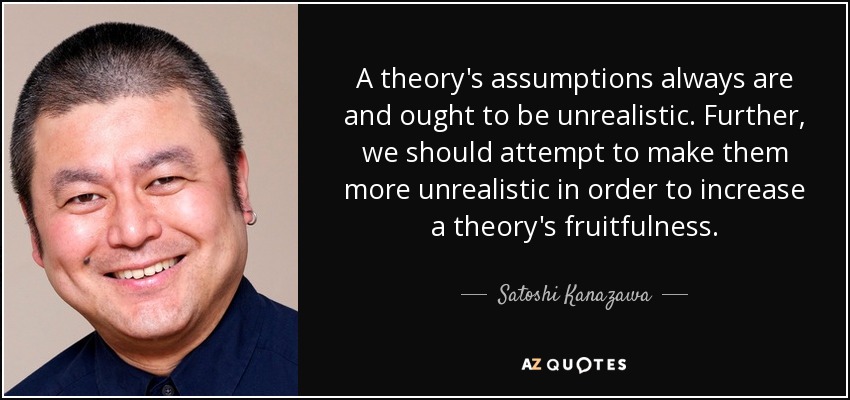
A theory's assumptions always are and ought to be unrealistic. Further, we should attempt to make them more unrealistic in order to increase a theory's fruitfulness.
Given our inevitably incomplete knowledge about key structural aspects of our ever-changing economy and the sometimes asymmetric costs or benefits of particular outcomes, a central bank... need to consider not only the most likely future path for the economy but also the distribution of possible outcomes about that path. They then need to reach a judgment about the probabilities, costs, and benefits of the various possible outcomes under alternative choices for policy.
It was obvious that their profits were simply cash borrowed from destiny with some random payback time.
If I had better foresight, maybe I could have improved things a little bit. But frankly, if I had perfect foresight, I would never have taken this job in the first place.
It is interesting that the investment industry has invented new ways to lose money when the old ways seemed to work just fine.
High leverage is unsafe, not just for a company but the entire economy... LBOs are reducing the safety. Management loses the power to do many things. It has no margin for error and less margin for additional risk.
I'd decided to take the risk, and either I'd succeed or else.
What went wrong is we had tremendous concentration in the sense we put a lot of our money to work against U.S. real estate. We got here by lending money, and putting money to work in the U.S. real estate market, in a size that was probably larger than what we ought to have done on a diversification basis.
The key to risk management is never putting yourself in a position where you cannot live to fight another day.
A good rule of thumb is to assume that everything matters.
The technical explanation is that the market-sensitive risk models used by thousands of market participants work on the assumption that each user is the only person using them.
The kinds of errors that cause plane crashes are invariably errors of teamwork and communication.
If you don't invest in risk management, it doesn't matter what business you're in, it's a risky business.
I can assure you, as long as I'm here, as long as my colleagues are here, we do know about risks.
At Berkshire, I both initiate and monitor every derivatives contract on our books ... If Berkshire ever gets in trouble, it will be my fault. It will not be because of the misjudgments made by a risk committee or chief risk officer.
My client loved risk. Risk, I had learned, was a commodity in itself. Risk could be canned and sold like tomatoes.
This awful catastrophe is not the end but the beginning. History does not end so. It is the way its chapters open.
We gauge risk literally hundreds of times per day, usually well and often subconsciously. We start assessing risk before the disaster even happens. We are doing is right now. We decide where to live and what kind of insurance to buy, just like we process all kinds of everyday risks: we wear bike helmets, or not. We buckle our seatbelts, smoke cigarettes, and let our kids stay out until midnight. Or not.
The public totally discounts low-probability high-consequence events. The individual says, it's not going to be this plane, this bus, this time.
If you spend more than 13 minutes analyzing economic and market forecasts, you've wasted 10 minutes
Indeed, better risk management may be the only truly necessary element of success in banking.
One thing that makes it possible to be an optimist is if you have a contingency plan for when all hell breaks loose.
Thoughtfully assessing and addressing enterprise risk and placing a high value on corporate transparency can protect the one thing we cannot afford to lose: trust.
Risk is just an expensive substitute for information.
If you don't know the Jewelry, know the Jeweller
Follow AzQuotes on Facebook, Twitter and Google+. Every day we present the best quotes! Improve yourself, find your inspiration, share with friends
or simply: