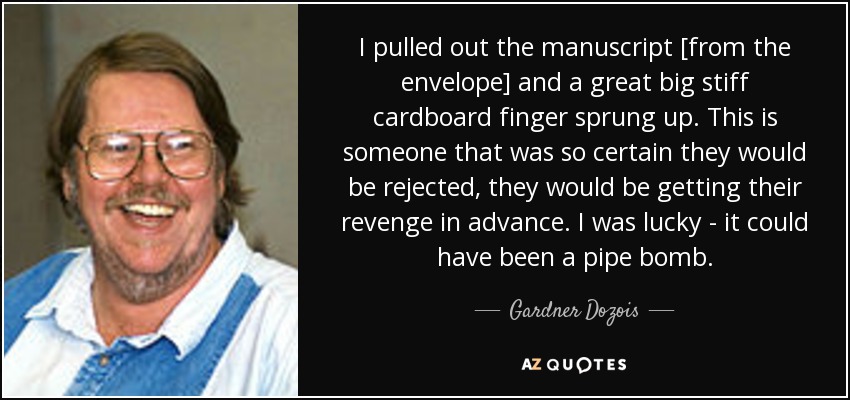
I pulled out the manuscript [from the envelope] and a great big stiff cardboard finger sprung up. This is someone that was so certain they would be rejected, they would be getting their revenge in advance. I was lucky - it could have been a pipe bomb.
Learn punctuation; it is your little drum set, one of the few tools oyu have to signal the reader where the beats and emphases go. (If you get it wrong, any least thing, the editor will throw your manuscript out.) Punctuation is not like musical notation; it doesn't indicate the length of pauses, but instead signifies logical relations. There are all sorts of people out there who know these things very well. You have to be among them even to begin.
You need a good editor because every writer thinks he can write a War and Peace, but by the time he gets it on paper, it's not War and Peace anymore; it's comic-book stuff. Your manuscript is both good and original. But the part that is good is not original, and the part that is original is not good.
A lot of manuscripts that come in, you wonder by what outrageous fantasy the author believes that this should be pressed into print.
If you invent two or three people and turn them loose in your manuscript, something is bound to happen to them -- you can't help it; and then it will take you the rest of the book to get them out of the natural consequences of that occurrence, and so first thing you know, there's your book all finished up and never cost you an idea.
The reason 99% of all stories written are not bought by editors is very simple. Editors never buy manuscripts that are left on the closet shelf at home.
I told that girl, in the kindest, gentlest way, that I could not consent to deliver judgment upon any one's manuscript, because an individual's verdict was worthless. It might underrate a work of high merit and lose it to the world, or it might overrate a trashy production and so open the way for its infliction upon the world. I said that the great public was the only tribunal competent to sit in judgment upon a literary effort, and therefore it must be best to lay it before that tribunal in the outset, since in the end it must stand or fall by that mighty court's decision any way.
Thus there are two books from whence I collect my Divinity; besides that written one of God, another of his servant Nature, that universal and public Manuscript, that lies expans'd unto the eyes of all; those that never saw him in the one, have discovered him in the other.
The most important lesson in the writing trade is that any manuscript is improved if you cut away the fat.
I still love books. Nothing a computer can do can compare to a book. You can't really put a book on the Internet. Three companies have offered to put books by me on the Net, and I said, 'If you can make something that has a nice jacket, nice paper with that nice smell, then we'll talk.' All the computer can give you is a manuscript. People don't want to read manuscripts. They want to read books. Books smell good. They look good. You can press it to your bosom. You can carry it in your pocket.
Your manuscript is both good and original; but the part that is good is not original, and the part that is original is not good.
I can't predict how reading habits will change. But I will say that the greatest loss is the paper archive - no more a great stack of manuscripts, letters, and notebooks from a writer's life, but only a tiny pile of disks, little plastic cookies where once were calligraphic marvels.
What I had to face, the very bitter lesson that everyone who wants to write has got to learn, was that a thing may in itself be the finest piece of writing one has ever done, and yet have absolutely no place in the manuscript one hopes to publish.
During the Qin Dynasty, all books not relating to practical concerns such as agriculture or construction were ordered burned by the emperor to guard against "dangerous thought." Whether accounts of zombie attacks perished in the flames will never be known. This obscure section of a medical manuscript, preserved in the wall of an executed Chinese scholar, might be proof of such attacks.
How is it that, a full two centuries after Jane Austen finished her manuscript, we come to the world of Pride and Prejudice and find ourselves transcending customs, strictures, time, mores, to arrive at a place that educates, amuses, and enthralls us? It is a miracle. We read in bed because reading is halfway between life and dreaming, our own consciousness in someone else's mind.
When I knew what I had to do / I took all my notebooks, all my manuscripts / and ate them page by page / so I could take my words with me
There are too many people in the world as it is, but the supply of ancient manuscripts is severely limited.
Let's find and remedy all our weaknesses before our enemies get a chance to say a word. That is what Charles Darwin did. ...When Darwin completed the manuscript of his immortal book "The Origin Of Species" he realized that the publication of his revolutionary concept of creation would rock the intellectual and religious worlds. So he became his own critic and spent another 15 years checking his data, challenging his reasoning, and criticizing his conclusions.
Our life is a book to which we add daily, until suddenly we are finished, and then the manuscript is burned.
Edward and I had not had a last grand scene of farewell, nor did I plan one. To speak the word was to make it final. It would be the same as typing the words The End on the last page of a manuscript. So we did not say our goodbyes, and we stayed very close to each other, always touching. Whatever end found us, it would not find us separated.
Somewhere in the center of my soul, a rusty chain began to unwind. It freed itself, link by link, from where it had rested, unobserved, waiting for him. My hands, which had been balled up and pressed against his chest, unfurled with it. The chain continued to drop, to an unfathomable depth where there was nothing but darkness and Matthew. At last it snapped to its full length, anchoring me to a vampire. Despite the manuscript, despite the fact that my hands contained enough voltage to run a microwave, and despite the photograph, as long as I was connected to him, I was safe.
This was a manuscript of the night we couldn’t read.
The point is, I can’t tell you how to succeed. But I can tell you how not to: Give in to the shame of being rejected and put your manuscript—or painting, song, voice, dance moves, [insert passion here]—in the coffin that is your bedside drawer and close it for good. I guarantee you that it won’t take you anywhere. Or you could do what this writer did: Give in to your obsession instead.
This manuscript of yours that has just come back from another editor is a precious package. Don't consider it rejected. Consider that you've addressed it 'to the editor who can appreciate my work' and it has simply come back stamped 'Not at this address'. Just keep looking for the right address.
The question of manuscript changes is very important for literary criticism, the psychology of creation and other aspects of the study of literature.
Follow AzQuotes on Facebook, Twitter and Google+. Every day we present the best quotes! Improve yourself, find your inspiration, share with friends
or simply: