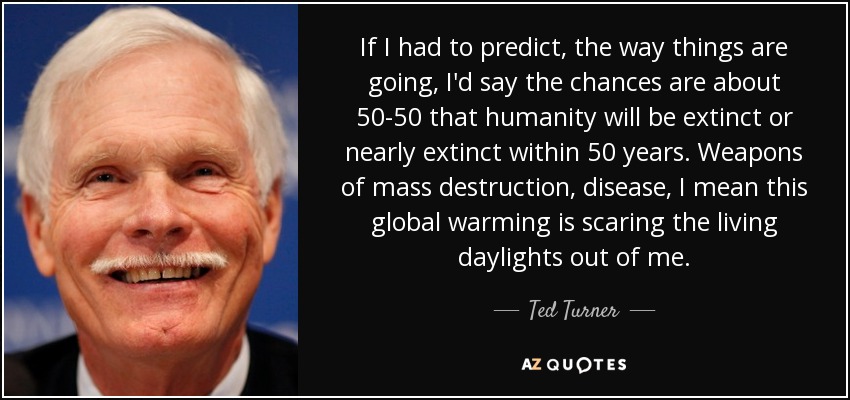
If I had to predict, the way things are going, I'd say the chances are about 50-50 that humanity will be extinct or nearly extinct within 50 years. Weapons of mass destruction, disease, I mean this global warming is scaring the living daylights out of me.
As far as Iraq is concerned, let's not forget what the UNSCR is about, that the main consideration in Iraq is that there is a leader who has been developing weapons of mass destruction, and has been violating UN resolutions for over a decade.
If we invade Iraq and the regime is very close to falling, I'm very, very concerned that the Iraqis will, in fact, use weapons of mass destruction.
I worry most about proliferation of weapons of mass destruction in such a way that they could be acquired by non-governmental organizations, like terrorist groups, especially the radical groups. When a nation state has a nuclear weapon, it's a little bit easier to control the use of it, but for non-governmental groups it's much more difficult.
North Korea is making several demands in exchange for giving up their nuclear program, including a promise from America not to attack them. Which is a little strange because for us to attack them we would have to have slam dunk proof that they have weapons of mass destruction. I mean, for Gods sakes people, we're not maniacs. It would have to be an air-tight case. We wouldn't just come in there and start bombing you.
The number of nuclear bombs on the planet today - the sheer quantity of weapons of mass destruction in the possession of people and governments throughout the world - along with the fact that the use of brute force and militarism is an almost knee-jerk way of problem-solving on the planet today, makes the eradication of war the great moral issue of this generation.
I want to remember what bullshit looks like when weapons of mass destruction are diagrammed out and whacko "intelligence" is delivered in an ominous way to strike fear into people and especially to pull on the idealism and zeal of the young.
The power of art is as powerful as weapons of mass destruction; it's just where war destroys, art inspires. But in order to inspire, you need to react to it. And, if it doesn't penetrate your mind, you can't react to it.
Change of regime with respect to Iraq had nothing to do with this; it had everything to do with the fact that Iraq had weapons of mass destruction. And at the time change in regime as a policy came into effect in 1998, it was seen as the only way to compel Iraq to get rid of its weapons of mass destruction.
I think all of the attention of the world, to include the attention of the Arab world, should be on Saddam Hussein and whether or not he is prepared to give up the weapons of mass destruction that he has used to terrorise the region.
It remains our policy to change the regime until such time as the regime changes itself. So far, we cannot be sure that he is cooperating or he [Saddam Hussein] is acting in a way that could give us comfort, or should give the international community comfort, that he is giving up his weapons of mass destruction. He continues to give us statements that suggest he is not in possession of weapons of mass destruction when we know he is.
One of our objectives today is very important for many people, for millions of people on our planet - it is joining efforts in the fight against terrorism and other similar challenges: countering drug trafficking and proliferation of weapons of mass destruction, fighting famine, preserving environment and biodiversity, taking efforts to make the world more predictable, more stable.
I regret the fact that Saddam [Hussein] didn't have weapons of mass destruction that we thought. I don't regret removing him from power.
This is why mustard gas is such a danger or any weapon of mass destruction is such a dangerous thing because it - it's victims become everyone in the end.
Saddam's removal is necessary to eradicate the threat from his weapons of mass destruction
I can't imagine anyone who doesn't think the world is safer without a tyrant who murdered his own people, used weapons of mass destruction against them and flouted the world for so many years.
The intelligence community was absolutely uniform and uniformly wrong about the existence of weapons of mass destruction (in Iraq).
I do have reason to believe there were weapons of mass destruction in Iraq.
I've learned to distinguish between the greatness of God and the inexcusable evil that has been done by those professing his name. And so I do not deduce [as Christopher Hitchens does] that God is not great, and that religion poisons everything. After all, if I failed to distinguish between the genius of Einstein and the abuse of his science to create weapons of mass destruction, I might be tempted to say science is not great, and technology poisons everything.
The 'coming of the Self' is immanent; and the process of collective 'individuation' is living itself out in human history. One way or another, the world is going to be made a single whole entity. But it will be unified either in mutual mass destruction or by means of mutual human consciousness. If a sufficient number of individuals can have the experience of the coming of the Self as an individual, inner experience, we may just possibly be spared the worst features of its external manifestation.
Fear is a weapon of mass destruction.
Tridents (sic) are not weapons of mass destruction.
The consequence of Mr. Bush's and Blair's historic lie that the reason for invading Iraq was weapons of mass destruction, is that everything is being doubted.
We hear so much about weapons of mass destruction. But nine out of 10 war victims are killed by guns. It's the AK-47 that's a weapon of mass destruction.
Think about this: terrorism, epidemics, poverty, the proliferation of weapons of mass destruction-all challenges that know no borders-the reality is that climate change ranks right up there with every single one of them.
Follow AzQuotes on Facebook, Twitter and Google+. Every day we present the best quotes! Improve yourself, find your inspiration, share with friends
or simply: