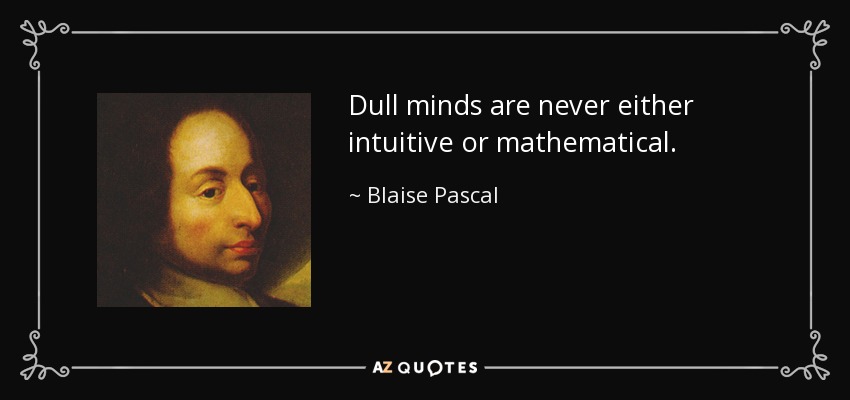
Dull minds are never either intuitive or mathematical.
It is the heart which perceives God and not the reason.
I've dealt with numbers all my life, of course, and after a while you begin to feel that each number has a personality of its own. A twelve is very different from a thirteen, for example. Twelve is upright, conscientious, intelligent, whereas thirteen is a loner, a shady character who won't think twice about breaking the law to get what he wants. Eleven is tough, an outdoorsman who likes tramping through woods and scaling mountains; ten is rather simpleminded, a bland figure who always does what he's told; nine is deep and mystical, a Buddha of contemplation.
It is a profoundly erroneous truism, repeated by all copy books and by eminent people when they are making speeches, that we should cultivate the habit of thinking of what we are doing. The precise opposite is the case. Civilization advances by extending the number of important operations which we can perform without thinking about them.
We are so presumptuous that we should like to be known all over the world, even by people who will only come when we are no more. Such is our vanity that the good opinion of half a dozen of the people around us gives us pleasure and satisfaction.
And who can doubt that it will lead to the worst disorders when minds created free by God are compelled to submit slavishly to an outside will? When we are told to deny our senses and subject them to the whim of others? When people devoid of whatsoever competence are made judges over experts and are granted authority to treat them as they please? These are the novelties which are apt to bring about the ruin of commonwealths and the subversion of the state.
Bridges would not be safer if only people who knew the proper definition of a real number were allowed to design them.
If a nonnegative quantity was so small that it is smaller than any given one, then it certainly could not be anything but zero. To those who ask what the infinitely small quantity in mathematics is, we answer that it is actually zero. Hence there are not so many mysteries hidden in this concept as they are usually believed to be. These supposed mysteries have rendered the calculus of the infinitely small quite suspect to many people. Those doubts that remain we shall thoroughly remove in the following pages, where we shall explain this calculus.
It is the invaluable merit of the great Basle mathematician Leonard Euler, to have freed the analytical calculus from all geometric bounds, and thus to have established analysis as an independent science, which from his time on has maintained an unchallenged leadership in the field of mathematics.
Theology, Mr. Fortune found, is a more accommodating subject than mathematics; its technique of exposition allows greater latitude. For instance when you are gravelled for matter there is always the moral to fall back upon. Comparisons too may be drawn, leading cases cited, types and antetypes analysed and anecdotes introduced. Except for Archimedes mathematics is singularly naked of anecdotes.
However vast a man's spiritual resources, he is capable of but one great passion.
The ludicrous state of solid geometry made me pass over this branch.
What distinguishes a mathematical model from, say, a poem, a song, a portrait or any other kind of "model," is that the mathematical model is an image or picture of reality painted with logical symbols instead of with words, sounds or watercolors.
Nothing has done more to render modern economic theory a sterile and irrelevant exercise in autoeroticism than its practitioners’ obsession with mathematical, general-equilibrium models.
In studying mathematics or simply using a mathematical principle, if we get the wrong answer in sort of algebraic equation, we do not suddenly feel that there is an anti-mathematical principle that is luring us into the wrong answers.
The greatest reward lies in making the discovery; recognition can add little or nothing to that.
Prayers for the condemned man will be offered on an adding machine. Numbers constitute the only universal language.
Algebra reverses the relative importance of the factors in ordinary language. It is essentially a written language, and it endeavors to exemplify in its written structures the patterns which it is its purpose to convey. The pattern of the marks on paper is a particular instance of the pattern to be conveyed to thought. The algebraic method is our best approach to the expression of necessity, by reason of its reduction of accident to the ghostlike character of the real variable.
We could present spatially an atomic fact which contradicted the laws of physics, but not one which contradicted the laws of geometry.
So long as a man remains a gregarious and sociable being, he cannot cut himself off from the gratification of the instinct of imparting what he is learning, of propagating through others the ideas and impressions seething in his own brain, without stunting and atrophying his moral nature and drying up the surest sources of his future intellectual replenishment.
Blaise Pascal used to mark with charcoal the walls of his playroom, seeking a means of making a circle perfectly round and a triangle whose sides and angle were all equal. He discovered these things for himself and then began to seek the relationship which existed between them. He did not know any mathematical terms and so he made up his own. Using these names he made axioms and finally developed perfect demonstrations, until he had come to the thirty-second proposition of Euclid.
Ignorance and superstition ever bear a close and mathematical relation to each other.
While the individual man is an insoluble puzzle, in the aggregate he becomes a mathematical certainty. You can, for example, never foretell what any one man will be up to, but you can say with precision what an average number will be up to. Individuals vary, but percentages remain constant. So says the statistician.
Investment success cannot be captured in a mathematical equation or a computer program.
For hundreds of pages the closely-reasoned arguments unroll, axioms and theorems interlock. And what remains with us in the end? A general sense that the world can be expressed in closely-reasoned arguments, in interlocking axioms and theorems.
Follow AzQuotes on Facebook, Twitter and Google+. Every day we present the best quotes! Improve yourself, find your inspiration, share with friends
or simply: