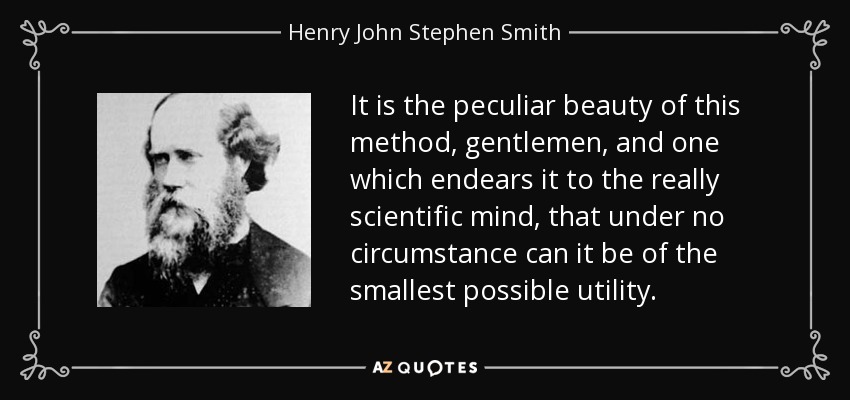
It is the peculiar beauty of this method, gentlemen, and one which endears it to the really scientific mind, that under no circumstance can it be of the smallest possible utility.
The mathematician is fascinated with the marvelous beauty of the forms he constructs, and in their beauty he finds everlasting truth.
What I love about cooking is that after a hard day, there is something comforting about the fact that if you melt butter and add flour and then hot stock, it will get thick! It's a sure thing! It's a sure thing in a world where nothing is sure; it has a mathematical certainty in a world where those of us who long for some kind of certainty are forced to settle for crossword puzzles.
A child is born on that day, and at that hour when the celestial rays are in mathematical harmony with his individual Karma. His horoscope is a challenging portrait, revealing his unalterable past and its probable future result. But the natal chart can be rightly interpreted only by men of intuitive wisdom - These are few.
To throw in a fair game at Hazards only three-spots, when something great is at stake, or some business is the hazard, is a natural occurrence and deserves to be so deemed; and even when they come up the same way for a second time if the throw be repeated. If the third and fourth plays are the same, surely there is occasion for suspicion on the part of a prudent man.
Bistromathics itself is simply a revolutionary new way of understanding the behavior of numbers. Just as Einstein observed that space was not an absolute but depended on the observer's movement in space, and that time was not an absolute, but depended on the observer's movement in time, so it is now realized that numbers are not absolute, but depend on the observer's movement in restaurants.
We do not worry about being respected in towns through which we pass. But if we are going to remain in one for a certain time, we do worry. How long does this time have to be?
Leibniz never married; he had considered it at the age of fifty; but the person he had in mind asked for time to reflect. This gave Leibniz time to reflect, too, and so he never married.
Every mathematician worthy of the name has experienced . . . the state of lucid exaltation in which one thought succeeds another as if miraculously . . . this feeling may last for hours at a time, even for days. Once you have experienced it, you are eager to repeat it but unable to do it at will, unless perhaps by dogged work. . . .
I recall once saying that when I had given the same lecture several times I couldn't help feeling that they really ought to know it by now.
Those who are accustomed to judge by feeling do not understand the process of reasoning, because they want to comprehend at a glance and are not used to seeking for first principles. Those, on the other hand, who are accustomed to reason from first principles do not understand matters of feeling at all, because they look for first principles and are unable to comprehend at a glance.
In the study of ideas, it is necessary to remember that insistence on hard-headed clarity issues from sentimental feeling, as it were a mist, cloaking the perplexities of fact. Insistence on clarity at all costs is based on sheer superstition as to the mode in which human intelligence functions. Our reasonings grasp at straws for premises and float on gossamers for deductions.
Nothing has done more to render modern economic theory a sterile and irrelevant exercise in autoeroticism than its practitioners’ obsession with mathematical, general-equilibrium models.
In studying mathematics or simply using a mathematical principle, if we get the wrong answer in sort of algebraic equation, we do not suddenly feel that there is an anti-mathematical principle that is luring us into the wrong answers.
The greatest reward lies in making the discovery; recognition can add little or nothing to that.
Prayers for the condemned man will be offered on an adding machine. Numbers constitute the only universal language.
Algebra reverses the relative importance of the factors in ordinary language. It is essentially a written language, and it endeavors to exemplify in its written structures the patterns which it is its purpose to convey. The pattern of the marks on paper is a particular instance of the pattern to be conveyed to thought. The algebraic method is our best approach to the expression of necessity, by reason of its reduction of accident to the ghostlike character of the real variable.
Just as the introduction of the irrational numbers ... is a convenient myth [which] simplifies the laws of arithmetic ... so physical objects are postulated entities which round out and simplify our account of the flux of existence... The conceptional scheme of physical objects is [likewise] a convenient myth, simpler than the literal truth and yet containing that literal truth as a scattered part.
We could present spatially an atomic fact which contradicted the laws of physics, but not one which contradicted the laws of geometry.
The theory of ramification is one of pure colligation, for it takes no account of magnitude or position; geometrical lines are used, but these have no more real bearing on the matter than those employed in genealogical tables have in explaining the laws of procreation.
So long as a man remains a gregarious and sociable being, he cannot cut himself off from the gratification of the instinct of imparting what he is learning, of propagating through others the ideas and impressions seething in his own brain, without stunting and atrophying his moral nature and drying up the surest sources of his future intellectual replenishment.
A linguist would be shocked to learn that if a set is not closed this does not mean that it is open, or again that "E is dense in E" does not mean the same thing as "E is dense in itself".
Attaching significance to invariants is an effort to recognize what, because of its form or colour or meaning or otherwise, is important or significant in what is only trivial or ephemeral. A simple instance of failing in this is provided by the poll-man at Cambridge, who learned perfectly how to factorize a^2 - b^2 but was floored because the examiner unkindly asked for the factors of p^2 - q^2.
Mathematical discoveries, small or great are never born of spontaneous generation.
Blaise Pascal used to mark with charcoal the walls of his playroom, seeking a means of making a circle perfectly round and a triangle whose sides and angle were all equal. He discovered these things for himself and then began to seek the relationship which existed between them. He did not know any mathematical terms and so he made up his own. Using these names he made axioms and finally developed perfect demonstrations, until he had come to the thirty-second proposition of Euclid.
Follow AzQuotes on Facebook, Twitter and Google+. Every day we present the best quotes! Improve yourself, find your inspiration, share with friends
or simply: