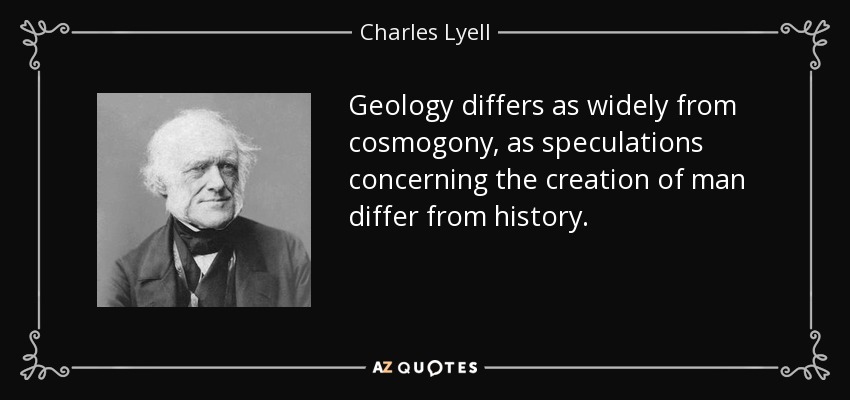
Geology differs as widely from cosmogony, as speculations concerning the creation of man differ from history.
Gradually the sunken land begins to rise again, and falls perhaps again, and rises again after that, more and more gently each time, till as it were the panting earth, worn out with the fierce passions of her fiery youth, has sobbed herself to sleep once more, and this new world of man is made.
A scientist should be the happiest of men. Not that science isn't serious; but as everyone knows, being serious is one way of being happy, just as being gay is one way of being unhappy.
At first he who invented any art that went beyond the common perceptions of man was naturally admired by men, not only because there was something useful in the inventions, but because he was thought wise and superior to the rest. But as more arts were invented, and some were directed to the necessities of life, others to its recreation, the inventors of the latter were always regarded as wiser than the inventors of the former, because their branches of knowledge did not aim at utility.
Criticism, though dignified from the earliest ages by the labours of men eminent for knowledge and sagacity, has not yet attained the certainty and stability of science.
During the century after Newton, it was still possible for a man of unusual attainments to master all fields of scientific knowledge. But by 1800, this had become entirely impracticable.
It is a right, yes a duty, to search in cautious manner for the numbers, sizes, and weights, the norms for everything [God] has created. For He himself has let man take part in the knowledge of these things ... For these secrets are not of the kind whose research should be forbidden; rather they are set before our eyes like a mirror so that by examining them we observe to some extent the goodness and wisdom of the Creator.
It is not knowing, but the love of learning, that characterizes the scientific man.
Man has an intense desire for assured knowledge.
Men will gather knowledge no matter what the consequences. Science will go on whether we are pessimistic or optimistic, as I am. More interesting discoveries than we can imagine will be made, and I am awaiting them, full of curiosity and enthusiasm.
Only to often on meeting scientific men, even those of genuine distiction, one finds that they are dull fellows and very stupid. They know one thing to excess; they know nothing else. Pursuing facts too doggedly and unimaginatively, they miss all the charming things that are not facts. ... Too much learning, like too little learning, is an unpleasant and dangerous thing.
Our immediate interests are after all of but small moment. It is what we do for the future, what we add to the sum of man's knowledge, that counts most. As someone has said, 'The individual withers and the world is more and more.' Man dies at 70, 80, or 90, or at some earlier age, but through his power of physical reproduction, and with the means that he has to transmit the results of effort to those who come after him, he may be said to be immortal.
Science moves, but slowly, slowly, creeping on from point to point. ... Yet I doubt not through the ages one increasing purpose runs, And the thoughts of men are widened with the process of the suns. ... Knowledge comes, but wisdom lingers.
Statistics, one may hope, will improve gradually, and become good for something. Meanwhile, it is to be feared the crabbed satirist was partly right, as things go: "A judicious man," says he, "looks at Statistics, not to get knowledge, but to save himself from having ignorance foisted on him."
The saying that a little knowledge is a dangerous thing is, to my mind, a very dangerous adage. If knowledge is real and genuine, I do not believe that it is other than a very valuable posession, however infinitesimal its quantity may be. Indeed, if a little knowledge is dangerous, where is a man who has so much as to be out of danger?
We do not ask what hope of gain makes a little bird warble, since we know that it takes delight in singing because it is for that very singing that the bird was made, so there is no need to ask why the human mind undertakes such toil in seeking out these secrets of the heavens. ... And just as other animals, and the human body, are sustained by food and drink, so the very spirit of Man, which is something distinct from Man, is nourished, is increased, and in a sense grows up on this diet of knowledge, and is more like the dead than the living if it is touched by no desire for these things.
[At the end of the story, its main character, Tom] is now a great man of science, and can plan railroads, and steam-engines, and electric telegraphs, and rifled guns, and so forth; and knows everything about everything, except why a hen's egg don't turn into a crocodile, and two or three other little things that no one will know till the coming of the Cocqcigrues.
The true science and study of mankind is man.
Fishing has been styled 'a contemplative man's recreation,' ... and science is only a more contemplative man's recreation.
For a long time it has been known that the first systems of representations with which men have pictured to themselves the world and themselves were of religious origin. There is no religion that is not a cosmology at the same time that it is a speculation upon divine things. If philosophy and the sciences were born of religion, it is because religion began by taking the place of the sciences and philosophy.
History, as it lies at the root of all science, is also the first distinct product of man's spiritual nature, his earliest expression of what may be called thought.
I have said that science is impossible without faith. ... Inductive logic, the logic of Bacon, is rather something on which we can act than something which we can prove, and to act on it is a supreme assertion of faith ... Science is a way of life which can only fluorish when men are free to have faith.
In all matters of opinion and science ... the difference between men is ... oftener found to lie in generals than in particulars; and to be less in reality than in appearance. An explication of the terms commonly ends the controversy, and the disputants are surprised to find that they had been quarrelling, while at bottom they agreed in their judgement.
In every section of the entire area where the word science may properly be applied, the limiting factor is a human one. We shall have rapid or slow advance in this direction or in that depending on the number of really first-class men who are engaged in the work in question. ... So in the last analysis, the future of science in this country will be determined by our basic educational policy.
In science the successors stand upon the shoulders of their predecessors; where one man of supreme genius has invented a method, a thousand lesser men can apply it. ... In art nothing worth doing can be done without genius; in science even a very moderate capacity can contribute to a supreme achievement.
Follow AzQuotes on Facebook, Twitter and Google+. Every day we present the best quotes! Improve yourself, find your inspiration, share with friends
or simply: