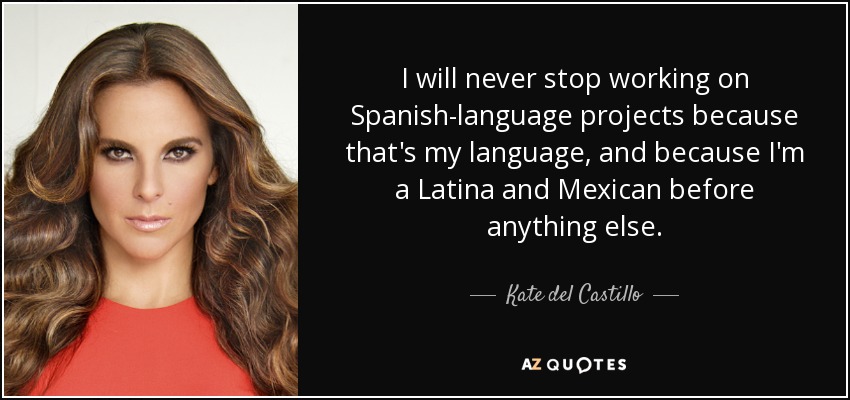
I will never stop working on Spanish-language projects because that's my language, and because I'm a Latina and Mexican before anything else.
Some of [Donald Trump] comments can be interpreted as potentially reducing the threat of nuclear war. The major threat right now is right on the Russian border. Notice, not the Mexican border, the Russian border. And it's serious. He has made various statements moving towards reducing the tensions, accommodating Russian concerns and so on.
Right at the beginning of all of this [Ukraine to join NATO], serious senior statesmen, people like [George] Kennan for example and others warned that the expansion of NATO to the east is going to cause a disaster. I mean, it's like having the Warsaw Pact on the Mexican border. It's inconceivable. And others, senior people warned about this, but policymakers didn't care. Just go ahead.
A Romney presidency will be awesome unless you're poor, sick, gay, female, Mexican or a dog.
I did a film called The Jesuit, which was an independent film. I did that shortly after Mistresses. I was still feeling soft and I was nursing, but it was a character I'd never played before. That was a Paul Schrader script, with an up-and-coming Mexican director, named Alfonso Ulloa. That has Tim Roth and Paz Vega in it, and I enjoyed that, as well.
We're Mexican not Mexican't!
It wasn't a cutdown to call someone a Mexican. It would kill my career to refer to someone as Mexican today. It's like calling me an American.
I learned this one growing up in Texas and, subsequently, living in Los Angeles: always use the 'usted' form when speaking to a Spanish official. Mexican border patrol cops don't like it when you call them 'amigo,' give them a hardy pat on the back, slip a $20 in their pocket. No bueno, it doesn't fly. By the way, those of you not laughing at that obviously took French in high school, and that was a gay choice.
I've been called a racist before, and let me tell you something - that is harsh. That's a really ugly thing to call someone. That's like being called a Mexican.
[My photography teacher] gave me the Mexican Day Books of Edward Weston and just blew me away with this work. The fact that you could be this fabulous visual artist, with all this milieu of people like Diego Rivera and you could sleep with these gorgeous, amazing women, that you could live that life - that photography could deliver you that life.
I love Indian, Italian and Mexican food. And if it's a romantic type of thing, I like a good French restaurant.
Question the images. Take them by the hand and don't let the sweet distancing they offer you vanquish you; do away with the distance's comfort or the soft indifference you derive from concentrating on the quality of the framing, the use of light and shadows, the successful composition. Force these images to bring you to the Mexican Southeast, to history, to the struggle, to this taking sides, to choose a faction.
I love melodrama. I love the simple fact. When you read Euripides he's a page turner. It's like reading a Mexican comic book romance.
I think that in the colonial imaginary of the average Mexican, in how it drives us, the economic dependence on the US, and in some cases cultural dependence, is quite palpable, very strong.
European militants recognize Mumia Abu-Jamal, and the Mexican militants followed their example and legitimated his work because the Europeans said, "Hey, Mumia Abu-Jamal is relevant in the US. I, the European, am telling you. I am your political guide, your icon, your mentor for political references. I am telling you that you should support the relevant causes."
Mexican food is my absolute, #1 favorite food. But all the cutting and dicing is very time-consuming. I do like to cook a few times a week, but it's not always that intricate with the shells and the cheese, etcetera.
When I eat cilantro, it's like someone sprayed perfume down my throat. It closes up my throat, even if there's only a little piece. I like Mexican food, and I'll go out to a Mexican restaurant and tell them, 'Look, I will die if you get cilantro in my food.' Then there's always that one little piece that falls in, and I gag.
Mexican cinematographers Gabriel Figueroa and Emilio Fernandez were students of both Sergei Eisenstein and Toland. Their exteriors and lighting were gorgeous. And the films Ingmar Bergman did with Sven Nykvist were exceptional.
But lots of emerging racial tensions in California have nothing to do with whites: Filipinos and Samoans are fighting it out in San Francisco high schools. Merced is becoming majority Mexican and Cambodian. They may be fighting in gangs right now, but I bet they are also learning each other's language.
'm constantly depressed by the Mexican gang members I meet in East L.A. who essentially live their lives inside five or six blocks. They are caught in some tiny ghetto of the mind that limits them to these five blocks because, they say, "I'm Mexican. I live here." And I say, "What do you mean you live here - five blocks? Your granny, your abualita, walked two thousand miles to get here. She violated borders, moved from one language to another, moved from a sixteenth-century village to a twenty-first-century city, and you live within five blocks?"
In the beginning, I was always playing some kind of gangbanger and the token Mexican dude who didn't have a lot of lines but was in the entire movie. At the same time, everyone gets typecast, and I decided that if I was going to play a stereotypical role, I was going to play it like a three-dimensional character.
If you don't have that science and technology and brains as an input, as you don't have in large parts of Latin America, if you don't focus your education on that, if you don't find your 10,000 best scientists, but you do find your 10,000 best soccer players, the consequences are, you become a World Cup Champion in Soccer, like Brazil, but you don't become Korea, which earned 1/5 of what a Mexican did in 1975 and today earns five times more.
Now everybody is mafia. You got the Russian mafia, the Mexican mafia. Everybody is mafia these days.
Mexican style of boxing training is different from what my father had trained me. It was good for me because it was an added knowledge, an addition to my boxing IQ.
I live in a town that's two and a half hours from the border. I know people who have lived in San Antonio for generations, sometimes seven generations, their families are from there, and they are of Mexican descent, and they've never gone farther than the border.
Follow AzQuotes on Facebook, Twitter and Google+. Every day we present the best quotes! Improve yourself, find your inspiration, share with friends
or simply: