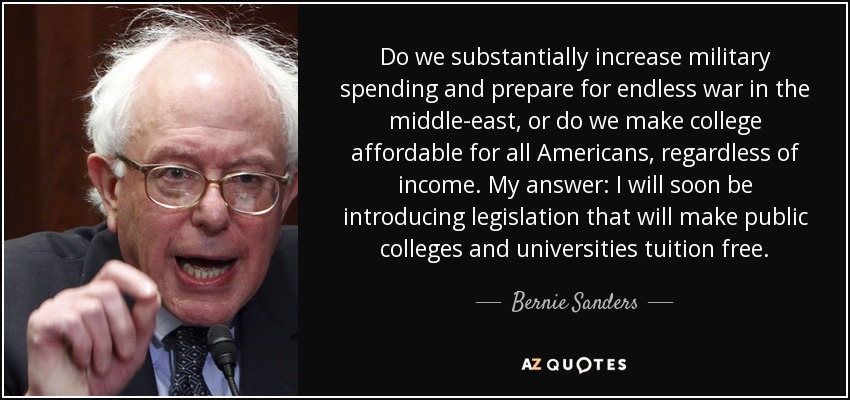
Do we substantially increase military spending and prepare for endless war in the middle-east, or do we make college affordable for all Americans, regardless of income. My answer: I will soon be introducing legislation that will make public colleges and universities tuition free.
I do not believe that we must maintain a bloated military budget which spends almost as much as the rest of the world combined and may lead us to perpetual warfare in the Middle East.
As I've submerged myself in news of the revolutions sweeping North Africa and the Middle East, I wanted desperately to feel part of what was going on. And then it hit me: This is what white people were doing to me after Obama was elected!
It is no secret that many Islamic movements in the Middle East tend to be authoritarian, and some of the so-called 'Islamic regimes' such as Saudi Arabia, Iran - and the worst case was the Taliban in Afghanistan - they are pretty authoritarian. No doubt about that.
The crises in North Korea, Iran, the Middle East, show how quickly things can change and how they can go wrong. We must be prepared. And right now the Army is not.
Even before 9/11 I was gripped by a sense of dread: our lack of criticism about what we were doing in the Middle East - the slagging off of a whole religious tradition.
My dad was working abroad, in Iraq, and he was a doctor. We used to go and visit him, in Baghdad, off and on. For the first ten years of my life, we used to go backwards and forwards to Baghdad, so that was quite amazing. I spent a lot of time traveling around the Middle East.
Toppling secular dictators in the Middle East has only led to chaos and the rise of radical Islam.
Israel is our strongest, most reliable ally in the Middle East. Of course, we're their most reliable ally, too.
In a summer marked by instability in the Middle East and Eastern Europe, I know the world also took notice of the small American city of Ferguson, Missouri - where a young man was killed, and a community was divided. So yes, we have our own racial and ethnic tensions.
If everybody that had two cars had a Prius instead of an SUV, we wouldn't be in the Middle East right now.
Darwin found out that when you took horses up to the high country in the Middle East, they would then grow long hair after a season or two. But when you took them - these long-haired horses - back into the low, hot country, they wouldn't get rid of the long hair, just in case, for about four generations.
The prostitute journalist is a familiar and well-understood figure in the Middle East, and Saddam Hussein's regime made lavish use of the buyability of the regional press. Now we, too, have hired that clapped-out old floozy, Miss Rosie Scenario, and sent her whoring through the streets.
I think there is a general interest in films that deal with contemporary issues. Constructions of Iran, Islam, the Middle East as well as the U.S. itself are also of interest, it seems.
Americans are curious about the texture of everyday life in the Middle East because they rarely get to see it. I wanted readers to feel like they were sitting around the dinner table with me and my friends, hearing what average people really say and really think, [where] the dinner table is the best place to find out.
So much of what we see and hear about the Middle East focuses on what we call politics, which is essentially ideology. But when it comes to the Middle East, and especially the Arab world, simply depicting people as human beings is the most political thing you can do.
In the Middle East, bread is so essential to everyday life that word for it in Egyptian Arabic is aish, which means life. It's always been the staple grain. But the predicament is that the Fertile Crescent, where wheat cultivation began, has now become the part of the world most dependent on imported wheat.
The Middle East is the only region in the world outside of sub-Saharan Africa where rates of malnutrition actually rose over the past decade or two, instead of falling.
There's a long history in the Middle East of "bread intifadas," starting with 1977 in Egypt, when Anwar Sadat tried to lift bread subsidies. People rebelled and poured into Tahrir Square, shouting slogans against the government just like they did earlier this year. Sadat learned his lesson and kept bread subsidies in place, and so did a host of other Middle Eastern dictators - many of whom were propped up for years by the West, partly through subsidized American wheat.
The problem is that so many of them are not getting told. This is a massive problem, not just in the Middle East but for places from Africa to Afghanistan. There are millions of stories out there, millions of potential Booksellers of Kabul or Valentino Achak Dengs.
There are definitely recurring themes in humanity's relationship with our environment. The biggest is probably adaptation, because humans are incredibly good at adapting to new environments in relatively short periods of time. The ancestors of Homo sapiens started leaving Africa over one million years ago, moving from warm, tropical climates into the freezing wilderness of Europe and the desert ecosystems of the Middle East.
But when you only speak using generalizations, you run the danger of denying the specific. In recent decades, millions of people have come to us from cultural groups within which women have absolutely no rights. They do not have a voice of their own and they are totally dependent on their fathers, brothers or husbands. That applies to North Africa and that applies to large parts of the Middle East. It isn't always linked to Islam.
I told Sarah Palin it would be absolutely fine. I thought it would be appropriate. There was tremendous press, and I think it`s something that`s very important to discuss.Not even for her son, but for so many other sons and daughters that are coming back from the Middle East, where they have traumatic problems. They have tremendous problems.
We owe $20 trillion, and we're a mess. And we've spent $6 trillion in the Middle East, according to a report that I just saw.And it's politicians like Secretary [Hillary] Clinton that have caused this problem.
There seems also to be a tremendous risk to indigenous cultures if we insist that all scholarship be conducted in English. We are, for example, dealing with ancient and very highly-developed cultures in Korea, Japan, China and the Middle East. What is the impact on cultural and scholarly vitality forcing everyone to do their work in English? I do not have an answer, but this issue has been very much on my mind.
Follow AzQuotes on Facebook, Twitter and Google+. Every day we present the best quotes! Improve yourself, find your inspiration, share with friends
or simply: