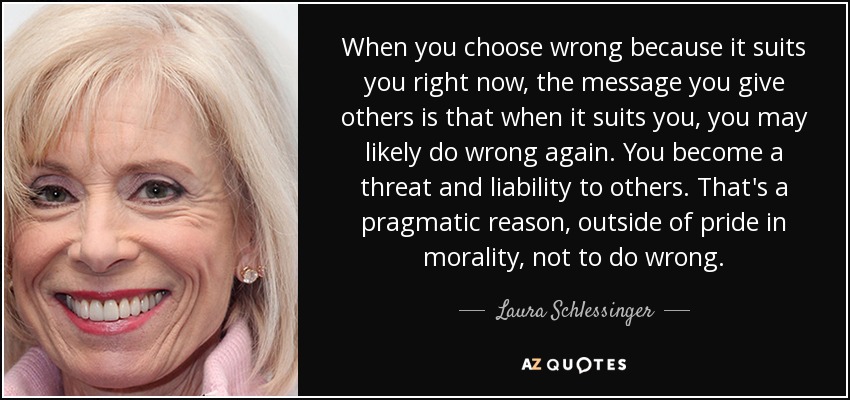
When you choose wrong because it suits you right now, the message you give others is that when it suits you, you may likely do wrong again. You become a threat and liability to others. That's a pragmatic reason, outside of pride in morality, not to do wrong.
Integrity, honesty, and honor may not give immediate rewards or gratification, and they can be life-threatening (for example, being a whistle-blower or turning state's evidence). The absence of integrity, honesty, and honor do not always bring punishment or scorn, and can be life-aggrandizing (connivers and cheats often gain power and wealth). Therefore, morality must be its own reward.
The reward for doing right is mostly an internal phenomenon: self-respect, dignity, integrity, and self-esteem.
How could politics be a science, if laws and forms of government had not a uniform influence upon society? Where would be the foundation of morals, if particular characters had no certain or determinate power to produce particular sentiments, and if these sentiments had no constant operation on actions?
It seems then, say I, that you leave politics entirely out of the question, and never suppose, that a wise magistrate can justly be jealous of certain tenets of philosophy, such as those of Epicurus, which, denying a divine existence, and consequently a providence and a future state, seem to loosen, in a great measure, the ties of morality, and may be supposed, for that reason, pernicious to the peace of civil society.
Ever since men became capable of free speculation, their actions, in innumerable important respects, have depended upon their theories as to the world and human life, as to what is good and what is evil. This is true in the present day as at any former time. To understand an age or a nation, we must understand its philosophy, and to understand its philosophy we must ourselves be in some degree philosophers. There is here a reciprocal causation: the circumstances of men s lives do much to determine their philosophy, but, conversely, their philosophy does much to determine their circumstances.
Moral philosophy is nothing else but the science of what is good, and evil, in the conversation, and society of mankind. Good, and evil, are names that signify our appetites, and aversions; which in different tempers, customs, and doctrines of men, are different.
Productiveness is your acceptance of morality, your recognition of the fact that you choose to live-that productive work is the process by which man's consciousness controls his existence, a constant process of acquiring knowledge and shaping matter to fit one's purpose, of translating an idea into physical form, of remaking the earth in the image of one's values-that all work is creative work if done by a thinking mind.
If religion is the establishing of a relationship between man and the universe, then morality is the explanation of those activities that automatically result when a person maintains a relationship to the universe.
It is unreasonable [for a father] to expect moral success with [his] children without submitting to the laws of morality.
And there was a real shedding of the old dogma, like boundaries of morality were being broken down and everybody was into the new party mode of just loving on each other. Which destroyed thousands of us. I lost 16 of my personal friends through that lifestyle.
Those who conduct themselves with morality, integrity and consistency need not fear the forces of inhumanity and cruelty.
Understanding the simple fact that morality differs around the world, and even within societies, is the first step toward understanding your righteous mind.
Morality binds and blinds. It binds us into teams … but thereby makes us go blind to objective reality.
Every society and religion has rules, for both have moral laws. And the essence of morality consists, as in art, of drawing the line somewhere.
So always, if we look back, concern for face-to-face morality, and its modern emphasis on justice as well, have historically evolved as religious issues.
Science cannot destroy the consciousness of freedom, without which there is no morality and no art, but it can refute it.
Our ability to adapt and therefore to accept everything is one of our greatest dangers. Creatures that are completely flexible, changeable, can have no fixed morality.
But the imposition of morality onto science, - where it does not belong - has become rampant in recent years.
There must be more equality established in society, or morality will never gain ground, and this virtuous equakity will not rest firmly even when founded on a rock, if one half of mankind be chained to its bottom by fate, for they will be continually undermining it through ignorance or pride
Today courts wrongly interpret separation of church and state to mean that religion has no place in the public arena, or that morality derived from religion should not be permitted to shape our laws. Somehow freedom for religious expression has become freedom from religious expression. Secularists want to empty the public square of religion and religious-based morality so they can monopolize the shared space of society with their own views. In the process they have made religious believers into second-class citizens.
Religion and morality are critical to how students think about politics and form opinions on political issues.
It is wrong to expect a reward for your struggles. The reward is the act of struggle itself, not what you win. Even though you can't expect to defeat the absurdity of the world, you must make that attempt. That's morality, that's religion. That's art. That's life.
The web of hypocrisy of today hangs on the frontiers of two domains, between which our time swings back and forth, attaching its fine threads of deception and self-deception. No longer vigorous enough to serve morality without doubt or weakening, not yet reckless enough to live wholly to egoism, it trembles now toward the one and now toward the other in the spider-web of hypocrisy, and, crippled by the curse of halfness, catches only miserable, stupid flies.
The revolutionary despises public opinion. He despises and hates the existing social morality in all its manifestations. For him, morality is everything which contributes to the triumph of the revolution. Immoral and criminal is everything that stands in its way.
Follow AzQuotes on Facebook, Twitter and Google+. Every day we present the best quotes! Improve yourself, find your inspiration, share with friends
or simply: