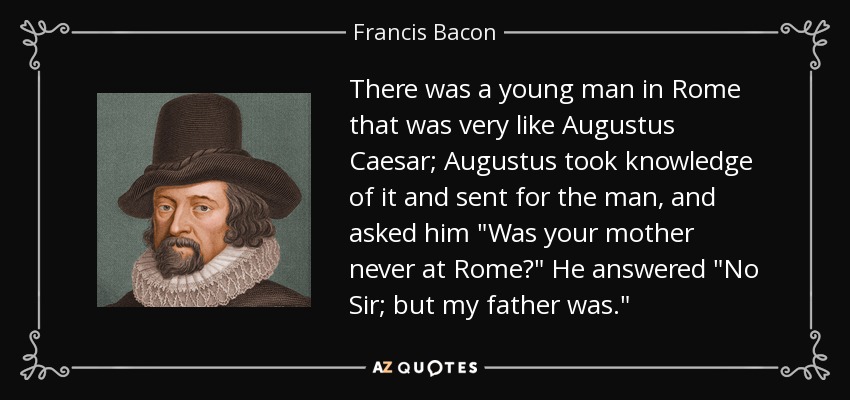
There was a young man in Rome that was very like Augustus Caesar; Augustus took knowledge of it and sent for the man, and asked him "Was your mother never at Rome?" He answered "No Sir; but my father was."
I guess I was a mom so late in life, my daughter was the greatest thing since sliced bread.
Commerce is against morality. Morality is going to lose every time.
I think with motherhood and child-rearing in general, everyone's going to tell you how to do it and why. I've always said to other mothers and women when they've asked me, that you have to find your own way and find out what works for your family, at all costs.
A mother's yearning feels the presence of the cherished child even in the degraded man.
It would seem that something which means poverty, disorder and violence every single day should be avoided entirely, but the desire to beget children is a natural urge.
The tie which links mother and child is of such pure and immaculate strength as to be never violated.
She never quite leaves her children at home, even when she doesn't take them along.
I did consider marriage and motherhood extreme and doomed commitments. Not out of any experience of them as such, but it was simply the way I looked at things.
However time or circumstances may come between mother and her child, their lives are interwoven forever.
The reason child care is such a loaded issue is that when we talk about it, we are always tacitly talking about motherhood. And when we're talking about motherhood we're always tacitly assuming that child care must be a very dim second to full-time mother care.
Wherever the State touches the personal life of the infant, the child, the youth, or the aged, helpless, defective in mind, body or moral nature, there the State enters "woman's peculiar sphere," her sphere of motherly succor and training, her sphere of sympathetic and self-sacrificing ministration to individual lives.
I have met few men in my life, worth repeating eight times.
With a generous endowment of motherhood provided by legislation, with all laws against voluntary motherhood and education in its methods repealed, with the feminist ideal of education accepted in home and school, and with all special barriers removed in every field of human activity, there is no reason why woman should not become almost a human thing. It will be time enough then to consider whether she has a soul.
For boys, the family was the place from which one sprang and to which one returned for comfort and support, but the field of action was the larger world of wilderness, adventure, industry, labor, and politics. For girls, the family was to be the world, their field of action the domestic circle. He was to express himself in his work and, through it and social action, was to help transform his environment; her individual growth and choices were restricted to lead her to express herself through love, wifehood, and motherhood--through the support and nurture of others, who would act for her.
Borrow a child and get on welfare. Borrow a child and stay in the house all day with the child, or go to the public park with the child, and take the child to the welfare office and cry and say your man left you and be humble and wear your dress and your smile, and don't talk back.
Know that every mother occasionally feels "at the end of her rope." When you reach the end of your rope, don't add guilt to your frustration. No one said motherhood was going to be easy.
Not rarely, and this is especially true of wives and mothers, the motive behind assuming a disproportionate share of work and responsibility is completely unselfish. We want to protect, to spare those of whom we are fond. We forget that, regardless of the motive, the results of such action are almost always destructive and unproductive.
Ideas about mothers have swung historically with the roles of women. When women were needed to work the fields or shops, experts claimed that children didn't need them much. Mothers, who might be too soft and sentimental, could even be bad for children's character development. But when men left home during the Industrial Revolution to work elsewhere, women were "needed" at home. The cult of domesticity and motherhood became a virtue that kept women in their place.
... [the] special relation of women to children, in which the heart of the world has always felt there was something sacred, serves to impress upon women certain tendencies, to endow them with certain virtueswhich will render them of special value in public affairs.
The problem, thus, is not whether or not women are to combine marriage and motherhood with work or career but how they are to do so--concomitantly in a two-role continuous pattern or sequentially in a pattern involving job or career discontinuities.
How can it be broad to be the same thing to everyone and narrow to be everything to someone? No, a woman’s function is laborious, but because it is gigantic, not because it is minute. (What’s Wrong with the World)
He didn't realize that love as powerful as your mother's for you leaves its own mark.
My mother had a slender, small body, but a large heart-a heart so large that everybody's joys found welcome in it, and hospitable accommodation.
Having children just puts the whole world into perspective. Everything else just disappears.
Follow AzQuotes on Facebook, Twitter and Google+. Every day we present the best quotes! Improve yourself, find your inspiration, share with friends
or simply: