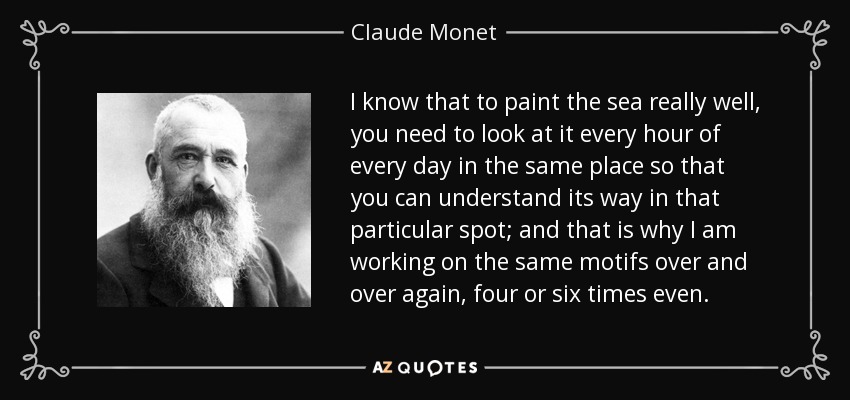
I know that to paint the sea really well, you need to look at it every hour of every day in the same place so that you can understand its way in that particular spot; and that is why I am working on the same motifs over and over again, four or six times even.
Directors who have inspired me include Billy Wilder, Federico Fellini, lngmar Bergman, John Ford, Orson Welles, Werner Herzog, Stanley Kubrick, Alfred Hitchcock, Francis Ford Coppola and Ernst Lubitsch. In art school, I studied painters like Edward Hopper, who used urban motifs, Franz Kafka is my favorite novelist. My approach to film stems from my art background, as I go beyond the story to the sub-conscious mood created by sound and images.
The motif must always be set down in a simple way, easily grasped and understood by the beholder. By the elimination of superfluous detail, the spectator should be led along the road that the artist indicates to him, and from the first be made to notice what the artist has felt.
Carl Orff's Carmina Burana has the ability to take you from placidity to power in one sonic breath. It is music of dignity and strength, with primitive, energetic passages, evoking absolute beauty from the simplest of phrases. It brings up something that has everything to do with significance - squeezing joy and motif that you just can't drop - it stays with you.
This symmetrical composition--the same motif at the beginning and at the end--may seem quite "novelistic" to you, and I am willing to agree, but only on condition that you refrain from reading such notions as "fictive," "fabricated," and "untrue to life" into the word "novelistic." Because human lives are composed in precisely such a fashion.
And more than once in the course of time, the same theme reappears: among the mystics of the fifteenth century, it has become the motif of the soul as a skiff, abandoned on the infinite sea of desires, in the sterile field of cares and ignorance, among the mirages of knowledge, amid the unreason of the world - a craft at the mercy of the sea's great madness, unless it throws out a solid anchor, faith, or raises its spiritual sails so that the breath of God may bring it to port.
One day I noticed that I could go on working my art motif no matter what the weather might be. I no longer needed the sun, for I took my light everywhere with me.
Some day there may be... machinery that needs but to be wound up and sent roaming o'er hill and dale, through fields and meadows, by babbling brooks and shady woods - in short, a machine that will discriminately select its subject and, by means of a skillful arrangement of springs and screws, compose its motif, expose the plate, develop, print, and even mount and frame the result of its excursion, so that there will be nothing for us to do but to send it to the Royal Photographic Society's exhibition and gratefully to receive the 'Royal Medal'.
Almost all great writers have as their motif, more or less disguised, the passage from childhood to maturity, the clash between the thrill of expectation and the disillusioning knowledge of truth. 'Lost Illusion' is the undisclosed title of every novel.
I want to make beautiful paintings. But I don't make beautiful paintings by putting beautiful paint on a canvas with a beautiful motif. It just doesn't work. I expect my paintings to be strong and surprising.
If, while I'm painting, I distort or destroy a motif, it is not a planned or conscious act, but rather it has a different justification: I see the motif, the way I painted it, is somehow ugly or unbearable. Then I try to follow my feelings and make it attractive. And that means a process of painting, changing or destroying - for however long it takes - until I think it has improved. And I don't demand an explanation from myself as to why this is so.
One of the metaphors of the book is the carpet. Not just the flying carpet, but the carpet as a woven surface in which many repetitions and motifs recur and mirror one another. This is very much reflected within the stories: they have borders within borders, repeated motifs which change. They have their feet in oral conventions, and for the mnemonics, the storyteller needs to have a structure in order to remember the stories.
The central icon of Catholic Christianity is mother and child. That motif is so deep in not just our human experience but in our animal, biological past.
For the machine meant the conquest of horizontal space. It also meant a sense of that space which few people had experienced before – the succession and superimposition of views, the unfolding of landscape in flickering surfaces as one was carried swiftly past it, and an exaggerated feeling of relative motion (the poplars nearby seeming to move faster than the church spire across the field) due to parallax. The view from the train was not the view from the horse. It compressed more motifs into the same time. Conversely, it left less time in which to dwell on any one thing.
I like the idea of it as a trickster motif. You know like you're kind of just messing around with people's memories of songs.
On one hand you have a string quartet, which is not a symphony. On the other hand is you have me sampling them and making it sound like there is many more people playing, so the whole notion of, kind of, sampling applied to classical music is very intriguing to me because composers throughout history have borrowed motifs and quotes from one another.
Just as a classical dancer repeats the same movements again and again, in order to achieve a greater perfection of line and balance, so Degas repeats the same motifs - it was one of the things that gave him so much sympathy with dancers.
One of the things I try to do is try to make repetitions, rhymes, and mirrorings across the subject matter of my own books so that the chapter titles and the epigraphs and pictures all kind of form a tapestry. In this book, I retell fifteen of the stories. You have the critical frame, and then you have these rosettes like the motif in a carpet.
This is about objects, not motifs. The photo is only a substitute for an object; it is unsuitable as a picture in its customary sense.
By the combination of lines and colors, under the pretext of some motif taken from nature, I create symphonies and harmonies that represent nothing absolutely real in the ordinary sense of the word but are intended to give rise to thoughts as music does.
I shot many scenes of Hamburg, albums full of postcard motifs, and I discarded almost all of them. I ride my bike through Hamburg every day. I go shopping here, I go to the doctor - and yet I no longer have the eye for telling stories about this damn city, even though I love it.
I am a sur le motif painter, always in-the-field, with a French easel that folds up into a box, with backpack straps on it. Many of the sites I haunt are desolately beautiful. Few other people go there. I am gloriously alone, unmolested, and absorbed in attempting to see what I am looking at.
When a sculptor creates a sculpture, a writer writes a novel, or a painter paints a motif on a canvas, he needs talent and expertise. But to be successful in his endeavor, he also needs to have the passionate feeling that he wants, at all costs, to create a work of art which, in his head, constantly demands to be accomplished. The same also applies to developing board games or card games.
History is a state of yearning. I yearn for Kay Lake throughout this entire thing. There's an essay I've written where I talked about living in the past. There's a whole motif in the book of then and now. And I lived there.
Whenever I work on the computer, I have folders and you know how you always give everything working titles, if you have a riff or a motif or a chord progression or a lyric written on a page, it's just a line or a word or something so I always give everything a working title when I'm making a folder.
Follow AzQuotes on Facebook, Twitter and Google+. Every day we present the best quotes! Improve yourself, find your inspiration, share with friends
or simply: