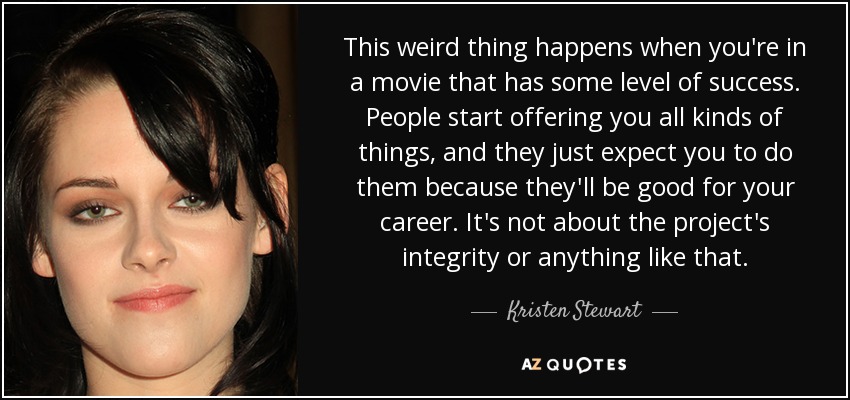
This weird thing happens when you're in a movie that has some level of success. People start offering you all kinds of things, and they just expect you to do them because they'll be good for your career. It's not about the project's integrity or anything like that.
I think people are used to seeing actors be wide open and desperately giving of themselves, and while I do that on a movie set as much as I can, it's so unnatural for me to do it on television, in interviews, in anything like that. I also don't find that my process as an actor is really anyone else's business.
There is no reason why challenging themes and engaging stories have to be mutually exclusive - in fact, each can fuel the other. As a filmmaker, I want to entertain people first and foremost. If out of that comes a greater awareness and understanding of a time or a circumstance, then the hope is that change can happen.
When you start out as a filmmaker, you do parodies, because you can't really compete on a studio level.
A style is not a matter of camera angles or fancy footwork, it's an expression, an accurate expression of your particular opinion.
It's always been my formula to get the next picture set up before anyone's seen the last one.
I'm terrible at horror movies, by the way. I get scared so easily.
There's an electrical thing about movies.
I loved old black and white movies, especially the Fred Astaire and Ginger Rogers musicals. I loved everything about them - the songs, the music, the romance and the spectacle. They were real class and I knew that I wanted to be in that world.
The only thing worse than watching a bad movie is being in one.
The movie, by sheer speeding up of the mechanical, carried us from the world of sequence and connections into the world of creative configurations and structure.
The public has lost the habit of movie-going because the cinema no longer possesses the charm, the hypnotic charisma, the authority it once commanded. The image it once held for us all — that of a dream we dreamt with our eyes open — has disappeared. Is it still possible that one thousand people might group together in the dark and experience the dream that a single individual has directed?
And the VCR did the same thing: the movie industry thought nobody would ever watch movies any more.
If movies are causing moral decay, then crime ought to be going up, but crime is going down.
These movies are like my kids. I just love them to death. Some of them go to Harvard and some of them can barely graduate high school.
I think movies glamorize violence, in the sense that they make it in a way that it's either cool or funny.
I don't actually sit down and write, but I just have a lot of different ideas about films and making movies.
It's very much like filmmaking always is-you're always asked to do something that you're not sure you know how to do. So you make an educated guess as to what you think will work and you hope between that and plan B, that you can end up with a product that's really good.
Analyses of the movie marketplace points to an interesting phenomenon: High-profile movies are continuing to do well year-to-year in the U.S. and overseas - this past summer, for example, the top 10 movies registered at the same level as in '04.
I think there are movies that are so gigantic that you need a second unit
What troubles me is not that movie stars run for office, but that they find it easy to get elected. It should be difficult. It should be difficult for millionaires, too.
A government institution called the Finnish Film Foundation funds filmmaking there, and I wrote several screenplays but never got any money. They were sent back to me, and they said that they were too commercial for them.
There is no filmmaking legislation because distributors are not interested in sharing their money with the film industry - for instance, by giving a percentage of ticket sales back to filmmakers.
Well, I look at it like this: When you go to a restaurant, the less you know about what happens in the kitchen, the more you enjoy your meal. If the soup tastes good, everything's cool, and you don't necessarily want to know what's in it. The same thing holds true with movies.
In Europe, there is no television filmmaking legislation that could assist film production because private broadcasters are not interested in supporting Polish film.
Follow AzQuotes on Facebook, Twitter and Google+. Every day we present the best quotes! Improve yourself, find your inspiration, share with friends
or simply: