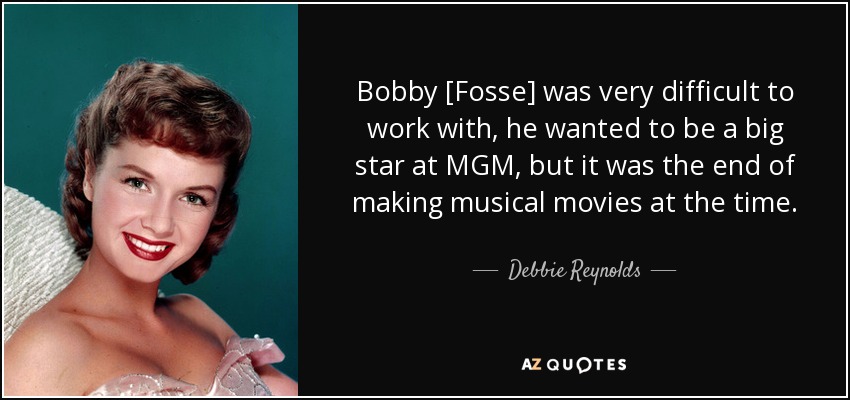
Bobby [Fosse] was very difficult to work with, he wanted to be a big star at MGM, but it was the end of making musical movies at the time.
The 1970s was probably the most exciting decade to be a teenager, from discovering Little Richard at the end of the 1960s to glam rock to punk rock to electro music. So much happened in that 10-year span. There were so many musical revolutions. Some were happening at the same time. You had disco going on behind punk. You had Michael Jackson. You had the Sex Pistols.
The only difficulty is that I'm playing to two audiences, and it's too bad the noise detracts from the show, because it's a great show. I've seen my own self out there, and it's a very good musical show. Sometimes the show gets lost in the hysteria and sometimes it doesn't.
[My mother] is much more musical, and by the time I started writing songs - by the time I was about 17 - she started to believe in me, musically.
What is usually called 'intelligence' refers to the linguistic and logical capacities that are valued in certain kinds of school and for certain school-like tasks. It leaves little if any room for spatial intelligence, personal intelligences, musical intelligence, etc.
When I was writing, I wanted every word to be not only deliberate, but musical. Precious.
I took the name originally as a kind of disguise because I didn't want people to know I was about to embark on a s****y musical career that would last five months. And a lot of people took funny names back then.
I grew up in the time just when cassettes were waning and CDs were growing. And so mix tapes - and not mix CDs - mix tapes were an important part of the friendship and mating rituals of New York adolescents. If you were a girl and I wanted you - to show you I like you, I would make you a 90-minute cassette wherein I would show off my tastes. I would play you a musical theater song next to a hip-hop song next to an oldie next to some pop song you maybe never heard, also subliminally telling you how much I like you with all these songs.
I think there's a huge parallel that affects my musical taste, and connections that have to do with my ethnic diversity and my musical tastes and the diversity of that. And it's interesting that, growing up on the circuit, it posed such a challenge, not only to me deciding what my identity was amongst my peers, but then on the music side, it was like trying to explain or convince people especially in the music industry that there was a place for what I was trying to do. But at the same time, I think it has a lot to do with timing and even me, like, understanding it.
Underground hip-hop is, like, one of my foundations, I would say a cornerstone of my foundation of my musical tastes.
I like to say that I had a really good musical education because it was inclusive of all styles of music and I like it like that.
I personally feel that there's a lot of music journalism that is dominated by genre, because you need a language in which to write, but actually the things that strike people about music, are very hard to write about, and its sonic connections, it's a sense of harmony that I think we all have even if we don't know how to express it - it's something musical, it's synapse connections in our brain.
My musical ambitions are not that great. I make music I like, and thankfully - for my ability to make an (fairly...) honest living - at least some others like the music too.
Once you get into the book, you've got to constantly find your - the rhythm of your prose. And it ends up being quite a musical experience either way.
What excites me about a lot of the artists I love - and I realize, well, they created their own personal world that I could enter into through their music and through their songwriting. There's people that can do it instrumentally, like Jimi Hendrix or Edge of U2 or Pete Townshend. I didn't have as unique - a purely musical signature. I was a creature of a lot of different influences.
I think a lot of actors, especially actors with a theater background, have a musical ear. A lot of actors just want to be musicians anyway, and a lot of musicians want to be actors.
All parents want to send their children to the best possible schools. But because a good school is a relative concept, a family cannot achieve its goal unless it outbids similar families for a house in a neighborhood served by such a school. Failure to do so often means having to send your kids to a school with metal detectors at the front entrance and students who score in the 20th percentile in reading and math. Most families will do everything possible to avoid having to send their kids to a school like that. But because of the logic of musical chairs, they're inevitably frustrated.
Find something you like, go into a room, close the door and read it aloud. Read it aloud. Everybody in the world who likes dance can see dance, or hear music, or see art, or admire architecture - but everybody in the world uses words who is not a recluse or mute. But the writer has to take these most common things, more common than musical notes or dance positions, a writer has to take some adverbs, and verbs and nouns and ball them up together and make them bounce.
I write a lot of children's verse and I think it delights in the language. It pleases people. It's very musical. It's very lyrical and that's certainly a very important aspect of poetry. But I think that a lot of it is verse. I write well-wrought verse.
I wish and pray there are a lot of young people with technology and way of thinking that can create a brand new kind of musical theatre.
My musical sensibilities were formed around punk rock, that quintessential dilution of an art that's both ugly and lovely at the same time.
The book works better if I know everything I can about the ending. Not just what happens, but how it happens and what the language is; not just the last sentence, but enough of the sentences surrounding that last sentence to know what the tone of voice is. I imagined it as something almost musical. Then you are writing toward something; you know the sound of your voice at the end of the story. That's how you want to sound in those final sentences: the degree that it is uplifting or not, the degree that it is melancholic or not.
Our visual and musical artists have no incentive to be educated. So what we get is a bunch of uneducated artists inspiring misinformation, miseducation and illiteracy.
I was a little worried that the familiarity would be a little weird, but I think for me everything is musical in my life. For me, timing is a rhythm.
My musical style has changed dramatically from my first album until now. That's the real developmental shift. But my clothing has pretty much stayed the same. The important thing is to be real.
Follow AzQuotes on Facebook, Twitter and Google+. Every day we present the best quotes! Improve yourself, find your inspiration, share with friends
or simply: