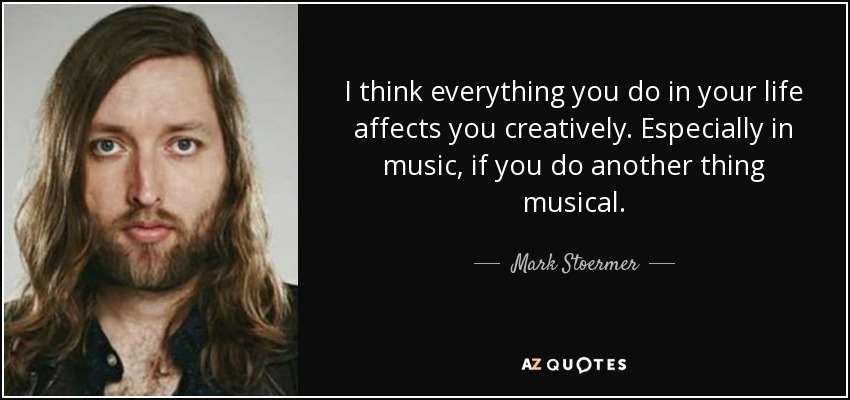
I think everything you do in your life affects you creatively. Especially in music, if you do another thing musical.
You begin to see that all of these things are connected: The kind of cuts that mean less environmental protection are also the kind of cuts that mean less musical education for the schools and that also mean more overcrowded schools.
I was lucky to get one good adaptation. Field of Dreams the Musical is lurking in the wings. Hope it will provide my daughters with a ton of money someday.
Avant-garde, jazz, pop, classical, country and western, rock, free, straight-ahead, etc. are ultimately meaningless terms in the face of the music being discussed at best - at worst, those terms often serve as code words for what is in fact a cultural / political discussion more than a musical one.
I'd shift disciplines, whether it was musical instruments or sports or whatever, and it's the same with that.
I thought about what I wanted to do besides playing violin and singing backup in a band. Don't get me wrong, playing and singing in That Dog was really fun, but I wanted to work on other musical projects and sing more. So I started a vocal project, i.e. Imaginaryland.
There are so many international musical connections here, in Amsterdam. And some of them are amazingly successful.
On Broadway and in the United States it's very different - people crossover all the time into television. I think that we'll get there [in London] in the end, but it has to start with who comes to see you in the musical and whether they can see beyond the dancing and the singing.
I'm looking for the surprises, you know, and the unexpected moments of technology, the unexpected moments of musical creation.
I don't have a community like a black community to belong to [with] a musical platform that's been built for years and years and years, or the film-making culture, and I don't have the white one to belong to.
God has provided true musical and spiritual restoration.
My musical instrument is Hebrew and, to me, this is the most important fact about my writing.
We wanted a musical number that would capture the exhilaration of being out on a boat as they were and sailing with the stars and all that. So that's the origin of We Know the Way. From very early on we said, for an audience that doesn't know this, what we need a song that can really have the kind of sweep and the, you know, pull you in. So that was early on, we conceived of like that should be a musical moment [in Maona].
I've always loved that film ['The Three Caballeros'], and we were looking for a way to apply it to our own work, and 'Trolls' was it - psychedelic, musical and kinetic insanity.
I was just in a few episodes the first season [ of Empire]. They didn't kill me, but I haven't been back in season two or three. I don't know if they have plans for me or not. But I enjoyed working on it. And I think it's a really talented group of actors and, boy, very enterprising to try and shoot those every week, you know, with musical numbers and all that stuff.
The biggest secret weapon we had in regards to really being true to this part of the world, and making sure this part of the world could see themselves in this film [Moana] in a way that felt positive and accurate, was Opetaia, my co-writer, Opetaia Foa'i, who has a great band called Te Vaka and is an amazing musical and cultural ambassador.
I want as many people to see the show [Hamilton] in its musical theater form as possible before it's translated, and whether it's a good act of translation or a bad act of translation, it's a leap, and very few stage shows manage the leap successfully.
We forget to thank the scientists that began these musical inventions and systems. The guy that invented the phonograph and gramophone - Thomas Edison!
Essentially a joke is creating an idea, whether sonic or visual, whether it's something musical or a traditional joke.
We got to be really good friends [Jack Lemmon and Walter Matthau]. It was just thrilling, every day. Every single day. I had a big couple of musical numbers in [Out to Sea], and I remember doing one of them and shooting it from beginning to end.
Of course, when you see [ musical numbers] in the movie [Out To Sea ], it's cut into a lot with other scenes, but we shot the number straight through, so here I am doing it, and sitting right in front of me in the audience was Donald O'Connor. And I was, like, "Oh, my God, I can't believe I'm performing a musical number in front of Donald O'Connor," who's one of the greats of the silver screen. But it was a thrilling experience, it really was.
In reality everybody has got musical thoughts. If you are able to overcome the part of it which is muscle training, which is what most musical playing actually is, performance actually is, is muscle training, and you are able to convert your ideas directly into music, you're a musician, too.
In some ways, comedy and something like a musical do go hand-in-hand.
I came first to America in 1977 at the invitation of a man who wanted to make my life story into a musical. But my agent said it was not to be and it was never done. So I went back, but I'd seen New York, and I wanted to live there. Because everybody talks to you in the street. See, nobody talks to you in England.
Bobby [Fosse] was very difficult to work with, he wanted to be a big star at MGM, but it was the end of making musical movies at the time.
Follow AzQuotes on Facebook, Twitter and Google+. Every day we present the best quotes! Improve yourself, find your inspiration, share with friends
or simply: