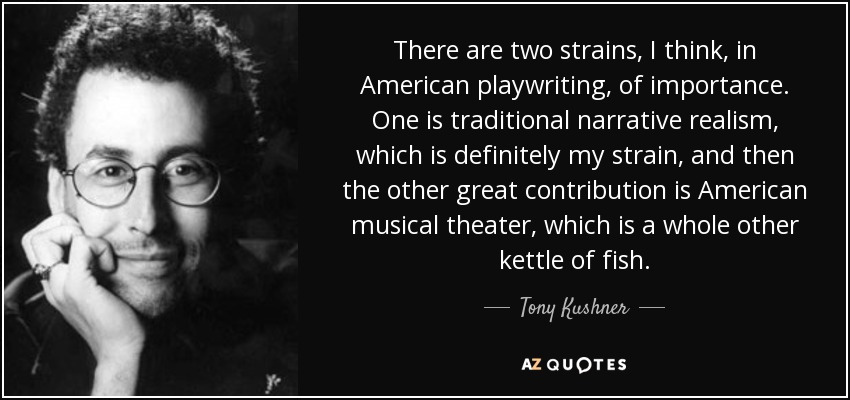
There are two strains, I think, in American playwriting, of importance. One is traditional narrative realism, which is definitely my strain, and then the other great contribution is American musical theater, which is a whole other kettle of fish.
Being on a film set is like being in tech forever. In theater, when you finally finish rehearsing, you go onstage and you do the lights and the sets and you make the machine of the production work. It takes usually about ten days in the theater, two or three weeks if it's a really big musical. I mean, it's hell on earth. You just sit around forever while they adjust the lights. And every playwright with half a brain runs for the hills when tech starts because it's so boring, and you don't want to talk to the director because the director is running this giant machine.
Barry White is my musical hero. He was the guy who you danced to in the club and then when you took your lady home to the bedroom, you listened to him there, too! That's who I always wanted to be - the guy who was always there.
I think a lot about writing and I try to read a lot. Being a musician, I don't take the words lightly; they are very, very important to me. At the same time, the words have to be musical and have to fit.
If I can quote myself, I explained whatever it is I'm doing once for No Tell Motel, and I still think it's the clearest I've ever been about this: "I don't write free verse poems - mostly because I can't. But I am interested in the musical effects achievable with free verse."
Most of us do know we have no immortality. And when you've found a genius, someone who has already purchased his immortality in musical or literary terms, it's maddening.
Commercial record has never interested me. It's amazing I was in a band like The Police that had such phenomenal commercial success. Part of what made The Police what it was was that we didn't all come in with obvious mainstream musical tastes. We were a rock band and somehow we had to make rock music, but it was informed by a lot of things outside of the mainstream for sure.
We worked very hard on that untitled record to do something different and that we were proud of and to try a bunch of different ideas. It was like this gigantic musical laboratory that we were going to every day. I love that record, I think that's one of the high watermarks of us as a band.
Michael Jackson changed the format and history of music. His videos were films. He was the first who floated on the stage and changed the concept of a musical performance. He created something that's still the basis of a lot of what's done today.
The amazing thing about the cistern is that, if you're improvising in a dead room, you play your note and then you're left with your thoughts and you have to be really quick on your feet and be able to move through many different musical thoughts seamlessly. Improvising there is just, like, you play a note and then you had at least ten seconds to think, "What would be the perfect accompanying note to that?" And then you could add that note. You can just build this puzzle that was really amazing.
In my own musical existence I don't feel that being a guitar player is like the best thing on earth to be. I would rather be a balanced musician. Playing in a group, I'm tending to think more about the music and less about the guitar. That's just me getting older. I'm not interested in being a virtuoso guitar player or anything like that.
I think any musical has so many moving parts and the challenge is unifying all the moving parts in particular because you have the camera and now it's all about adaptation and what works in one medium doesn't necessarily work in another so the challenge is to stay as true as you can to the material and yet not be afraid to step out of it and add elements to make it satisfying cinematically.
I'm very happy with the things I do. Maybe I'm just lucky I like to do so many things. I don't remember any musical job that I did only for the money. Even when I worked as a music supervisor on cruise ships I did it for romantic reasons. When I work for TV it's because I want to.
The best thing I ever bought will always be the next piece of musical equipment. I'm always interested in new techniques and there seems to be a never ending supply of great equipment to play, and to play with. My studio is a bit of a playroom.
The thing that interests me far more than anything is creating music, songwriting and arranging, and in that context drumming itself is a means to an end. I think it's really easy to forget that - I'd sooner play something musical than flash, and as I can't play anything flash, I try to be musical. Drums can set a mood, create an impression, as much as anything else.
I'm not the kind of guy who walks around with a notebook writing lyrics. For me, melody and song structure come first and foremost. Unless the melody gets stuck in my head, I'll move on. Once I have the musical idea pretty firm, I just try to write words that are incredibly honest and relate to my life on that given night. I'll sit with the music on my headphones and pen and paper all night long until it's done.
Everything has to be intrinsic plot-wise in the same way, to use the Linda Williams analogy but to move it on a bit, as musicals - in old musicals, like in an old Cole Porter musical, you get the action, then they do a song, which reflects a moment - everything stops while that is being sung - and then you restart. These days in most musicals, the plot keeps moving through the song. I think it would be nice if someone constructed some pornography where the sex continues to propel you through the story.
Another way of working is setting deliberate constraints that aren't musical ones - like saying, "Well, this piece is going to be three minutes and nineteen seconds long and it's going to have changes here, here and here, and there's going to be a convolution of events here, and there's going to be a very fast rhythm here with a very slow moving part over the top of it." Those are the sort of visual ideas that I can draw out on graph paper. I've done a lot of film music this way.
In fact, quite a lot of what I do has to do with sound texture, and, you can't notate that. You can't notate the sound of "St. Elmo's Fire." There's no way of writing that down. That's because musical notation arose at a time when sound textures were limited. If you said violins and woodwind that defined the sound texture; if I say synthesizer and guitar it means nothing - you're talking about 28,000 variables.
The society that produced The Who, The Stones, Dylan, Paul McCartney and later on people, like myself, is over. The materialistic society that produces these kinds of bombastic performances that don't have any value or musical meaning, is very conspicuous, look at me, I'm rich, dig my brand. That's what missing, Bob Dylan made us feel worthy, I try to do the same thing. Respect for the audience with music that is meaningful and soulful. Go for what moves you and not necessarily what you think will be commercial.
It's such hard work doing a musical. I did my first musical last year, performing in The Producers, and it was a big part to suddenly be doing Leo Bloom in that. It's such hard work. It's a proper slog. It became like clocking in. And it's a big factory - you go in, everyone's got their little plot, people are taking in and out of it if they have days off or holidays, and it's just a jigsaw that all works. It always amazes me that this product would happen every night and it was just all these elements coming together in a big machine.
I grew up in an extremely musical atmosphere. There was a lot of music and singing around. I never really thought about one not singing, as a person. I've always sung and made music, it was just self-understood.
Every opera, because every opera is a unique slice of a particular perspective, historical perspective and psychological perspective if not musical style, and so forth, they all present different challenges. Some can be musically very challenging, some can be psychologically more challenging. There is always something that requires a pretty specific amount of energy and attention.
I think it's silly when people try compartmentalize musical genres. That was always my problem with the chillwave thing - people were trying to make it into some kind of musical movement, when it was not a movement. A couple dudes had a couple songs for a couple months. It's going to be a disparate onslaught of people throwing ideas at the wall.
I had no inkling I was going to run into this kind of luck I experienced. It's all happened and it's all turned my life around overnight; opportunities have knocked on my door and I'm just making use of them. I don't want to do anything and everything. I want to be a brand that every time I leverage my name I want people to feel sure that it's going to be something good - so whether it be my movies, my perfume, my restaurant, my musical, it'll be good work, good food and good everything.
Follow AzQuotes on Facebook, Twitter and Google+. Every day we present the best quotes! Improve yourself, find your inspiration, share with friends
or simply: