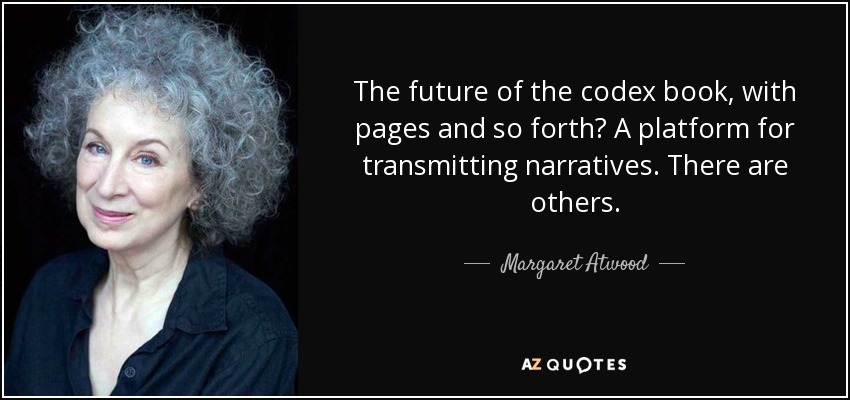
The future of the codex book, with pages and so forth? A platform for transmitting narratives. There are others.
The left hemisphere acts as an "interpreter," watching the actions and behaviors of the body and assigning a coherent narrative to these events. And the left hemisphere works this way even in normal, intact brains. Hidden programs drive actions, and the left hemisphere makes justifications. This idea of retrospective storytelling suggests that we come to know our own attitudes and emotions, at least partially, by inferring them from observations of our own behavior.
Women are presented with a very narrow aspect of the female narrative. And now we live in a culture and a time where it gets to us very quickly and very young. So how do you maintain in a child that sense of unique identity before they get thrown all that is projected on them?
I do think any modern storyteller is influenced by the stories we all grow up with and become familiar with, our shared cultural narratives.
When media "narratives" about [Pope] Francis get set in concrete, and act as filters bending or distorting (or ignoring) aspects of his vision and his teaching that don't fit the established story line, the Church has a problem.
There's an obvious investment in some media circles in the "narrative" of "the pope who's finally going to get with it."
The most enduring of the false narratives is that the signature phrase of the early pontificate - "Who am I to judge?" - was a matter of the pope jettisoning millennia of Catholic moral teaching. It was not. It was a specific response to the circumstances of a man who had repented and was trying to live an upright life.
Then [Catholics] owe [pope] the loyalty that is expressed in speaking the truth to him - and that puts a premium on knowing whether what you're happy about, on unhappy about, has a basis in fact, or is merely a reflection of the "narrative.
The Limits Of Control is not surrealism, but it is an experiment in which expectations are deliberately removed: expectations for narrative form, for action in a film, for certain emotional content. We wanted to remove those things and see if we could still make a film that was a beautiful film experience, with deliberately removing things many people would expect.
The story of the memoir is a story of me creating certain narratives so that I could live with my own experience and with the uneasy relationship between what I was doing and what I believed in - or what I saw as an uneasy relationship between those two things.
If one writes the rules then one can contradict oneself. It's all about rhetoric, about official narratives.
I was born in the era of the novel. I've written many, as well as collections of poetry, and essays for mouthing off. I've written to inches, word-counts, page-counts, even the sonnet and the screenplay (which I call a plot poem). I write narrative. That's it. I just want to tell it.
Many of our holidays revolve around traumas that happened to our people and how we must remember them in specific ways. The way these stories are told and what we take away from them can change, and do in certain contexts, but overall I am not sure whether Jews want to let go of the narrative of the victim.
It's interesting to think about the history of Israel in relation to the history of the U.S.. There were Native Americans living here that U.S. settlers totally displaced, and that narrative is not connected with the Isreal-Palestinian struggle at all.
The narrative image has more dimensions than the painted image - literature is more complex than painting. Initially, this complexity represents a disadvantage, because the reader has to concentrate much more than when they're looking at a canvas. It gives the author, on the other hand, the opportunity to feel like a creator: they can offer their readers a world in which there's room for everyone, as every reader has their own reading and vision.
In some sense that was a blessing, because it forced me to focus on prose. I feel my narrative voice in prose is more authentically me because I developed it without ever soliciting the advice of anyone else.
I view my stories as sexual or personal. Curiously, I don't. When I was writing those stories I thought of them as comedy pieces in the vein of performance monologue, such as you might get with Richard Pryor, or Lenny Bruce, or George Carlin. So I don't feel vulnerable because I know the line of demarcation between "Writer Kevin" and "Narrative Kevin."
By definition it uses and plays and delights in time. It delights in the interlacing of chronologies and the consequences of that interlacing. And those have personal and psychological expressions in a character. Aside from other issues of writing, psychological characterization is what narrative can do best.
I'm not sure any narrative model has been more important for me than Benjamin Britten's chamber operas.
The best painting is totally non-narrative. It doesn't have to tell you a story.
If we have anything to offer, as filmmakers and as TV makers now, it's this ability to feel as close to a documentary as you can get in a narrative form.
And that sort of victimization narrative is something we shouldn't contribute to. On the other hand, we have to acknowledge that there is a radical element in Islam, jihadism, that needs to be called by name and needs to be confronted.
I read slave narratives, books like Bullwhip Days, Incidents in the Life of a Slave Girl. [The Root's chairman] Henry Louis Gates has an amazing documentary called Many Rivers to Cross - really, his whole writings; he's such a wealth of knowledge.
You know, it's people's lives, so as you get a little older, your own life narrative, I guess, invades a little more. It's not like we're traveling in separate buses to each show. It's a labor of love, so we just do it because we like it. Maybe someone's gonna move, or not want to go on a tour for some reason - that could happen, I guess.
When you're in the studio, you've got a narrative for what goes on, you might switch on a bit of gear and it might not work as you intended or come out a bit wrong, and you try and exploit it.
Follow AzQuotes on Facebook, Twitter and Google+. Every day we present the best quotes! Improve yourself, find your inspiration, share with friends
or simply: