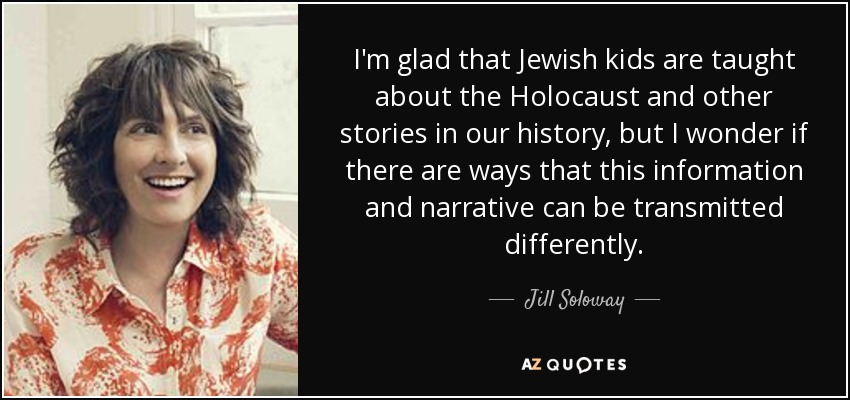
I'm glad that Jewish kids are taught about the Holocaust and other stories in our history, but I wonder if there are ways that this information and narrative can be transmitted differently.
A lot of narrative films leave you no space for anything else but eating popcorn. I want to go in the complete opposite direction. I have to evacuate all psychology, to be less a protagonist and more a presence.
And that sort of victimization narrative is something we shouldn't contribute to. On the other hand, we have to acknowledge that there is a radical element in Islam, jihadism, that needs to be called by name and needs to be confronted.
The Limits Of Control is not surrealism, but it is an experiment in which expectations are deliberately removed: expectations for narrative form, for action in a film, for certain emotional content. We wanted to remove those things and see if we could still make a film that was a beautiful film experience, with deliberately removing things many people would expect.
It's interesting to think about the history of Israel in relation to the history of the U.S.. There were Native Americans living here that U.S. settlers totally displaced, and that narrative is not connected with the Isreal-Palestinian struggle at all.
In fact, I always assumed that most everything I read was true, to one degree or another. I couldn't articulate this fact until after I read Tim O'Brien's The Things They Carried and he discussed Happening Truth, Story Truth, and Emotional Truth. I always understood that the facts of The Sun Also Rises or On the Road were the facts as dictated by a certain narrative structure, but because the experiences of those characters echoed my own feelings about the world. I knew there was a Happening Truth behind them.
I'm not the type to generalise about an entire generation. I think the most general thing I can say, is that things are way more dispersed, and way more de-centralised than they were twenty years ago. I don't really feel like people talk about my generation the way people would talk about Generation X in their early 90's when Nirvana blew up. I feel like there was an easier, more coherent narrative to find, than you can now.
I read slave narratives, books like Bullwhip Days, Incidents in the Life of a Slave Girl. [The Root's chairman] Henry Louis Gates has an amazing documentary called Many Rivers to Cross - really, his whole writings; he's such a wealth of knowledge.
The story of the memoir is a story of me creating certain narratives so that I could live with my own experience and with the uneasy relationship between what I was doing and what I believed in - or what I saw as an uneasy relationship between those two things.
If one writes the rules then one can contradict oneself. It's all about rhetoric, about official narratives.
I was born in the era of the novel. I've written many, as well as collections of poetry, and essays for mouthing off. I've written to inches, word-counts, page-counts, even the sonnet and the screenplay (which I call a plot poem). I write narrative. That's it. I just want to tell it.
Many of our holidays revolve around traumas that happened to our people and how we must remember them in specific ways. The way these stories are told and what we take away from them can change, and do in certain contexts, but overall I am not sure whether Jews want to let go of the narrative of the victim.
The narrative image has more dimensions than the painted image - literature is more complex than painting. Initially, this complexity represents a disadvantage, because the reader has to concentrate much more than when they're looking at a canvas. It gives the author, on the other hand, the opportunity to feel like a creator: they can offer their readers a world in which there's room for everyone, as every reader has their own reading and vision.
Many images of animals, mammals or birds, resurface regularly in my narratives. They are not symbols, but chromatic benchmarks. For me, music has always been the perfect construction - an inaccessible ideal.
In some sense that was a blessing, because it forced me to focus on prose. I feel my narrative voice in prose is more authentically me because I developed it without ever soliciting the advice of anyone else.
I view my stories as sexual or personal. Curiously, I don't. When I was writing those stories I thought of them as comedy pieces in the vein of performance monologue, such as you might get with Richard Pryor, or Lenny Bruce, or George Carlin. So I don't feel vulnerable because I know the line of demarcation between "Writer Kevin" and "Narrative Kevin."
By definition it uses and plays and delights in time. It delights in the interlacing of chronologies and the consequences of that interlacing. And those have personal and psychological expressions in a character. Aside from other issues of writing, psychological characterization is what narrative can do best.
I'm not sure any narrative model has been more important for me than Benjamin Britten's chamber operas.
The charade of politics is to make voters think that the personal narrative of the candidate affects the operation of the corporate state. It doesn't really matter on the fundamental issues whether the President is Republican or Democratic.
I started a production company out of necessity, the need for great narratives for actors of color.
I want to do different projects and be versatile. I don't want to get fixed into narrative comedy.
The best painting is totally non-narrative. It doesn't have to tell you a story.
If we have anything to offer, as filmmakers and as TV makers now, it's this ability to feel as close to a documentary as you can get in a narrative form.
Muslim communities are the ones that going to see radicalization happening at a mosque or hear it in the community or even among their own family members. And the other part is that there is a narrative that ISIS and other jihadists pose that this is a war between Muslims and the rest of the world.
I was also thinking about isolation on an evolutionary scale as well, like when you think of an island like Madagascar where things are free to evolve unfettered by outside powers. That starts to reach into the underlying narrative, which is more of a literal story that I used as a construct to build songs around.
Follow AzQuotes on Facebook, Twitter and Google+. Every day we present the best quotes! Improve yourself, find your inspiration, share with friends
or simply: