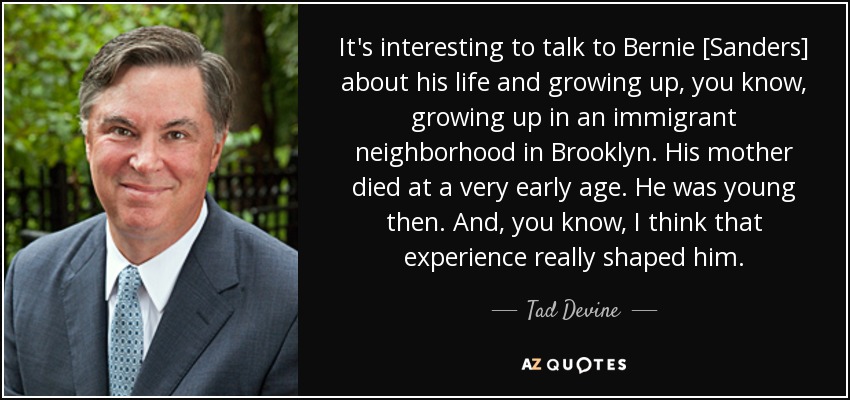
It's interesting to talk to Bernie [Sanders] about his life and growing up, you know, growing up in an immigrant neighborhood in Brooklyn. His mother died at a very early age. He was young then. And, you know, I think that experience really shaped him.
I studied with Sandy Meisner at the Neighborhood Playhouse. I was in the last class to study with him before he had his larynx removed, so I actually remember the sound of his voice. He was an incredible teacher.
But what we found in the study is that churches are ten times less diverse than the neighborhoods they sit in. So there's something more going on than just reflecting the neighborhood, yeah.
So one of the profound things we found when studying these congregations, the mixed ones, is just how much overlap and interracial ties that develop not only with the people in the congregation, but they start meeting each other's families, and their friends, and they go to each other's neighborhoods if they live in different neighborhoods, and at work they meet people they wouldn't otherwise met, and so it creates a whole new definition of what the group is.
And again, this connection that you get: I meet Joe at church. Joe's connected to a whole network of people I don't know. Joe likes me. He invites me over to his son's birthday party, and I meet his whole family. I meet his friends. I get to know his neighborhood. That happens all the time.
I think it's going to open up a wider place for a discussion about we ought to come together in our churches, in our neighborhoods, in our work places, in our clubs and our networks. I think it'll be more acceptable to talk about it. We'll see what happens. It'll take some time. But I think it will.
I'm sort of a cavedweller: I miss my house, my yard, my kitchen, my wife. The trees. When I get home, I like to get down into my office neighborhood as soon as I can.
I'm writing songs about New York. A lot of them carry the names of neighborhoods in Long Island. Maspeth, Montauk. I'm getting into the idea of a F. Scott Fitzgerald-esque Long Island back when New York was...New York.
When I was about five my dad built a stage for me in our basement. A full stage, with a curtain, a backdrop and a dressing room. There were three colored spotlights - a red one, a white one, and a blue one. Blue was for nighttime scenes, and red was for when we were in hell. If the neighborhood kids wanted to use the stage, they had to incorporate me into the play.
I used to stand in front of the mirror in my bedroom. I shared a bedroom - like a lot of people in my era, in my neighborhood - with my two brothers and an uncle. And I'd stand there in front of the mirror over the dresser and I would practice: meek young men grow up in libraries, believing it their duty to accept the views of Cicero, Bacon and Baba.
I had a friend in the neighborhood whose father had Playboy magazines, and we would go over and look at them. I remember cutting out pictures and hiding them in my room.
Gardening is a cooperative affair. I am a part of a neighborhood in which plants, dirt, rocks and a human family participate collectively in a love affair with place.
When I read, you know, a rough neighborhood of Portland, I'm like - what? - they didn't have kombucha bars there?
But, once again, when I said I'm so grateful for my mom just being adamant about me staying in public school - that is what allowed me to be exposed to so many different types of people. I went to a high school that was by the beach. I elected to do bussing my junior high school years. And my first year of high school, I would take the bus from my neighborhood to the beach schools. And at those schools, you had such a mix of so many types of kids.
At age 12 I had an obsession with Kubrick's A Clockwork Orange and then proceeded to watch all the other Kubrick films I could including a doc called Stanley Kubrick: A Life in Pictures in which it was revealed to me that he started as a photographer...I got a camera sometime shortly after, but spent many years just photographing flowers in my neighborhood.
I do think that we have to be careful not to assume that getting a perm or wearing a blonde wig is a desire for whiteness. It may or may not be. Listen, I live in a poor black neighborhood where women wear blue hair, green hair, and all kinds of stuff. So, I simply see it as a different set of choices.
The images that people see in the media of black people - whether journalistic or narrative - remain horrible. And those images, combined with the lack of respect among black people in the poorer neighborhoods for themselves, and the part the police and other people coming into those neighborhoods play, it creates no value for life.
We see God all the time here. People only hear bad things about our neighborhood. Kensington is known as the badlands. I always say you have to be careful when you call a place the badlands because that is exactly what they said about Nazareth. Nothing good can come from there. I think we see God in the margins.
The problem is that the Chicken-Soup-for-the-Soul stuff may feel good, but none of that typical stuff helps when somebody in your neighborhood is murdered.
It was absolutely killing me that I've spent the first 25 years of my life tryin' to avoid bullets. That was always the main concern. Don't go out late. Don't go to any shady neighborhoods. Don't hang in bars alone. Why? Because you wanna avoid bullets. So once I get to 35 then I was like "Woo, okay. Made it." And now there's a new warning. Now it's like strokes; I gotta watch my health.
Hybart is a little community I grew up in, so it was just a wonderful time in those years. I was the youngest of about nine boys in the neighborhood and we played ball all the time, and I looked up to them and they let me play around with them, and we just had a good time.
When you have a candidate like Donald Trump saying that Mexicans are rapists and drug dealers, and also doubling down and suggesting that we should deport 11 million undocumented workers, who are mostly people that came to this country to better themselves, and to patrol neighborhoods of predominantly Muslims families. This shows you how deeply held those feelings really are in our country and that the Republicans have absolutely no interest in helping minorities.
I was born the day before the March on Washington. I grew up in Brooklyn, New York. Everybody in my neighborhood was a Democrat. We just didn't have any Republicans, because anyone running as a Republican was very out of touch with what our community needed.
There are certain neighborhoods in America like that - like in Pittsburgh, where I'm from - where people wouldn't think it's even livable for human beings. Those are the areas that I connect with because I come from places like that, and I just think it's interesting how the rest of the world acts like it doesn't exist. But a lot of the best things come from there.
I am happy to have success in the entertainment biz, but the root of my happiness comes from my neighborhood, NYC.
Follow AzQuotes on Facebook, Twitter and Google+. Every day we present the best quotes! Improve yourself, find your inspiration, share with friends
or simply: