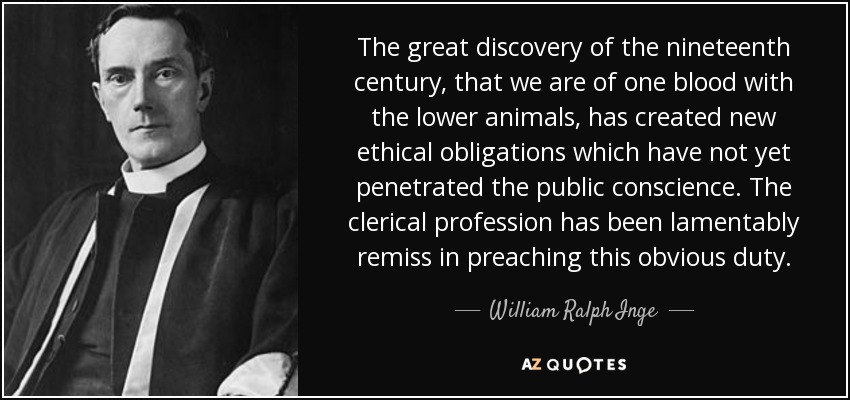
The great discovery of the nineteenth century, that we are of one blood with the lower animals, has created new ethical obligations which have not yet penetrated the public conscience. The clerical profession has been lamentably remiss in preaching this obvious duty.
It is a sobering fact that the prominence of central banks in this century has coincided with a general tendency towards more inflation, not less. [I]f the overriding objective is price stability, we did better with the nineteenth-century gold standard and passive central banks, with currency boards, or even with 'free banking.' The truly unique power of a central bank, after all, is the power to create money, and ultimately the power to create is the power to destroy.
The nineteenth century, utilitarian throughout, set up a utilitarian interpretation of the phenomenon of life which has come down to us and may still be considered as the commonplace of everyday thinking. ... An innate blindness seems to have closed the eyes of this epoch to all but those facts which show life as a phenomenon of utility
It seems to be saying perpetually; 'I am the end of the nineteenth century; I am glad they built me of iron; let me rust.' ... It is like a passing fool in a crowd of the University, a buffoon in the hall; for all the things in Paris has made, it alone has neither wits nor soul.
Born Losers is a beautiful piece of writing. Scott Sandage is history's Dickens; his bleak house, the late nineteenth century world of almost anonymous American men who failed. With wit and sympathy, Sandage illuminates the grey world of credit evaluation, a little studied smothering arm of capitalism. This is history as it should be, a work of art exploring the social cost of our past.
The greatest measure of the nineteenth century was passed by corruption, aided and abetted by the purest man in America.
You have as much computing power in your iPhone as was available at the time of the Apollo missions. But what is it being used for? It’s being used to throw angry birds at pigs; it’s being used to send pictures of your cat to people halfway around the world; it’s being used to check in as the virtual mayor of a virtual nowhere while you’re riding a subway from the nineteenth century.
Bismarck's genius, as well as his great flaw, was the same as that of another outstanding nineteenth-century politician of the German-speaking world, Prince Clemens Metternich. Both men were artificers, able to hold off the future by building a fragile present out of pieces of the past.
The hope for the twentieth century rests on recognition that war and depression are man-made, and needless. They can be avoided in the future by turning from the nineteenth-century characteristics just mentioned (materialism, selfishness, false values, hypocrisy, and secret vices) and going back to other characteristics that our Western Society has always regarded as virtues: generosity, compassion, cooperation, rationality, and foresight, and finding a increased role in human life for love, spirituality, charity, and self discipline.
When the rate of return on capital exceeds the rate of growth of output and income, as it did in the nineteenth century and seems quite likely to do again in the twenty-first, capitalism automatically generates arbitrary and unsustainable inequalities that radically undermine the meritocratic values on which democratic societies are based.
It seems to me that the novel is very much alive as a form. Without any question, every epoch has its own forms, and the novel nowadays cannot resemble that of the nineteenth century. In this domain all experiments are justified, and it is better to write something new clumsily than to repeat the old brilliantly. In the nineteenth century, novels dealt with the fate of a person or of a family; this was linked to life in that period. In our time the destinies of people are interwoven. Whether man recognizes it or not, his fate is much more linked to that of many other people than it used to be.
Since the last decades of the nineteenth century, revolt against the objectified world has determined the character of art and literature.
Problems in human engineering will receive during the coming years the same genius and attention which the nineteenth century gave to the more material forms of engineering. We have laid good foundations for industrial prosperity, now we want to assure the happiness and growth of the workers through vocational education, vocational guidance, and wisely managed employment departments. A great field for industrial experimentation and statemanship is opening up.
The creative person wants to be a know-it-all. He wants to know about all kinds of things-ancient history, nineteenth century mathematics, current manufacturing techniques, hog futures. Because he never knows when these ideas might come together to form a new idea. It may happen six minutes later, or six months, or six years. But he has faith that it will happen.
In his wretched life of less than twenty-seven years Abel accomplished so much of the highest order that one of the leading mathematicians of the Nineteenth Century could say without exaggeration, "Abel has left mathematicians enough to keep them busy for five hundred years." Asked how he had done all this in the six or seven years of his working life, Abel replied, "By studying the masters, not the pupils."
The golden age of equal rights in Spain was a myth, and belief in it was a result, more than a cause, of Jewish sympathy for Islam. The myth was invented by Jews in nineteenth-century Europe as a reproach to Christians.
We had learned how to invent things, and the question of why we invent things receded in importance. The idea that if something could be done it should be done was born in the nineteenth century. And along with it, there developed a profound belief in all the principles through which invention succeeds: objectivity, efficiency, expertise, standardization, measurement, and progress. It also came to be believed that the engine of technological progress worked most efficiently when people are conceived of not as children of God or even as citizens but as consumers-that is to say, as markets.
Darwin's theory of evolution is the last of the great nineteenth-century mystery religions. And as we speak it is now following Freudians and Marxism into the Nether regions, and I'm quite sure that Freud, Marx and Darwin are commiserating one with the other in the dark dungeon where discarded gods gather.
We forget that the nineteenth century often turned work into sport. We, in contrast, often turn sport into work.
Throughout the first half of the nineteenth century, the (Rothschild) brothers conducted important transactions on behalf of the governments of England, France, Prussia, Austria, Belgium, Spain, Naples, Portugal, Brazil, various German states and smaller countries. They were the personal bankers of many of the crowned heads of Europe. They made large investments, through agents, in markets as distant as the United States, India, Cuba and Australia.
Difficult for actors to extemporise in nineteenth-century English. Except for Robert Hardy and Elizabeth Spriggs, who speak that way anyway.
Absolutely delightful, at first for its unspoiled picture of late-nineteenth-century Japan as seen through the eyes of three remarkable but very different Americans, [the missionary William Elliot Griffis [1843-1928], the scientist Edward Sylvester Morse [1838-1925], and the writer Lafcadio Hearn], and then for the marvelous reconstruction of how Japan worked on their minds, radically changing their perceptions of the country and the whole relationship between East and West--between the barbarian and the civilized. The book is a tour de force.
The Marxist doctrine is omnipotent because it is true. It is comprehensive and harmonious, and provides men with an integral world outlook irreconcilable with any form of superstition, reaction, or defence of bourgeois oppression. It is the legitimate successor to the best that man produced in the nineteenth century, as represented by German philosophy, English political economy and French socialism.
It's easy to see golf not as a game at all but as some whey-faced, nineteenth-century Presbyterian minister's fever dream of exorcism achieved through ritual and self-mortification.
I cannot sufficiently celebrate the glorious liberty that reigns in the public libraries of the twentieth century as compared with the intolerable management of those of the nineteenth century, in which the books were jealously railed away from the people, and obtainable only at an expenditure of time and red tape calculated to discourage any ordinary taste for literature.
Follow AzQuotes on Facebook, Twitter and Google+. Every day we present the best quotes! Improve yourself, find your inspiration, share with friends
or simply: