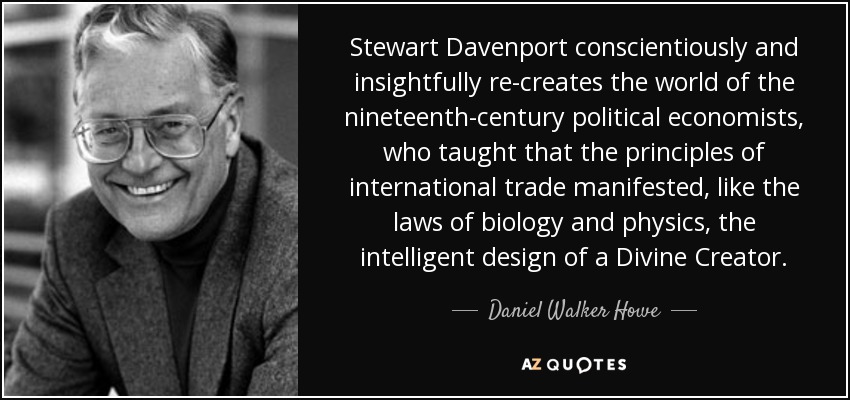
Stewart Davenport conscientiously and insightfully re-creates the world of the nineteenth-century political economists, who taught that the principles of international trade manifested, like the laws of biology and physics, the intelligent design of a Divine Creator.
Monarchs not only fashion their age, but are fashioned by it, so that they can become a sort of personification of the age. If Elizabeth I, independent, strong, represents the age of Shakespeare's heroines, a woman's heyday, Victoria represents another image of womanhood, predominant in the nineteenth century: a woman who, although queen in her own right, leaned on her husband, looked up to him, and went into perpetual mourning after his death. The feminist movement filled her with shocked horror and outrage.
Posterity--the forlorn child of nineteenth century optimism--grows ever harder to conceive.
Just as the French of the nineteenth century invested their surplus capital in a railway-system in the belief that they would makemoney by it in this life, in the thirteenth they trusted their money to the Queen of Heaven because of their belief in her power to repay it with interest in the life to come.
You have read and heard that communist theory-the science of communism created in the main by Marx, this doctrine of Marxism-has ceased to be the work of a single socialist of the nineteenth century, even though he was a genius, and that it has become the doctrine of millions and tens of millions of proletarians all over the world, who are applying it in their struggle against capitalism.
We must succumb to the general influence of the times. No man can be of the tenth century, if he would; be must be a man of the nineteenth century.
In the middle years of the nineteenth century there first became abundant in this strange world of ours a class of men, men tending for the most part to become elderly, who are called, and who are very properly called, but who dislike extremely to be called--"Scientists.
The social problem of the twentieth century is whether civilized nations can restore themselves to sanity after their nineteenth-century aberrations of individualism and capitalism.
I never meant to marry. In my opinion, a woman born in the last half of the nineteenth century of the Christian era suffered from enough disadvantages without willfully embracing another.
In the early nineteenth century, the doctrine of self-sufficiency came to apply to families as well as individuals.... The familybecame a special protected place, the repository of tender, pure, and generous feelings (embodied by the mother) and a bulwark and bastion against the raw, competitive, aggressive, and selfish world of commerce (embodied by the father).... In performing this protective task, the good family was to be as self-sufficient as the good man.
American family life has never been particularly idyllic. In the nineteenth century, nearly a quarter of all children experienced the death of one of their parents.... Not until the sixties did the chief cause of separation of parents shift from death to divorce.
The nineteenth century was the last moment in history when a relatively educated layperson could follow what was going on in the world of science and invention to a wide degree. Also, there were no "professionals". This was a time when amateur explorers, naturalists and enthusiasts were are still making major contributions to progress.
Up until the middle of the nineteenth century, men of science were all believers. Most of the great early English naturalists were also ministers; they were the only ones who had education and leisure for such pursuits. Darwin himself almost became a minister. God's power was always thought to be most easily and obviously revealed in the majestic works of nature.
In the name of economy a thousand wasteful devices would be invented; and in the name of efficiency new forms of mechanical time-wasting would be devised: both processes gained speed through the nineteenth century and have come close to the limit of extravagant futility in our own time. But labor-saving devices could only achieve their end-that of freeing mankind for higher functions-if the standard of living remained stable. The dogma of increasing wants nullified every real economy and set the community in a collective squirrel-cage.
If anything qualifies as an irony of history it would be this: that Marx and Engels throughout the nineteenth century wrote about America the United States as the great country of the future, of freedom and equality and a good life for the working man, and a country of revolution and emancipation, and of Russia as the great country of despotism, backwardness, savagery and superstition.
The nineteenth-century way of looking at the photograph was as a mirror for the memory, and at that time the photographs almost looked like mirrors, with their polished metallic surfaces.
Photography mirrored the [nineteenth century] will towards rigor, towards defining details, the need for miniscule description, the long-distance optics, for technology at the service of truth, for concepts of credibility, of objectivity, the need to archive, for the consolidation of institutions like the museum, in short, towards a need to control memory.
In the nineteenth century, government agencies in Washington had, almost without exception, flatly refused to hire even one female.
Nevertheless, what was made in the hope of transforming the world need not be rejected because it failed to do so – otherwise, one would also have to throw out a good deal of the greatest painting and poetry of the nineteenth century. An objective political failure can still work as a model of intellectual affirmation or dissent.
The financial history of the Baltimore and Ohio since the close of the nineteenth century is interesting chiefly in connection with changes in the control of the property
Only the bad artists of the nineteenth century were frightened by the invention of photography; the good ones all welcomed it and used it.
Only the bad artists of the nineteenth century were frightened by the invention of photography; the good ones all welcomed it and used it. Degas liked it not only because it provided an accurate record, but because the snapshot showed him a means of escape from the classical rules of design. Through it he learnt to make a composition without the use of formal symmetry.
We must face the fact that we are on the brink of times when man may be able to magnify his intellectual and inventive capability, just as in the nineteenth century he used machines to magnify his physical capacity. Again, as then, our innocence is lost. And again, of course, the innocence, once lost, cannot be regained. The loss demands attention, not denial.
There was this enormous burst of sculptural creative juice in the nineteenth century, and all that stuff is just so decorative. Even in pieces cast from a mold, you get a more sensuous, handmade, individual sense from it.
If we live in the Nineteenth Century, why should we not enjoy the advantages which the Nineteenth Century offers? Why should our life be in any respect provincial?
Follow AzQuotes on Facebook, Twitter and Google+. Every day we present the best quotes! Improve yourself, find your inspiration, share with friends
or simply: