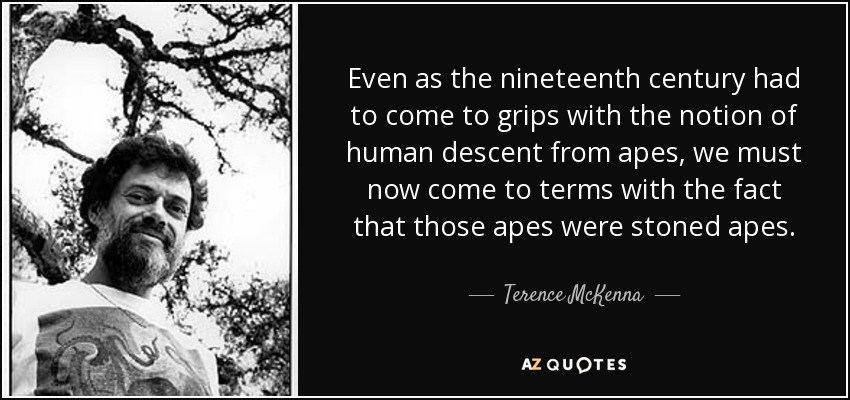
Even as the nineteenth century had to come to grips with the notion of human descent from apes, we must now come to terms with the fact that those apes were stoned apes.
In the great debates of early-nineteenth century geology, catastrophists followed the stereotypical method of objective science-empirical literalism. They believed what they saw, interpolated nothing, and read the record of the rocks directly.
Given that the nineteenth century was the century of Socialism, of Liberalism, and of Democracy, it does not necessarily follow that the twentieth century must also be a century of Socialism, Liberalism and Democracy: political doctrines pass, but humanity remains, and it may rather be expected that this will be a century of authority ... a century of Fascism. For if the nineteenth century was a century of individualism it may be expected that this will be the century of collectivism and hence the century of the State.
The plain fact is that there are no conclusions. If we must state a conclusion, it would be that many of the former conclusions of the nineteenth-century science on philosophical questions are once again in the melting-pot.
If war can indeed be turned into a relic, then the virtue of greed will recede further. From a given society's standpoint, one big upside of wanton material acquisition has traditionally been the way it drives technological progress-which, after all, helps keep societies strong. In the nineteenth century, Russia ans Germany had little choice about modernizing; in those days stasis invited conquest. But if societies no longer face conquest, breakneck technological advance is an offer they can refuse, and frugality a luxury people can afford.
History, when rightly written, is but a record of providence; and he who would read history rightly, must read it with his eyes constantly fixed on the hand of God. This statement of a nineteenth-century historian sums up the responsibility of the Christian teacher of history, for he who would teach history or any subject matter rightly, must teach it with his eyes constantly fixed on the hand of God.
What if criticism is a science as well as an art? Not a pure or exact science, of course, but these phrases belong to a nineteenth-century cosmology which is no longer with us.
Alexander von Humboldt’s wide-ranging Views of Nature is a masterpiece of nineteenth-century natural history, at once science and art. Mark W. Person’s stunning new translation makes the wonders of this classic accessible to the English-language world of the present.
Peter Kropotkin...was recognized by friend and foe as one of the greatest minds...of the nineteenth century...The lucidity and brilliance of his mind combined with his warm-heartednes s into the harmonious whole of a fascinating and gracious personality.
Humphry Repton, the leading garden theorist of the nineteenth century, defined a garden as 'a piece of ground fenced off from cattle, and appropriated to the use and pleasure or man: it is, or ought to be, cultivated and enriched by art'.
Here was St. Augustine, the oldest city in the United States. How to build a hotel to meet the requirements of nineteenth century America and have it in keeping with the character of the place ? that was my hardest problem.
The degeneration of the revolution in Russia does not pass from the revolution for communism to the revolution for a developed kind of capitalism, but to a pure capitalist revolution. It runs in parallel with world-wide capitalist domination which, by successive steps, eliminates old feudal and Asiatic forms in various zones. While the historical situation in the seventeenth, eighteenth and nineteenth centuries caused the capitalist revolution to take liberal forms, in the twentieth century it must have totalitarian and bureaucratic ones.
France placed the state above society , democracy above constitutionalism, and equality above liberty. As a result, for much of the nineteenth century it was democratic, with broad suffrage and elections, but hardly liberal. it was certainly a less secure home for individual freedom than was England or America.
The nineteenth-century wave of feminism was started by older women who had been through the radicalizing experience of getting married and becoming the legal chattel of their husbands (or the equally radicalizing experience of not getting married and being treated as spinsters).
Percussion music is revolution. Sound and rhythm have too long been submissive to the restrictions of nineteenth century music. Today we are fighting for their emancipation. Tomorrow, with electronic music in our ears, we will hear freedom. At the present stage of revolution, a healthy lawlessness is warranted. Experiment must necessarily be carried on by hitting anything-tin pans, rice bowls, iron pipes-anything we can lay our hands on. Not only hitting, but rubbing, scraping, making sound in every possible way...What we can't do ourselves will be done by machines which we will invent.
A day will come when the European god of the nineteenth century will be classed with the gods of Olympus and the Nile.
The situation of the factory worker today is reminiscent in certain respects of that of the nineteenth-century capitalist whose wife dragged him reluctantly toward "culture" and away from his "materialistic" preoccupations.
And now I am eking out my days in my corner, taunting myself with the bitter and entirely useless consolations that an intelligent man cannot seriously become anything; that only a fool can become something. Yes, sir, an intelligent nineteenth-century man must be, is morally bound to be, an essentially characterless creature; and a man of character, a man of action - an essentially limited creature. This is my conviction at the age of forty. I am forty now, and forty years - why, it is all of a lifetime, it is the deepest of old age. Living past forty is indecent, vulgar, immoral!
All religions worthy of the name are now making great efforts to purify their doctrines and return to their original standpoint, all except Christianity! You surely know that the nineteenth century Christianity is not the religion taught by Christ. Christ's religion has been changed and corrupted.
It's not the nineteenth century; I'm not meant to be judged on how good a housekeeper I am. Getting down on the floor with a lemon and a bucket of vinegar does not make me a better person.
Hyper-selectionism has been with us for a long time in various guises; for it represents the late nineteenth century's scientific version of the myth of natural harmony all is for the best in the best of all possible worlds (all structures well designed for a definite purpose in this case). It is, indeed, the vision of foolish Dr. Pangloss, so vividly satirized by Voltaire in Candide the world is not necessarily good, but it is the best we could possibly have.
The Irish were treated horribly, even here in Boston. For example, in the late nineteenth century they were treated pretty much like African Americans. You could find signs here in Boston in the restaurants saying "No dogs and Irish."
When we talk about Orientalist painting, we're talking about painting generally from the seventeenth through the nineteenth century, and some would say even into the twentieth, that allows Europe to look at Africa, Asia Minor, or East Asia in a way that's revelatory but also as a place in which you can empty yourself out. A place in which there is no place. It's an emptiness and a location at once.
There was a time, in the nineteenth century, for example, when women spoke mostly about the house, children, birth, and so forth, because it was their domain. That's changing a little, now.
Writers in the nineteenth century - people like George Eliot and Flaubert - were accustomed to addressing particular communities with which they shared not only linguistic meanings but also an experience and history. Those communities have progressively split in the twentieth century, and grown more heterogeneous, and writers emerging from minority communities have found themselves addressing audiences closer to their experience and history - a phenomenon derided by conservative white men as identity politics and multiculturalism in the arts.
Follow AzQuotes on Facebook, Twitter and Google+. Every day we present the best quotes! Improve yourself, find your inspiration, share with friends
or simply: