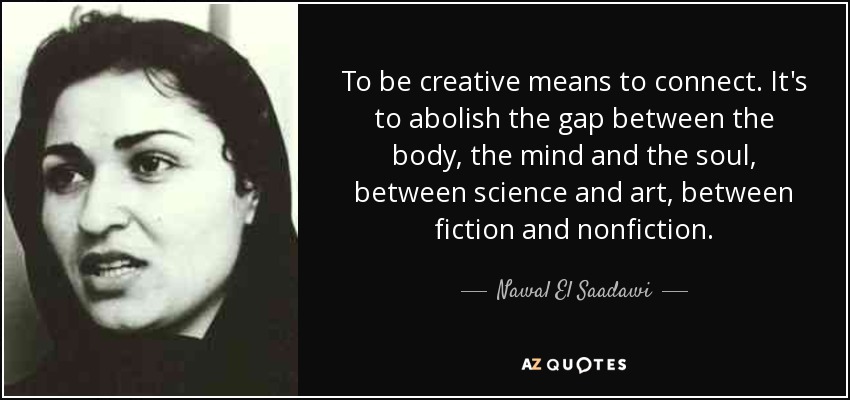
To be creative means to connect. It's to abolish the gap between the body, the mind and the soul, between science and art, between fiction and nonfiction.
I give this book 5 Stars and highly recommend it to all fiction, nonfiction, and poetry writers, aspiring writers, bloggers or journalists.
The other reason I didn't want to fictionalize it is because one of the main points of publishing a memoir in nonfiction was that I wanted to write about what had been a very lonely experience. The books that most saved my life as a kid were the ones that articulated lonely experiences that I had thought were mine alone.
I'm just too lazy. I wish I could be someone that has wild affairs - all of my favorite nonfiction novels are about these wild affairs and postmarital agonistes - but to be honest, I'm someone that doesn't deal well with instability.
A lot of attention has been paid in Latin America to the new generation of nonfiction writers, authors like Julio Villanueva Chang, Diego Osorno, Cristóbal Peña, Gabriela Wiener, Leila Guerriero, Cristian Alarcón, among others. These are writers doing important, groundbreaking work. So the talent is there, as is the habit of radio listenership, and what we propose to do is unite the two. We want to have these immensely gifted journalists - men and women who've already revitalized the long-form narrative - we want them to tell their stories in sound.
I'm drawn to fiction that hints at nonfiction, that blurs or seems to blur the boundaries between invention and autobiography.
I'm not a poet, but I was in the poetry program. And I'm also not much of a nonfiction writer, at least not in the standard sense of nonfiction, nor especially in the way we were thinking about nonfiction back then, in the late 90s.
As a student at the time, I kind of felt like my only options as a nonfiction writer were to either jump on the personal essay bus or linger back at the station, hoping that some other heretofore unknown mode of transportation was going to magically show up to take me where I wanted to go.
I write funny nonfiction adventure books about crazy, serious worlds.
If you write nonfiction, a historical account of what really happened, first of all, it's always White men who do that and you don't have the voices that are really interesting to me, of the people who are not sheltered by the big umbrella of the establishment.
I feel better off doing what I know how to do. I feel a strong element of fictional style in travel writing anyway. Some call it creative nonfiction.
I think I can safely call 2012 average. Overall, it was a stronger year for nonfiction than fiction - a situation that would've surprised me back in January, when I was looking forward to big new novels from several authors I really love.
I like European and South American literature, but mostly I read nonfiction.
I'm all about nonfiction. I rarely read fiction. I like to read about things that really happened, facts, real life situations. That's what inspires me.
When I wrote nonfiction, my best work was the really personal stuff.
Nonfiction is easy and fiction is hard.
The hardest piece of nonfiction I ever wrote isn't anywhere close to the easiest piece of fiction I never wrote.
Blogging has helped create an expanded awareness of the creative nonfiction genre, generally. But I suspect many bloggers continue to be unaware that they are (or have the potential to be) "literary" or "artful."
Maybe I have a one-track mind, but the best writers and thinkers are focusing on nonfiction these days; this is the genre where a writer can make a mark and change an aspect of the world - much more so than in fiction.
And there are two types of stories. One type is one's own story. The other type is telling the stories of others. Thanks to this genre, writers of nonfiction can now use the tools of the reporter, the points of view and ear for dialog of a novelist, and the passion and wordplay of the poet.
Nonfiction, for the most part, is facts, and it's "how I was mistreated. I was mistreated. Were you mistreated? Weren't we all mistreated?"
I always want to read Gore Vidal's nonfiction. Because everything he writes is an essay and it's worth reading.
If you can propose a memoir, even if you are eighteen years old - and what do you remember? What are you memeing? If you can propose a memoir, I believe someone will pay you to write it. And you will get a contract for nonfiction. And if it is about victimology in one way or another than you'll get more money. It's a sensation.
It's essential for me to be working on a nonfiction sort of research project simultaneous with multiple projects that are in different realms of art practice or not.
I love telling stories, I love for someone to see something, and go, "Oh, wow, I've never thought of it that way." Because I've had those moments in my life, where I go, "Oh, my God, I've never looked or approached this topic and had that insight or had that idea come to mind," to where it changes your life, it changes the way you see certain things. I love that. I think that's such a cool thing that we get to do by sharing stories, whether they're fiction or nonfiction.
Follow AzQuotes on Facebook, Twitter and Google+. Every day we present the best quotes! Improve yourself, find your inspiration, share with friends
or simply: