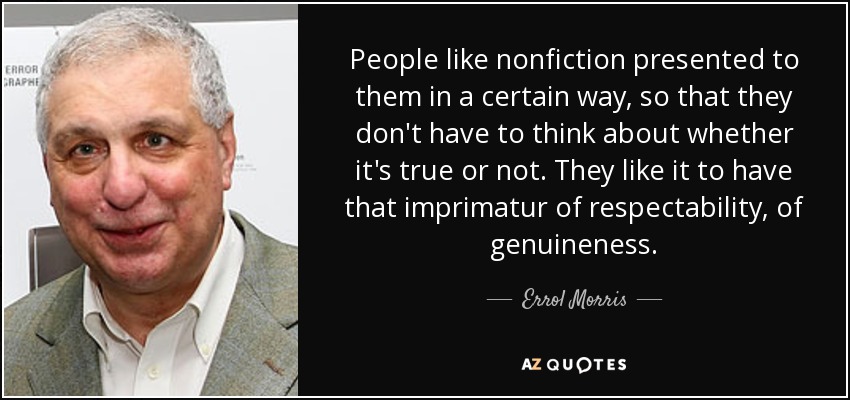
People like nonfiction presented to them in a certain way, so that they don't have to think about whether it's true or not. They like it to have that imprimatur of respectability, of genuineness.
The act of writing should not be accompanied by the sense of an audience, someone peering over your shoulder, but in nonfiction I think it’s almost imperative that you identify an audience so you can confirm or challenge or undermine whatever ideas or prejudices they might have about your subject.
I don't like to read nonfiction. To me, fact is something I can look up.
Nonfiction, qua label, is nothing more or less than a very flexible (easily breakable) frame that allows you to pull the thing away from narrative and toward contemplation, which is all I've ever wanted.
It's very bad to write a novel by act of will. I can do a book of nonfiction work that way - just sign the contract and do the book because, provided the topic has some meaning for me, I know I can do it. But a novel is different. A novel is more like falling in love. You don't say, 'I'm going to fall in love next Tuesday, I'm going to begin my novel.' The novel has to come to you. It has to feel just like love.
People and places are the twin pillars on which most nonfiction is built. Every human event happens somewhere, and the reader wants to know what that somewhere was like.
Nonfiction brought me back to earth and sobered me up whenever it seemed like I'd become too drunk on the lives and loves of imaginary people, but that doesn't mean it was any less thrilling or transporting, although it was often more illuminating.
When people ask what kind of nonfiction I write, I say 'all kinds,' but really I mean I don’t write any kind at all: I’m trying to dissolve the borders between memoir and journalism and criticism by weaving them together.
Though I consider The Chronology of Water to be an anti-memoir for very precise reasons, it is an art form, and thus as open to "critique" as any other art form. Memoir has a form, formal strategies, issues of composition and craft, style, structure, all the elements of fiction or nonfiction or painting or music or what have you.
The funny thing is that in Bosnia there are no words that are equivalent to fiction and nonfiction. From the storytelling point of view, the difference is artificial.
For me, a memoir is nonfiction and nonfiction has to be absolutely true.
I need to tell the things that are important but which don't make sense in terms of the narrative, things that would destroy symmetry or narrative pace. This is my personal belief about what it means to write nonfiction.
People seem to want to read more nonfiction than fiction.
Sometimes it bursts from your imagination fully formed, sometimes you absorb from nonfiction, sometimes you're able to imprint your own autobiographical experiences on a world you never yourself were a part of. A decent number of the one-liners in the title story originally came up in conversations with my girlfriend or my neighbor.
When I was in college I started writing prose, because a very smart professor asked me what I like to read and I said, "Novels," and she said, "You should be writing them then." Memoir never even occurred to me. I think I was afraid of nonfiction and I was afraid of navel-gazing, and of being seen.
Back in the day, a lot of our instructors in nonfiction were actually fiction scholars. So they would bring in stories as models for the essay. And in some ways that's a good idea, because we can all learn from other genres. But I think it also made me realize that I literally didn't have an essay model, and that if I wanted one I would have to find it.
Prose gets divided up into fiction and nonfiction and short fiction and long fiction and autobiographical nonfiction and so on. Poetry can do any of those things except with the added definition of intensified formal pressure.
Fiction stymies me with its possibility. I can't see the bottom and I freeze, cling to the side, or just choke. In nonfiction, particularly that which takes personal narrative for its primary topic, I have a finite space and a finite amount of material. I can't fabricate material, I can only shape and burrow into it.
If you're writing a book where you want to make a positive truth claim, then you should absolutely call it nonfiction or memoir. If you don't want to make that claim - if that's not what's important to you; if you're more interested in storytelling and interiority and interpersonal relationships than in objective, checkable facts about the world - then why wouldn't you call it a novel, and take advantage of what that gets you, of the extra freedom, of belonging to the tradition of the novel?
The nonfiction novel or literary memoir as authored by women is usually given a much harder time in mainstream criticism.
This is one of the ways fiction is more liberating than nonfiction - I don't have to be so concerned with fact. I had the paradigm of certain people in my head who became my characters, but I never considered these people to be from a "certain sector of society," unless we agree that we're all from certain sectors of society.
Every time I get through the work on a book of nonfiction, I say I'll never do it again; it takes so much out of you.
It's hard to do fiction and nonfiction simultaneously.
Nonfiction requires enormous discipline. You construct the terms of your story, and then you stick to them.
All nonfiction writers, whether they like it or not, are translators. The translator is the perfect journalist. The best journalism endeavors to convey an essential idea or story to an audience that knows very little about it, and that requires translation. To do this successfully, the writer must filter the idea through the prism of his eye, and his mind, and his writing style.
Follow AzQuotes on Facebook, Twitter and Google+. Every day we present the best quotes! Improve yourself, find your inspiration, share with friends
or simply: