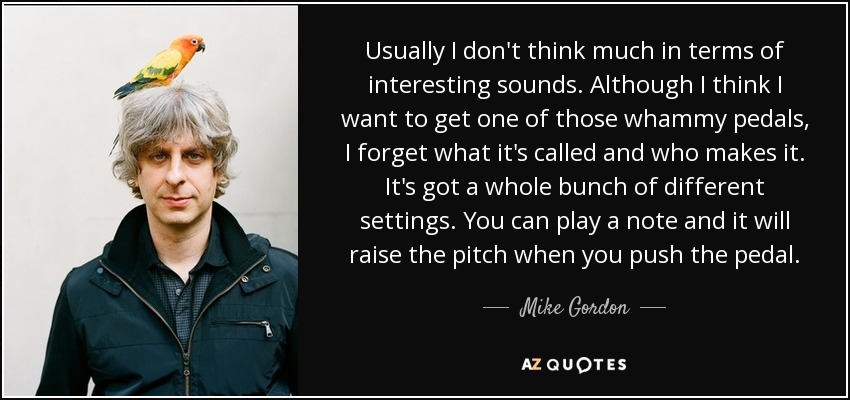
Usually I don't think much in terms of interesting sounds. Although I think I want to get one of those whammy pedals, I forget what it's called and who makes it. It's got a whole bunch of different settings. You can play a note and it will raise the pitch when you push the pedal.
In Braille you write your flat sign first and then your note.
I'm not quite sure. Probably because "Hanky Panky" and "I Think We're Alone Now" had more to do with it than anything else. For some reason, staccato eighth notes on a bass sounded like bubblegum. Basically, groups like the 1910 Fruitgum Co. took my early format and kind of perverted it, and made these mindless pre-fab hits over and over. In the 60s, anybody who was making commercial music, that is music that didn't have a political slant to it, or wasn't taking drugs, was bubblegum. And that term kind of hung on a lot of people back then, and it's unfortunate.
We spent a long time learning the craft of songwriting, Roger Glover and I, for a few years before we joined Deep Purple. You learn about the percussive value of words, and you learn about rhyme and meter. You learn that you can't transform a poem into a song lyric, mostly because the spoken shape of words is different than the sung shape of words. You wouldn't use the vowel 'U' or the vowel sound 'ooo' for a high note for example, its very difficult.
I note that warmists are often banging on about the fact that sceptics like Christopher Booker and myself 'only' have arts degrees. But actually that's our strength, not our weakness. Our intellectual training qualifies us better than any scientist - social or natural sciences - for us to understand that this is, au fond, not a scientific debate but a cultural and rhetorical one.
I think emotion is just anything that is emotional, you know, people can feel with music. Music is already so emotional, like the strings, the chords, and the notes and the melodies and stuff. And then you throw on a topic that everyone can relate to. That's gonna be real music.
The main reason for the break was a combination of travel and going back to university, which drew me into theatre more than music. I did stuff on acoustic guitar when I was traveling, filed it away and made notes, without it being musical notation. Just taped the odd thing, did a sketch, stuck it on a cassette. I thought at some point, I'll go back to it. Some of it I did use in '84-'85 when I started working in the Free Theatre in Christchurch. So it might seem like I had given up after the Pin Group, but I just went into a different avenue.
The first thing to note is that pornography and many abductions occur apart from the use of computers, and that most child abuse happens within the family. So I think the extra degree of danger that computers pose doesn't justify the frenzy.
At the end of the day, there are a hell of a lot of notes being played out there and I defy the average middle-American or the average punter to differentiate between them.
The criticism is that it's too simple, but my feeling is it's more of a challenge making someone feel an emotion in four notes than in 25 notes.
I don't write material. Funny things happen to me in the course of a day, and I just make notes.
Mozart's music is particularly difficult to perform. His admirable clarity exacts absolute cleanness: the slightest mistake in it stands out like black on white. It is music in which all the notes must be heard.
I listened to the pure crystalline notes of one of Mozart's concertos dropping at my feet like leaves from the trees.
You can see that there is scarcely an observable fact unworthy of mention in your notes, and yet you could easily spend more time scribbling than watching, and that would defeat the purpose. So be selective, don't be compulsive, and enjoy your note-taking.
'I have chosen you!' Keep that note of greatness in your creed. It is not that you have got God but that He has got you.
When I'm writing a script, before I can write dialogue or anything, I have two or three hundred pages of notes, which takes me a year. So, it's not like "what happens next." I've got things that I'm thinking about but I don't settle on them. And if I try to write dialogue before then, I can't. It's just garbage.
They would send me notes on what's going on, and we would pitch in and talk about what we wanted to talk about on the show. I just really did my homework. It was more like a real job for me. Doing this talk show was like, "Wow, this is what they do?!" I can't even imagine doing it every day.
A fragrance is a veritable story, told and explained in scent, in notes, in impressions. It's a score based on the emotions of each instant, a captivating music of the senses.
Nostalgia for people, cultures, everything. There's an ability to use these marks to note things that are erased, deleted. Traces are a species of history, of evidence. It's a way for the way the narrator to construct a semblance of self, even though all of this creates a deception, a way to think of one's traces as a real way to define oneself. The trace is fallible, impermanent. It's one of the motives I had in mind throughout the text.
I always took note of them, because I think if you're in the black or brown body, you're negotiating them all the time. It's like women taking note of sexism. It's a kind of incoherency that you are constantly negotiating.
There's such an energy created when the world is turned upside down, and when things are good again it's nice to take note. Then it goes away. Change. Change means friction. Friction happens where things aren't quite right, when everything is separating, when nothing is the same. Later you piece it back together.
"Study Bible" is the expression used for Bibles that include significant explanatory notes, usually at the bottom of the page, sometimes in the margins. Often a Study Bible will also include some brief articles, photographs of geographical and archaeological sites, fairly extensive maps, and charts that summarize a lot of information.
I've tried to write songs for other people and it usually requires them singing it and then changing the phrasing. I can put a lot of words in a song, and one of the reasons is, I'm not that good of a singer, so I don't hold a lot of notes.
Most of the EDM tracks right now are not very musical, they have one note that keeps playing. You really don't need to be a musician to do records like this, so I think me playing guitar for so many years and listening to rock 'n' roll and real music helps me when I work with vocalists like Lana Del Ray and Miley Cyrus.
I've always felt like every note of a song is of equal value.
Follow AzQuotes on Facebook, Twitter and Google+. Every day we present the best quotes! Improve yourself, find your inspiration, share with friends
or simply: