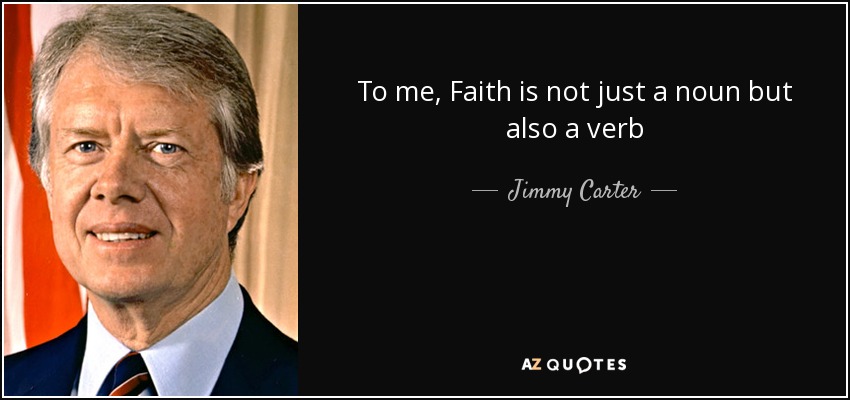
To me, Faith is not just a noun but also a verb
God isn't a noun but a process...a continual, infinitely creative outpouring of love and light onto all living things.
Mindgasm (noun) - An exhilarating neurostorm of intense intellectual pleasure. Fully revelatory understanding of a certain topic. Involuntary contractions of brain muscles usually accompanied by the overwhelming sensation of truth proximity. Visionarism. State of awe.
Love is more than a word. It's a noun and a verb.
Do you think it's possible that things that seem to be discrete in three dimensions might all be part of the same bigger object in four dimensions? ...What if humanity- that collective noun we so often employ- really is, at a higher level, a singular noun? What it what we perceive in three dimensions as seven billion individual human beings are really all just aspects of one giant being?
Growth of the soul is our goal, and there are many ways to encourage that growth, such as through love, nature, healing our wounds, forgiveness, and service. The soul grows well when giving and receiving love. I nourish my soul daily by loving others and being vulnerable to their love. Love is, after all, a verb, an action word, not a noun.
You must hear the birds song without attempting to render it into nouns and verbs.
The process of unlearning in order to relearn demands a new concept of knowledge not as thing but as a process, not as a noun but as a verb.
Virtually every beginning poet hurts himself by an addiction to adjectives. Verbs are by far the most important things for poems-especially wonderful tough monosyllables like "gasp" and "cry." Nouns are the next most important. Adjectives tend to be useless.
It's weird the way "finger puppet" sounds okay as a noun... ladies.
Ludicrous concepts…like the whole idea of a 'war on terrorism'. You can wage war against another country, or on a national group within your own country, but you can't wage war on an abstract noun. How do you know when you've won? When you've got it removed from the Oxford English Dictionary?
The word "love" is most often defined as a noun, yet al the more astute theorists of love acknowledge that we would all love better if we used it as a verb.
The adjective is the enemy of the noun. Variant: The adjective is the enemy of the substantive.
Here is God's purpose - For God, to me, it seems, is a verb not a noun, proper or improper; is the articulation not the art, objective or subjective; is loving, not the abstraction "love" commanded or entreated; is knowledge dynamic, not legislative code, not proclamation law, not academic dogma, not ecclesiastic canon. Yes, God is a verb, the most active, connoting the vast harmonic reordering of the universe from unleashed chaos of energy.
Fascist is not just an epithet. Fascist is a proper noun that means a specific thing. It`s a real thing. It`s not always referring to ancient history.
I think the best way to put it is that newspictures are the noun and the verb; our kind of photography is the adjective and adverb. The newspicture is a single frame; ours, a subject viewed in series. The newspicture is dramatic, all subject and action. Ours shows what's back of the action.
The concept of why is already in the vernacular. It is now a noun. "That company doesn't know their why." "They need to learn their why." "That politician needs to understand his why." We talk about it as a noun. That never existed prior to 2009. That never existed prior to 2006 when I first started articulating it. This is the most amazing thing to me. It has now become a concept. It's part of the way we think about businesses and transactions and decisions.
All people in the world - who are not hermits or mutes - speak words. They speak different languages, but they speak words. They say, "How are you" or "I'm not feeling well" all over the world. These common words - these common elements that we have between us - the writer has to take some verbs and nouns and pronouns and adjectives and adverbs and arrange them in a way that sound fresh.
"What is truth?" said jesting Pilate, and would not stay for an answer. Pilate was in advance of his time. For "truth" itself is an abstract noun, a camel, that is, of a logical construction, which cannot get past the eye even of a grammarian. We approach it cap and categories in hand: we ask ourselves whether Truth is a substance (the Truth, the Body of Knowledge), or a quality (something like the colour red, inhering in truths), or a relation ("correspondence"). But philosophers should take something more nearly their own size to strain at. What needs discussing rather is the use, or certain uses, of the word "true." In vino, possibly, "veritas," but in a sober symposium "verum."
I thought that Christian was a noun, a person looking for authenticity. I never understood that idea that a band could be Christian or something could be Christian. But it just can be and is.
When one crosses over from an activity, or the verb, of writing or doing, and becomes a noun, like "a writer" I think that is an act of supreme self-consciousness that I've never, in effect, made. I write, but I don't like to think of myself as a writer. I think it's somewhat self-aggrandizing and pretentious. Now, I am a teacher.
What really alarms me about President Bush's 'War on Terrorism' is the grammar. How do you wage war on an abstract noun? How is 'Terrorism' going to surrender? It's well known, in philological circles, that it's very hard for abstract nouns to surrender.
We need a name for the new replicator, a noun that conveys the idea of a unit of cultural transmission, or a unit of imitation. 'Mimeme' comes from a suitable Greek root, but I want a monosyllable that sounds a bit like 'gene'. I hope my classicist friends will forgive me if I abbreviate mimeme to meme. If it is any consolation, it could alternatively be thought of as being related to 'memory', or to the French word même. It should be pronounced to rhyme with 'cream'.
Whatever one wishes to say, there is one noun only by which to express it, one verb only to give it life, one adjective only which will describe it. One must search until one has discovered them, this noun, this verb, this adjective, and never rest content with approximations, never resort to trickery, however happy, or to vulgarism, in order to dodge the difficulty.
Whatever the thing you wish to say, there is but one word to express it, but one verb to give it movement, but one adjective to qualify it; you must seek until you find this noun, this verb, this adjective.
Follow AzQuotes on Facebook, Twitter and Google+. Every day we present the best quotes! Improve yourself, find your inspiration, share with friends
or simply: