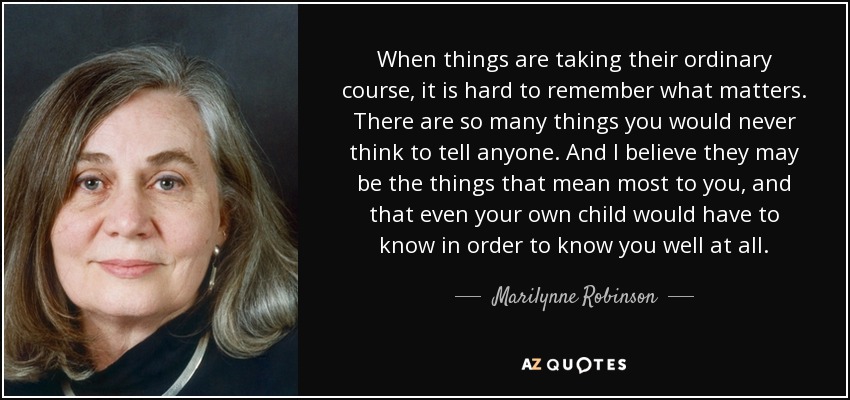
When things are taking their ordinary course, it is hard to remember what matters. There are so many things you would never think to tell anyone. And I believe they may be the things that mean most to you, and that even your own child would have to know in order to know you well at all.
When asked if I am pessimistic or optimistic about the future, my answer is always the same: If you look at the science about what is happening on earth and aren’t pessimistic, you don’t understand data. But if you meet the people who are working to restore this earth and the lives of the poor, and you aren’t optimistic, you haven’t got a pulse.
You have ordinary moments and ordinary moments and more ordinary moments, and then, suddenly, there is something monumental right there. You have past and future colliding in the present, your own personal Big Bang, and nothing will ever be the same.
There is something about wills which brings out the worst side of human nature. People who under ordinary circumstances are perfectly upright and amiable, go as curly as corkscrews and foam at the mouth, whenever they hear the words 'I devise and bequeath.
The world is a place where the extraordinary can sit just beside the ordinary with the thinnest of boundaries; that even in environments inhospitable to man, all sort of entities might thrive.
For me, running is both exercise and a metaphor. Running day after day, piling up the races, bit by bit I raise the bar, and by clearing each level I elevate myself. At least that’s why I’ve put in the effort day after day: to raise my own level. I’m no great runner, by any means. I’m at an ordinary – or perhaps more like mediocre – level. But that’s not the point. The point is whether or not I improved over yesterday. In long-distance running the only opponent you have to beat is yourself, the way you used to be.
We ordinary people might lack your great speed or your X-Ray vision, Superman, but never underestimate the power of the human mind. We carry the most dangerous weapon on Earth inside these thick skulls of ours.
I am not, in the ordinary acceptation of the term, a good-natured man; that is, many things annoy me besides what interferes with my own ease and interest. I hate a lie; a piece of injustice wounds me to the quick, though nothing but the report of it reach me. Therefore I have made many enemies and few friends; for the public know nothing of well-wishers, and keep a wary eye on those who would reform them.
You've faced horrors in these past weeks... I don't know which is worse. The terror you feel the first time you witness such things, or the numbness that comes after it starts to become ordinary.
The theater troubled her. It had a magic of its own, one that didn’t belong to her, one that wasn’t in her control. It changed the world, and said things were otherwise than they were. And it was worse than that. It was magic that didn’t belong to magical people. It was commanded by ordinary people, who didn’t know the rules. They altered the world because it sounded better.
Historic figures have homes to visit for posterity; the Lord of history left no home. Luminaries leave libraries and write their memoirs; He left one book, penned by ordinary people. Deliverers speak of winning through might and conquest; He spoke of a place in the heart.
How memories lie to us. How time coats the ordinary with gold. How it breaks the heart to go back and attempt to re-live them. How crushed we are when we discover that the gold was merely gold-plating thinly coated over lead, chalk and peeling paint.
Our duty is found in the revealed will of God in the Scriptures. Our trust must be in the sovereign will of God as He works in the ordinary circumstances of our daily lives for our good and His glory.
His [Death] voice is cold at first, John. It seems unfeeling. But if you listen without fear, you find that when he speaks, the most ordinary words become poetry. When he stands close to you, your life becomes a song, a praise. When he touches you, your smallest talents become gold; the most ordinary loves break your heart with their beauty.
The Superclass tries to promote its values. Ordinary people complain of divine injustice, they envy power, and it pains them to see others having fun. They don’t understand that no one is having fun, that everyone is worried and insecure, and that what the jewels, cars, and fat wallets conceal is a huge inferiority complex.
There is no such thing as an ordinary life.
She raised her eyes to his. They had both come from misery, she thought, and survived it. They had been drawn together through violence and tragedy, and had overcome it. They walked different paths and had found a mutual route. Some things last, she thought. Some ordinary things. Like love.
...for though she was ordinary, she possessed health, wit, courage, charm, and cheerfulness. But because she was not beautiful, no one ever seemed to notice these other qualities, which is so often the way of the world.
Satan frequently steals the will of God from us due to reasoning. The Lord may direct us to do a certain thing, but if it does not make sense - if it is not logical - we may be tempted to disregard it. What God leads a person to do does not always make logical sense to his mind. His spirit may affirm it and His mind reject it, especially if it would be out of the ordinary or unpleasant or if it would require personal sacrifice or discomfort.
Calmness of mind is one of the beautiful jewels of wisdom. It is the result of long and patient effort in self-control. Its presence is an indication of ripened experience, and of a more than ordinary knowledge of the laws and operations of thought.
"You do not really love me — you love nobody. Is that not true?" "Maybe," said Siddhartha wearily. "I am like you. You cannot love either, otherwise how could you practice love as an art? Perhaps people like us cannot love. Ordinary people can — that is their secret."
A man of ordinary talent will always be ordinary, whether he travels or not; but a man of superior talent (which I cannot deny myself to be without being impious) will go to pieces if he remains forever in the same place.
Revealingly, the central function of the Constitution as law--the supreme law--was to impose limitations not on the behavior of ordinary citizens but on the federal government. The government, and those who ran it, were not placed outside the law, but expressly targeted by it. Indeed, the Bill of Rights is little more than a description of the lines that the most powerful political officials are barred from crossing, even if they have the power to do so and even when the majority of citizens might wish them to do so.
Anyway, you can't leave her like that. You can't do that to the woman. She doesn't deserve it; nobody does. You don't belong to her and she doesn't belong to you, but you're both part of each other; if she got up and left now and walked away and you never saw each other again for the rest of your lives, and you lived an ordinary waking life for another fifty years, even so on your deathbed you would still know she was part of you.
The world was made up of people putting one foot in front of the other; and a life might appear ordinary simply because the person living it had been doing so for a long time.
Follow AzQuotes on Facebook, Twitter and Google+. Every day we present the best quotes! Improve yourself, find your inspiration, share with friends
or simply: