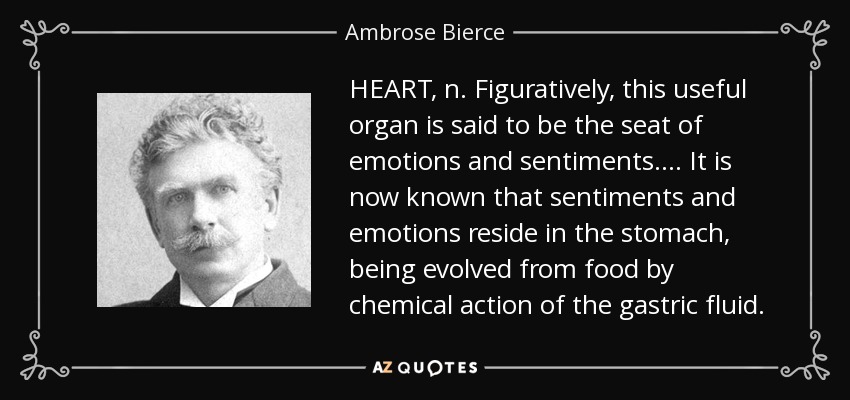
HEART, n. Figuratively, this useful organ is said to be the seat of emotions and sentiments . . . . It is now known that sentiments and emotions reside in the stomach, being evolved from food by chemical action of the gastric fluid.
A flower's fragrance declares to all the world that it is fertile, available, and desirable, its sex organs oozing with nectar. Its smell reminds us in vestigial ways of fertility, vigor, life-force, all the optimism, expectancy, and passionate bloom of youth. We inhale its ardent aroma and, no matter what our ages, we feel young and nubile in a world aflame with desire.
A broken heart is such a shabby thing, like poverty and failure and the incurable diseases which are also deforming. I hate it and am ashamed of it, and I must somehow repair this heart and put it back into its normal condition, as a tough somewhat scarred but operating organ.
It isn't the height that scares me - the height makes me feel alive with energy, every organ and vessel and muscle in my body singing at the same pitch. Then I realize what it is. It's him. Something about him makes me feel like I am about to fall. Or turn to liquid. Or burst into flames.
His absence will haunt their hallways, and he will be a space they can't fill. And then time will pass, and the hole will be gone, like when an organ is removed and the body's fluids flow into the space it leaves. Humans can't tolerate emptiness for long.
Humans are the reproductive organs of technology.
I'm going to eviscerate you and leave your organs on a pike in the yard as a warning to those who wear large jewelry.
On my license, it says I'm an organ donor, but the truth is I'd consider being an organ martyr. I'm sure I'm worth a lot more dead than alive - the sum of the parts equal more than the whole. I wonder who might wind up walking around with my liver, my lungs, even my eyeballs. I wonder what poor asshole would get stuck with whatever it is in me that passes for a heart.
Then the voices of the Ainur, like unto harps and lutes, and pipes and trumpets, and viols and organs, and like unto countless choirs singing with words, began to fashipn the theme of Iluvatar to a great music; and a sound arose of endless interchanging melodies woven in harmony that passed beyond hearing into the depths and into the heights, and the places of the dwelling of Iluvatar were filled to overflowing, and the music and the echo of the music went out into the Void, and it was not void.
The vast majority of us imagine ourselves as like literature people or math people. But the truth is that the massive processor known as the human brain is neither a literature organ or a math organ. It is both and more.
He was a clot looking for a place to happen, a splinter of bone hunting a soft organ to puncture, a lonely lunatic cell looking for a mate - they would set up housekeeping and raise themselves a cozy little malignant tumor.
Cutting out bad habits is far more effective than cutting out organs.
The word courage comes from the same stem as the French word Coeur, meaning "heart." Thus just as one's heart, by pumping blood to one's arms, legs, and brain enables all the other physical organs to function, so courage makes possible all the psychological virtues. Without courage other values wither away into mere facsimiles of virtue.
Man is the mirror God holds up to himself, the sense organ with which he apprehends his being.
There are those among us who would have us say that the mysteries of the brain are completely solved and little needs to be added to its knowledge. It is as if these fortunate persons had been present when this magnificent organ was created.
Behavior is ultimately the product of the brain, the most mysterious organ of them all.
By brain is meant, in the first instance, something more than the pink-grey jelly of the anatomist. It is, even to a scientist, the organ of imagination.
In order to understand what is meant by the word 'brain' as it is used by neuroscientists, we must bear in mind the evidence that this organ contains in some recorded form the basis of one's whole conscious life. It contains the record of all our aims and ambitions and is essential for the experience of all pleasures and pains, all loves and hates.
The linden, in the fervors of July, Hums with a louder concert. When the wind Sweeps the broad forest in its summer prime, As when some master-hand exulting sweeps The keys of some great organ, ye give forth The music of the woodland depths, a hymn Of gladness and of thanks.
Symptoms, then, are in reality nothing but a cry from suffering organs.
Organic chemistry is the study of organs; inorganic chemistry is the study of the insides of organs.
Why it is that animals, instead of developing in a simple and straightforward way, undergo in the course of their growth a series of complicated changes, during which they often acquire organs which have no function, and which, after remaining visible for a short time, disappear without leaving a trace ... To the Darwinian, the explanation of such facts is obvious. The stage when the tadpole breathes by gills is a repetition of the stage when the ancestors of the frog had not advanced in the scale of development beyond a fish.
It is probably no exaggeration to suppose that in order to improve such an organ as the eye at all, it must be improved in ten different ways at once. And the improbability of any complex organ being produced and brought to perfection in any such way is an improbability of the same kind and degree as that of producing a poem or a mathematical demonstration by throwing letters at random on a table.
O most sacred, most loving heart of Jesus, thou art concealed in the Holy Eucharist, and thou beatest for us still.... Thou art the heart of the Most High made man.... Thy Sacred Heart is the instrument and organ of Thy love. It did beat for us. It yearned for us. It ached for our salvation. It was on fire through zeal, that the glory of God might be manifested in and by us.... In worshipping thee I worship my incarnate God, my Emmanuel
One can truly say that the irresistible progress of natural science since the time of Galileo has made its first halt before the study of the higher parts of the brain, the organ of the most complicated relations of the animal to the external world. And it seems, and not without reason, that now is the really critical moment for natural science; for the brain, in its highest complexity-the human brain-which created and creates natural science, itself becomes the object of this science.
Follow AzQuotes on Facebook, Twitter and Google+. Every day we present the best quotes! Improve yourself, find your inspiration, share with friends
or simply: