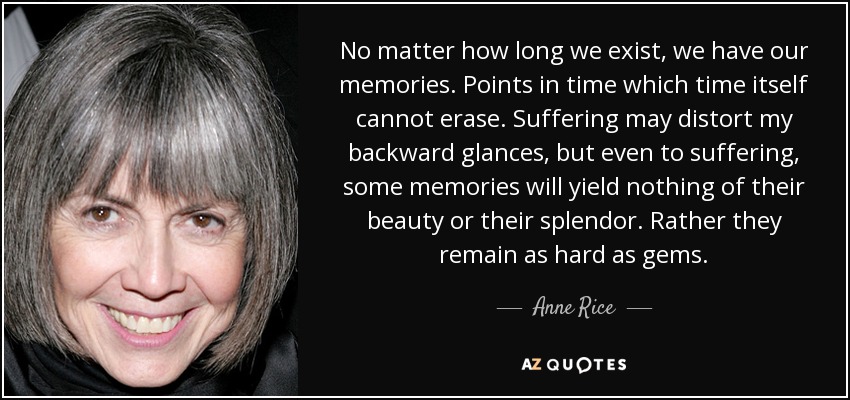
No matter how long we exist, we have our memories. Points in time which time itself cannot erase. Suffering may distort my backward glances, but even to suffering, some memories will yield nothing of their beauty or their splendor. Rather they remain as hard as gems.
Only everyone forgets how seldom our memory is accurate. Having more memory is just a way of distorting a greater amount of the past"p.193
The poets and philosophers I once loved had it wrong. Death does not come to us all, nor does the passage of time dim our memories and reduce our bodies to dust. Because while I was considered dead, and a headstone had been engraved with my name, in truth my life was just beginning.
The entire world was like a palace with countless rooms whose doors opened into one another. We were able to pass from one room to the next only by exercising our memories and imaginations, but most of us, in our laziness, rarely exercised these capacities, and forever remained in the same room.
You have to begin to lose your memory, if only in bits and pieces, to realize that memory is what makes our lives. Life without memory is no life at all... Our memory is our coherence, our reason, our feeling, even our action. Without it we are nothing.
Our memory fragments don't have any coherence until they're imagined in words. Time is a property of language, of syntax, and tense.
Vanity plays lurid tricks with our memory, and the truth of every passion wants some pretence to make it live.
there simply is no way to describe the past without lying. Our memories are not like fiction. They are fiction.
We are the sum total of our memories. Memories are the most precious things we have. Good or bad. That's what make us who we are. What would we be without them?
The past exists only in our memories, the future only in our plans. The present is our only reality. The tree that you are aware of intellectually, because of that small time lag, is always in the past and therefore is always unreal. Any intellectually conceived object is always in the past and therefore unreal. Reality is always the moment of vision before the intellectualization takes place. There is no other reality.
We live through books; we have adventures in them, we lead alternative lives through them. We expand our memories through them. And that sometimes art can offer us more intense experiences of the world than life itself can.
In our memories the stories of our lives defy chronology, resist transcription: past ambushes present, and future hurries into history.
Stop punishing yourself if you scared of your memories with me. Don't do that... Just stab me like this not you. It is only when you can stand on your feet that I can disappear with easy from your sight.
Health is a return to our memory of wholeness.
It's our memories that make us who we are. Without them, we're nothing. If that means we have to hurt sometimes, it's worth it.
Movies, over time, as they do or don't find their audience, or they find a different audience, they change in your memory and in the eyes of those who see it.
Fifty years from now I don't think optical realism is going to be an issue in visual communication any more. Experience is so much richer than light falling on your retina. You embody a microcosm of reality when you walk down the street - your memories, your varying degrees of awareness of what's going on around you, everything we could call the contextualizing information. Representing that information is going to be the main issue in the years ahead - how the world meets the mind, not the eye.
The question that comes up a lot is, if you had the chance to erase your memory of something specific, what would you erase? And my answer has always been, I wouldn't erase anything, personally. In some ways, I almost wouldn't want to erase anything from the public consciousness, either, for the same reason.
If the clockwork universe equated the human body with the mechanics of the clock, the digital universe now equates human consciousness with the processing of the computer. We joke that things don't compute, that we need a reboot, or that our memory has been wiped.
When our memories outweigh our dreams, it is then that we become old.
In our memories, there is a graveyard where we bury our dead. They all lie there together, the loved ones and the ones we hated, friends and foes and kin, with no distinction among them. We have to mourn every one of them, because our memories have made them as much a part of us as our bones or our skin. If we don't, we've no right to remember anything at all.
There is a wilful lemming-like persistance in remaking past successes time after time. They can't make them as good as they are in our memories, but they go on doing them and each time it's a disaster. Why don't we remake some of our bad pictures - I'd love another shot at 'Roots of Heaven' - and make them good?
You slide down in your seat and make yourself comfortable. On the screen in front of you, the movie image appears—enormous and overwhelming. If the movie is a good one, you allow yourself to be absorbed in its fantasy, and its dreams become part of your memories
If you could have a famous writer, dead or alive, write an obituary for you and really puff you up to have been something you weren’t, perhaps, or otherwise take liberties with your memory, what writer would you choose?
I think you learn how to write by reading an enormous amount, so then your memory is stocked with various constructions, various ways of shaping a paragraph, shaping a chapter.
Follow AzQuotes on Facebook, Twitter and Google+. Every day we present the best quotes! Improve yourself, find your inspiration, share with friends
or simply: