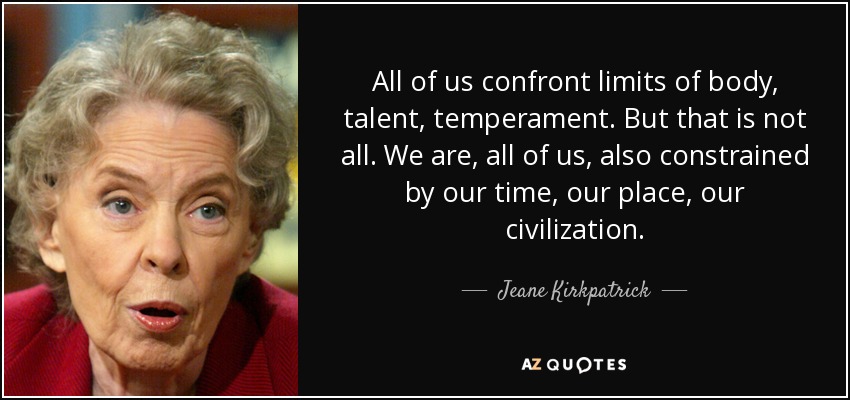
All of us confront limits of body, talent, temperament. But that is not all. We are, all of us, also constrained by our time, our place, our civilization.
There has been in our time a lack of reliance on language and a lack of experimentation which are frightening to anyone who sees them as symptoms. We know the phenomenon of stage-fright: it holds the player shivering, incapable of speech or action. Perhaps there is an audience-fright which the play can feel, which leaves him with these incapacities.
The test is the sixty seconds of every minute, and the sixty minutes of every hour, not our times of prayer and devotional meetings.
The greater part of our best years has been passed for our generation in these two great worldconvulsions. All will be changed after this war, which spends in one month more than nations earned before in yearsthere is no more security in our time than in those of the Reformation or the fall of Rome.
Even in an advanced stage of civilization, there is always a tendency to prefer those parts of literature which favor ancient prejudices, rather than those which oppose them; and in cases where this tendency is very strong, the only effect of great learning will be to supply the materials which may corroborate old errors and confirm old superstitions. In our time such instances are not uncommon; and we frequently meet with men whose erudition ministers to their ignorance, and who, the more they read the less they know.
We mourn; we sorrow for our loved ones that go - our wives, our husbands, our children, our parents; we sorrow for them; and it is well and proper that we should moum for them and shed tears for the loss, for it is our loss; but it is their gain, for it is in the march of progress, advancement and development. It will be all right when our time comes, when we have finished our work and accomplished what the Lord required of us.
If everyone has the same amount of time and yet some earn more than others, can we say then say that it's how we use our time that determines the money we make?
We will all, at some point in our lives, fall. Every single one of us. We shouldn't spend our time trying to avoid falling. We should spend it finding someone who will help us up!
Morning Glory's introduction to the magical ways of the Goddess, manifest in our time, has enlarged my understanding of Pagan ways, enriching my spirit and imagination.
We are loaded down with too many good things, more than we could ever need, while others are desperate for a small loaf. The good things we cling to are more than money; we hoard our resources, our gifts, our time, our families, out friends....how ludicrous it is to hold on to the abundance God has given us and merely repeat the words 'thank you'.
George Kennan and Paul Nitze were the Adams and Jefferson of the Cold War. They were there for the beginning, they witnessed its course over almost half a century, and they argued with each other constantly while it was going on. But they maintained throughout a remarkable friendship, demonstrating-as few others in our time have-that it is possible to differ with civility. Nicholas Thompson's is a fine account of that relationship, carefully researched, beautifully written, and evocatively suggestive of how much we have lost because such civility has become so rare.
We are capable of suffering with our world, and that is the true meaning of compassion. It enables us to recognize our profound interconnectedness with all beings. Don't ever apologize for crying for the trees burning in the Amazon or over the waters polluted from mines in the Rockies. Don't apologize for the sorrow, grief, and rage you feel. It is a measure of your humanity and your maturity. It is a measure of your open heart, and as your heart breaks open there will be room for the world to heal. That is what is happening as we see people honestly confronting the sorrows of our time.
The terrorism of the suicide bomber and the terrorism of aerial bombardment are indeed morally equivalent. To say otherwise (as either side might) is to give one moral superiority over the other, and thus serve to perpetuate the horrors of our time.
In a world in which the price of calculation continues to decrease rapidly, but the price of theorem proving continues to hold steady or increase, elementary economics indicates that we ought to spend a larger and larger fraction of our time on calculation.
It is the beginning of all true criticism of our time to realize that it has really nothing to say, at the very moment when it has invented so tremendous a trumpet for saying it.
Childhood is the one prison from which there's no escape, the one sentence from which there's no appeal. We all serve our time.
Does history warrant the conclusion that religion is necessary to morality - that a natural ethic is too weak to withstand the savagery that lurks under civilization and emerges in our dreams, crimes and wars? ... There is no significant example in history, before our time, of a society successfully maintaining moral life without the aid of religion.
More than anything else, kindness is a way of life. It is a way of living and walking through life. It is a way of dealing with all that is-our selves, our bodies, our dreams and goals, our neighbors, our competitors, our enemies, our air, our earth, our animals, our space, our time, and our very consciousness. Do we treat all creation with kindness? Isn't all creation holy and divine?
Tiny as a sparrow, fierce as an eagle, Lisbeth Salander is one of the great Scandinavian avengers of our time, an angry bird catapulting into the fortresses of power and wiping smiles off the faces of smug, predatory pigs.
There is a close relationship between a house full of possessions and a heart full of desires, between a cluttered closet and a crowded schedule, between having no place to put possessions and having no priorities for our life. These are precious clues. They remind us to slow down, to live in the present, to reduce the desires that drain our vitality, to clarify priorities so we can give our time and attention to what matters most. Tragically, in the press of modern life, we have managed to get backwards one of life's most vital truths: people are to be loved; things are to be used.
Corruption is one of the greatest enemies of progress in our time. It is the cancer at the heart of so many of the world's problems.
We spend most of our time and energy in a kind of horizontal thinking. We move along the surface of things....but, there are times when we must stop. We sit still. We lose ourselves in a pile of leaves or in its memory. We listen, and breezes from a whole other world begin to whisper.
I consider Otto Rank to be one of the great spiritual giants of the twentieth century, a genius as a psychologist and a saint as a human being. Though vilified by his original community of Freudians, he never became bitter. He died a feminist and deeply committed to social justice, in 1939....His deep understanding of creativity makes him a mentor for all of us living in a postmodern world....I believe that Art and Artist, especially chapters 12 to 14, may well emerge as the most valuable psychoanalysis of the spiritual life in our time.
Canada is our country. It belongs to us and we belong to it. Let us join together, in our time, and make history once again.
I have to declare in all candor that no one interested in being published in our time can afford to be so naive as to believe that a book will make it merely because it's good.
Follow AzQuotes on Facebook, Twitter and Google+. Every day we present the best quotes! Improve yourself, find your inspiration, share with friends
or simply: