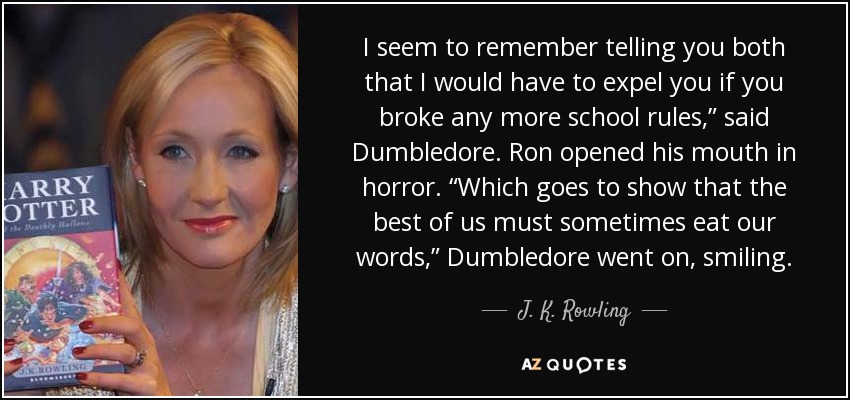
I seem to remember telling you both that I would have to expel you if you broke any more school rules,” said Dumbledore. Ron opened his mouth in horror. “Which goes to show that the best of us must sometimes eat our words,” Dumbledore went on, smiling.
It is better to allow our lives to speak for us than our words. God did not bear the cross only two thousand years ago. He bears it today, and he dies and is resurrected from day to day. It would be a poor comfort to the world if it had to depend on a historical God who died two thousand years ago. Do not, then, preach the God of history, but show him as he lives today through you.
Listening is much more than allowing another to talk while waiting for a chance to respond. Listening is paying full attention to others and welcoming them into our very beings. The beauty of listening is that those who are listened to start feeling accepted, start taking our words more seriously and discovering their true selves.
We are more connected than ever before, more able to spread our ideas and beliefs, our anger and fears. As we exercise the right to advocate our views, and as we animate our supporters, we must all assume responsibility for our words and actions before they enter a vast echo chamber and reach those both serious and delirious, connected and unhinged.
Things are going so well. We’re volleying words back and forth. Everything she says, I have something I can say back. We’re sparking, and part of me just wants to sit back and watch. We’re clicking. Not because a part of me is fitting into a part of her. But because our words are clicking into each other to form sentences and our sentences are clicking into each other to form dialogue and our dialogue is clicking together to form this scene from this ongoing movie that’s as comfortable as it is unrehearsed.
What is that we human beings ultimately depend on? We depend on our words. We are suspended in language. Our task is to communicate experience and ideas to others.
We hear a lot of talk these days about teaching values in higher education. Frankly, I am not sure this can be accomplished through a separate course in morality or ethics. I am convinced, however, that values are sustained on campus by the honesty of our words, and by the confidence we have in the words of others.
All our words and actions pass in review before God.
Beneath words and logic are emotional connections that largely direct how we use our words and logic.
I'm not really good at fun-to-know, human interest stuff. We're not 'celebrities', whose life itself is a performance. Good or bad or ugly, we are our words. They're what people meet.
Encourage others each and every day-nothing's more important than our words. Did you know that, on average, each of us speaks about twenty-five thousand words daily? My last book didn't have that many words. A lot of language is flowing out of our mouths every day and having an impact on those around us. But how much of that flow is fulfilling God's intended purpose for our speech? How much of it reflects pride, rather than a gospel-motivated humility?
Our words will either bring life and victory or death and destruction. If we want to be happy, we have to be serious about speaking words of life that line up with God's Word.
One might say that our words are a movie screen that reveals what we have been thinking and the attitudes we have.
Whether or not our prayer is heard depends not on the number of our words, but on the fervor of our souls.
What hypocrites we seem to be whenever we talk of ourselves! Our words sound so humble, while our hearts are so proud.
I never told my own religion nor scrutinized that of another. I never attempted to make a convert, nor wished to change another's creed. I am satisfied that yours must be an excellent religion to have produced a life of such exemplary virtue and correctness. For it is in our lives, and not from our words, that our religion must be judged.
Whenever there is a conflict between precept and example, the latter wins because deeds speak louder than our words.
If we tend to the things that are important in life, if we are right with those we love, and behave in line with our faith, our lives will not be cursed with the aching throb of unfulfilled business. Our words will always be sincere, our embraces will be tight. We will never wallow in the agony of ‘I could have, I should have’. We can sleep in a storm. And when its time, our goodbyes will be complete.
The Sufis advise us to speak only after our words have managed to pass through three gates. At the first gate, we ask ourselves, 'Are these words true?' If so, we let them pass on; if not, back they go. At the second gate, we ask, 'Are the necessary?' At the last gate, we ask, 'Are they kind?'
My brethren, let me say, be like Christ at all times. Imitate him in "public." Most of us live in some sort of public capacity-many of us are called to work before our fellow-men every day. We are watched; our words are caught; our lives are examined-taken to pieces. The eagle-eyed, argus-eyed world observes everything we do, and sharp critics are upon us. Let us live the life of Christ in public. Let us take care that we exhibit our Master, and not ourselves-so that we can say, "It is no longer I that live, but Christ that lives in me."
Spirituality is not a function of occupation or calling. A scientist may be more spiritual than a theologian; a teacher may be more spiritual than an officer. Spirituality is determined by personal outlook and priorities. It is evident in our words and actions.
For what St. Augustine said is true, that one can sing nothing worthy of God save what one has received from Him. Wherefore though we look far and wide we will find no better songs nor songs more suitable to that purpose than the Psalms of David, which the Holy Spirit made and imparted to him. Thus, singing them we may be sure that our words come from God just as if He were to sing in us for His own exaltation. Wherefore, Chrysostom exhorts men, women, and children alike to get used to singing them, so as through this act of meditation to become as one with the choir of angels.
There is a direct line that runs from our doctrine to our actions, from what is in our minds to what is in our words and ways... The heart spills over into life. Thoughts of God, and of all else, erupt into acts. The filling of the heart with wise thoughts of God becomes the most important, the most practical, business in the world.
Our greatest weakness lies in giving up.
Certain mystes aver that the real world has been constructed by the human mind, since our ways are governed by the artificial categories into which we place essentially undifferentiated things, things weaker than our words for them. We believe we invent symbols. The truth is that they invent us; we are their creatures, shaped by their hard, defining edges.
Follow AzQuotes on Facebook, Twitter and Google+. Every day we present the best quotes! Improve yourself, find your inspiration, share with friends
or simply: