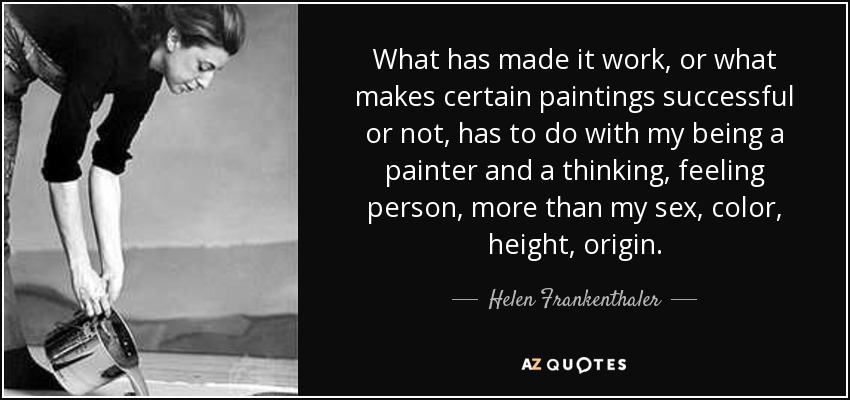
What has made it work, or what makes certain paintings successful or not, has to do with my being a painter and a thinking, feeling person, more than my sex, color, height, origin.
I became an animal painter because I loved to move among animals. I would study an animal and draw it in the position it took, and when it changed to another position I would draw that.
One interesting feature of criticism is seen in the ease with which it discovers what Addison called the specific quality of an author. In Livy, it will be the manner of telling the story; in Sallust, personal identification with the character; in Tacitus, the analysis of the deed into its motive. If the same test be applied to painters, it will find the prominent faculty of Correggio to be manifested in harmony of effect; of Poussin, in the sentiment of his landscapes; and of Raffaelle, in the general comprehension of his subject.
I am biased towards the belief that every painter must be grounded in strong and faultless drawing skills, and until one has not experimented with all styles of painting and has not comprehended their potentialities one's work is not complete. Even an abstract painter must know how to draw as well as a figurative artist. As for me, drawing has never created any problem, since I know how to draw anatomy correctly if I had to, I understand the function of muscle groups and sculpture.
The painter celebrates life where he finds it. His morality is the morality of enjoyment, of the continuous development of his own taste without shame or fear. It is a sort of heroism.
[Alexander] Hamilton estimated portrait painters as thieves of time.
Is the painter a plagiarist because he sets his palette to nature?
One feature about Los Angeles that I particularly love is the chance for association with all kinds of creative artists, a thing I never before have had. I certainly do love a number of the writers, the painters, the musicians, and the sculptors that I meet here. ... Next to the sunshine, I appreciate it the most of anything in California.
I've been painting off and on since I was in sixth grade. I don't paint when I'm acting - I'm not really able to split my focus that way. I do it intensely when I'm doing it, but I'm reluctant to take myself too seriously as a painter because that would mean there would be pressure to be better than I am.
I apologize if there's a Parkinson's painter in the audience. I assume you do your best work in the morning. Probably gets abstract by noon.
I am a hobbyist photographer so I relate to the visual arts that way, but Im not a painter.
Directors who have inspired me include Billy Wilder, Federico Fellini, lngmar Bergman, John Ford, Orson Welles, Werner Herzog, Stanley Kubrick, Alfred Hitchcock, Francis Ford Coppola and Ernst Lubitsch. In art school, I studied painters like Edward Hopper, who used urban motifs, Franz Kafka is my favorite novelist. My approach to film stems from my art background, as I go beyond the story to the sub-conscious mood created by sound and images.
I wanted to be a painter, really, when I was growing up as a kid. It was one thing that really took a grip on me.
During the Renaissance, women were not allowed to attend art school. Everyone asks, where are the great women painters of the Renaissance?
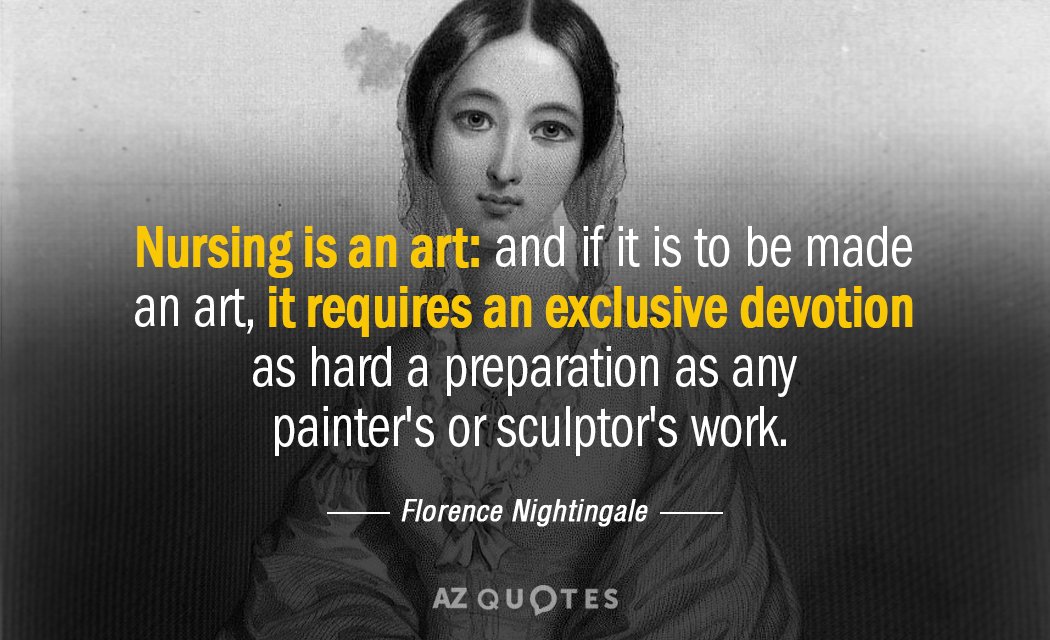
Nursing is an art: and if it is to be made an art, it requires an exclusive devotion as hard a preparation as any painter's or sculptor's work.
As for borrowing Mr. Whistler's ideas about art, the only thoroughly original ideas I have heard him express have had reference to his own superiority as a painter over painters greater than himself.
The great artist, whether he be musician, painter, or poet, is known for this absolute unexpectedness.
Art can mean a lot of things. At the heart of it, art is doing something you really believe in. Like my wife, she volunteers helping underprivileged kids, that's her art. To me, anything that you do that you truly believe in makes you an artist. It doesn't necessarily mean being a painter or a film maker. That's art, but there's more to it than that. As long as you're pouring your heart and soul into what you're doing, that's the weapon.
The musician of disordered sound, the poet of decomposed language, the painter and sculptor of the fragmented visual and tactile world: they all portray the break up of the self and, through the rearrangement and reassemble of the fragments, try to create new structures that possess wholeness, perfection, new meaning.
My sin as a painter is that I just want to paint anything I want to paint - and repaint.
Perhaps the central question about [Eliot] Porter's work is about the relationship between science, aesthetics, and environmental politics. His brother, the painter and critic Fairfield Porter, wrote in a 1960 review of [Porter's] colour photographs: 'There is no subject and background, every corner is alive,' and this suggests what an ecological aesthetic might look like.
I wanted to be a painter, somewhere between Abstract Expressionism and Pop.
If you're a painter, it's simply taken for granted that you'll spend a lot of time in museums studying great paintings, but if you're a cartoonist, it used to be very hard to see an original cartoon drawing.
Even the wisest man grows tense With some sort of violence Before he can accomplish fate, Know his work or choose his mate. Poet and sculptor, do the work, Nor let the modish painter shirk
King René of Anjou [(1409-80)]was a strange compound of amiable, great and trifling qualities. He was so excellent a sovereign as to acquire the surnom of the Good. He was brave in war, delighted in tournaments and wrote on them, instituted festivals and processions, partly religious and partly burlesque, was a fond husband, a romantic lover, a good painter for that age, and a true philosopher.
Follow AzQuotes on Facebook, Twitter and Google+. Every day we present the best quotes! Improve yourself, find your inspiration, share with friends
or simply: