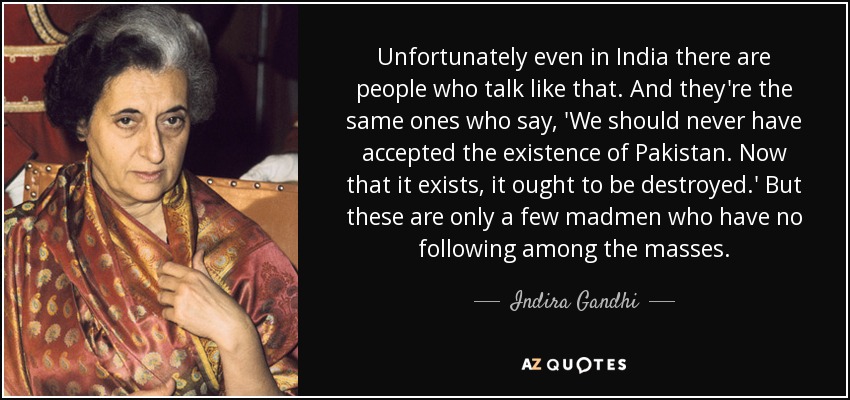
Unfortunately even in India there are people who talk like that. And they're the same ones who say, 'We should never have accepted the existence of Pakistan. Now that it exists, it ought to be destroyed.' But these are only a few madmen who have no following among the masses.
The Western press has always insisted that India was Pakistan's enemy and vice versa, that the Hindus were against the Muslims and vice versa. They've never said, for instance, that my party has been fighting this attitude ever since we have maintained that religious hostilities are wrong and absurd, that minorities cannot be eliminated from a country, that people of different religions must live together.
Education is the key to perpetuation of the [god] virus for the Taliban, Baptist or Catholic. If the virus cannot control public education, it will seek to divert resources from public coffers to fundamentalist school funding. From the madrassa schools of Pakistan to the Christian push for school vouchers in the United States and the religious home school movement, religions seek to control education or to control the resources for education.
I'm far from believing that we've solved the problem of violence in the 20th century and that's why I'm not discouraged that we still have the Biafras and the Northern Irelands and the East Pakistans and, for that matter, violence in American or Canadian cities.
Obviously Pakistan and the U.S. are very different countries, but we have common geopolitical interests in preventing communist take over in Afghanistan and hence, now that Pakistan has a government that we can cooperate with, even though it is a military government, we are working together with them in order to promote our common interests. But obviously we also differ with Pakistan on a number of issues.
The U.S. has and still is cooperating with various military dictatorships around the world. Obviously we would prefer to see them democratized, but we are doing it because we have national interests, whether it's working with Pakistan on Afghanistan or whatever.
In Canada, the U.S. and most of Europe it may be easy to take political stands, this is something for which you can be forced to pay with your life, or your freedom, in many other parts of the world, from Iran to Russia to Pakistan to China.
My central focus is what are we doing to protect the American people and the American homeland? Afghanistan and Pakistan are critical elements in that process.
I suspected [Richard Nixon] was very pro-Pakistan. Or rather I knew that the Americans had always been in favor of Pakistan - not so much because they were in favor of Pakistan, but because they were against India.
I had recently had the impression they were changing - not so much by becoming less pro-Pakistan as by becoming less anti-India. I was wrong. My visit to [Richard] Nixon did anything but avert the war.
Do you know why I won the last elections? It was because the people liked me, yes, because I had worked, yes, but also because the opposition had behaved badly toward me. And do you know why I won this war? Because my army was able to do it, yes, but also because the Americans were on the side of Pakistan.
America always thought it was helping Pakistan. But if it hadn't helped Pakistan, Pakistan would have been a stronger country.
Both India and Pakistan have a long history of deploying rhetorical strategies to skirt the issue of plebiscite or complete secession of the former princely state of Jammu and Kashmir. When feeling particularly belligerent Pakistan cries itself hoarse declaring the legitimacy of plebiscite held under United Nations auspices in J & K; India responds just as aggressively by demanding the complete withdrawal of Pakistani troops from the territory of pre-partition J & K; or, in a moment of neighborly solicitude, for conversion of the LOC to a permanent International border.
I sincerely hope that whatever influence the United States has in Pakistan, it will convince Pakistan that using terrorism as an instrument of state policy has no place in the world that we want to build.
If Pakistan honors in letter and in spirit the commitment that it gave to Mr. Vajpayee in 2004, that Pakistan territory will not be used for promoting terrorist acts against India, the sky is the limit of cooperation between our two countries. Basically, we are the same people. There are ties of religion. There are ties of language. There are ties of culture.
My vision is to work for the relationship between India and Pakistan which would be like the relation between Canada and the United States.
First of all, let me give my comments on the blasphemy law. This law was introduced by the military dictator General Ziaul Haq. No one demanded the blasphemy law in Pakistan. But he wanted to give protection to his undemocratic rule, dictatorship, by using religion. So Pakistan came into being in 1947, and from 1947 until 1986 no case against any minorities was registered under the protection of the blasphemy law. Nobody from minorities was killed and no act of violence happened [against them].
There [in Afghanistan] is also a growing insurgency threat from al-Qaida, the Taliban and other extremist elements, some of which comes from the tribal areas of Pakistan, as well as from the Northwest Frontier province and Baluchistan.
There is no way the Americans are going to be able to carry out a full scale war against Iraq and at the same time maintain the same kind of pressure on the Al Qaeda network in countries as diverse as Indonesia, Philippines, and Pakistan, as well as in Europe.
What we can do is make sure that Afghanistan is not a safe haven for Al Qaeda. What we can do it make sure that it is not destabilizing neighboring Pakistan, which has nuclear weapons. The key is we’ve got to have a clear objective...
We need to deal with the problem of al Qaeda, make sure that they can't have a sanctuary in Afghanistan and guarantee that we have regional stabilization and particularly focused on Pakistan.
The Islamists had control over territory that was about half the size of the Federal Republic of Germany. For years, we have been putting the lives of our troops on the line, we have taken huge losses and the Europeans cut the budget? If money is more important than the lives of our children, what else is this than the usual arrogance and superficiality? And where is all this terror coming from? It is a result of mistakes the West committed in Pakistan and Afghanistan in the 1980s, when they armed the Islamic rebels against the Soviet troops.
Recently, while I was in England, I saw a documentary on the BBC about the border between India and Pakistan at Wagah. When the border closes each evening around six o' clock, the soldiers on each side do these amazing high-stepping peacock march-offs (like a dance-off). The displays are almost identical on each side and thousands gather to watch them. Though they're patrolling along their separate borders, what comes across is how similar they are.
I believe in nature and humanity and am here to serve the common people of Pakistan. There is a great deal of suffering in this country and I'm here to help.
The basic problem affecting the Pakistan today is human rights. Islamic fundamentalists have no roots among the common people and while they are pushing hard for religious fundamentalists to take hold, the common people still seek change through humanitarian and common human rights law.
Follow AzQuotes on Facebook, Twitter and Google+. Every day we present the best quotes! Improve yourself, find your inspiration, share with friends
or simply: