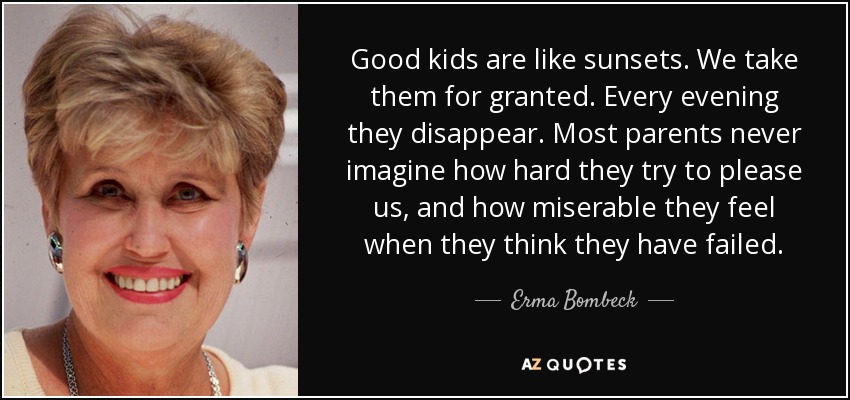
Good kids are like sunsets. We take them for granted. Every evening they disappear. Most parents never imagine how hard they try to please us, and how miserable they feel when they think they have failed.
Young men kill someone for a handful of coins, then are remorseless, even casual: Hey, man, things happen. And their parents nab the culprit: it was the city, the cops, the system, the crowd, the music. Anyone but him. Anyone but me.
Maybe someday it will seem quaint that, during a time of plague, some of the parents of the 1990s wanted to deny their children protection so that they could safeguard their own self- image. Or maybe we'll just seem like a bunch of lunatics.
I think that parents ought to get some idea of how the so- called "experts" have changed their advice over the decades, so that they won't take them deadly seriously, and so that if the parent has the strong feeling, "I don't like this advice," the parent won't feel compelled to follow it. . . . So don't worry about trying to do a perfect job. There is no perfect job. There is no one way of raising your children.
Forgiving presupposes remembering. And it creates a forgetting not in the natural way we forget yesterday's weather, but in the way of the great "in spite of" that says: I forget although I remember. Without this kind of forgetting no human relationship can endure healthily. I don't refer to a solemn act of asking for and offering forgiveness. Such rituals as sometimes occur between parents and children, or friends, or man and wife, are often acts of moral arrogance on the one part and enforced humiliation on the other. But I speak of the lasting willingness to accept him who has hurt us.
And fathers are a blessing, too, they give the place a tone; In fact each child should try and have some parents of its own.
We belong to that order of mammals, the primates, distinguished by its propensity for repeated single litters, intense parental care, long life-spans, late sexual maturity, and a complex and extensive social existence... Our protracted biological and psychological helplessness, which extends well into the third year of life, intensifies the bond between infant and parents, making possible a sense of generational continuity. In contrast to other primates these bonds are not obliterated after sexual maturity.
Young people...have more compassion and tenderness toward the elderly than most middle-aged adults. Nothing--not avarice, not pride, not scrupulousness, not impulsiveness--so disillusions a youth about her parents as the seemingly inhumane way they treat her grandparents.
Parents cannot expect advice to have the same force upon their children as experience has upon themselves.
The legacies that parents and church and teachers left to my generation of Black children were priceless but not material: a living faith reflected in daily service, the discipline of hard work and stick-to-itiveness, and a capacity to struggle in the face of adversity.
It's important for parents to watch for trouble and convey to their daughters that, if it comes, they are strong enough to deal with it. Parents who send their [adolescent] daughters the message that they'll be overwhelmed by problems aren't likely to hear what's really happening.
Traditionally parents have wondered what their teens were doing, but now teens are much more likely to be doing things that can get them killed.
The proliferation of support groups suggests to me that too many Americans are growing up in homes that do not contain a grandmother. A home without a grandmother is like an egg without salt.... The emotionally satisfying discussions that take place in Chronic Pain Outreach and Depression Resources are simply updated versions of the grandmotherly practice of hanging crepe. We could eliminate much of the isolation that support groups exist to fill and save the "traditional family" that everybody is so worried about if more couples took their aging parents to live with them.
For a parent, it's hard to recognize the significance of your work when you're immersed in the mundane details. Few of us, as we run the bath water or spread the peanut butter on the bread, proclaim proudly, "I'm making my contribution to the future of the planet." But with the exception of global hunger, few jobs in the world of paychecks and promotions compare in significance to the job of parent.
The child who would be an adult must give up any lingering childlike sense of parental power, either the magical ability to solveyour problems for you or the dreaded ability to make you turn back into a child. When you are no longer hiding from your parents, or clinging to them, and can accept them as fellow human beings, then they may do the same for you.
Parents can fail to cheer your successes as wildly as you expected, pointing out that you are sharing your Nobel Prize with a couple of other people, or that your Oscar was for supporting actress, not really for a starring role. More subtly, they can cheer your successes too wildly, forcing you into the awkward realization that your achievement of merely graduating or getting the promotion did not warrant the fireworks and brass band.
Parents vary in their sense of what would be suitable repayment for creating, sustaining, and tolerating you all those years, andwhat circumstances would be drastic enough for presenting the voucher. Obviously there is no repayment that would be sufficient . . . but the effort to call in the debt of life is too outrageous to be treated as anything other than a joke.
Some parents were awful back then and are awful still. The process of raising you didn't turn them into grown-ups. Parents who were clearly imperfect can be helpful to you. As you were trying to grow up despite their fumbling efforts, you had to develop skills and tolerances other kids missed out on. Some of the strongest people I know grew up taking care of inept, invalid, or psychotic parents--but they know the parents weren't normal, healthy, or whole.
In considering the ledger equal, understand the greatest gift you have given your parents is the opportunity to raise you. The things a child gets from parents can't compare to the things a parent gets from raising a child. Only by experiencing this can you understand the degree to which children give meaning to parents' lives.
Negotiating the adolescent stage is neither quick nor easy. . . . I have often said to parents, "If it isn't illegal, immoral, orfattening, give it your blessing." We do much better . . . if we find and support all the places we can appropriately say yes, and say only the no's that really matter.
In the nurturing family...parents see themselves as empowering leaders not as authoritative bosses. They see their job primarily as one of teaching their children how to be truly human in all situations. They readily acknowledge to the child their poor judgment as well as their good judgment; their hurt, anger, or disappointment as well as their joy. The behavior of these parents matches what they say.
The fetish of the great university, of expensive colleges for young women, is too often simply a fetish. It is not based on a genuine desire for learning. Education today need not be sought at any great distance. It is largely compounded of two things, of a certain snobbishness on the part of parents, and of escape from home on the part of youth. And to those who must earn quickly it is often sheer waste of time. Very few colleges prepare their students for any special work.
Love is at the root of all healthy discipline. The desire to be loved is a powerful motivation for children to behave in ways thatgive their parents pleasure rather than displeasure. it may even be our own long-ago fear of losing our parents' love that now sometimes makes us uneasy about setting and maintaining limits. We're afraid we'll lose the love of our children when we don't let them have their way.
And those handmade presents that children often bring home from school: They have so much value! The value is that the child put whatever he or she could into making them. The way we parents respond to the giving of such gifts is very important. To the child the gift is really self, and they want so much for their selves to be acceptable, to be loved.
Families need families. Parents need to be parented. Grandparents, aunts, and uncles are back in fashion because they are necessary. Stresses on many families are out of proportion to anything two parents can handle.
Follow AzQuotes on Facebook, Twitter and Google+. Every day we present the best quotes! Improve yourself, find your inspiration, share with friends
or simply: