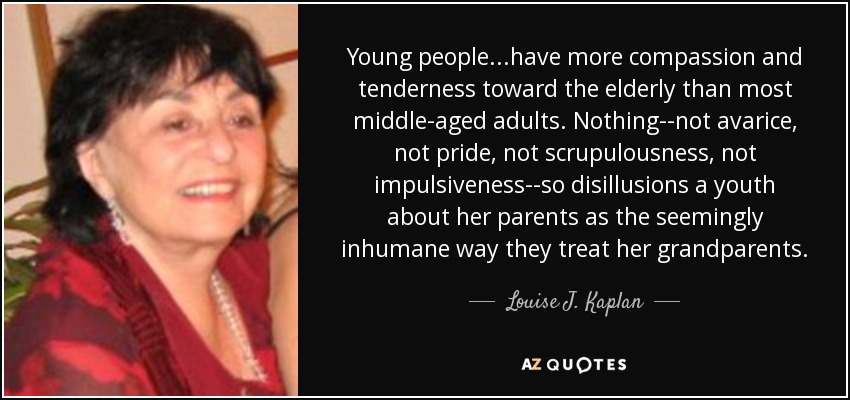
Young people...have more compassion and tenderness toward the elderly than most middle-aged adults. Nothing--not avarice, not pride, not scrupulousness, not impulsiveness--so disillusions a youth about her parents as the seemingly inhumane way they treat her grandparents.
The legacies that parents and church and teachers left to my generation of Black children were priceless but not material: a living faith reflected in daily service, the discipline of hard work and stick-to-itiveness, and a capacity to struggle in the face of adversity.
Adolescence is a time when children are supposed to move away from parents who are holding firm and protective behind them. When the parents disconnect, the children have no base to move away from or return to. They aren't ready to face the world alone. With divorce, adolescents feel abandoned, and they are outraged at that abandonment. They are angry at both parents for letting them down. Often they feel that their parents broke the rules and so now they can too.
It's important for parents to watch for trouble and convey to their daughters that, if it comes, they are strong enough to deal with it. Parents who send their [adolescent] daughters the message that they'll be overwhelmed by problems aren't likely to hear what's really happening.
Traditionally parents have wondered what their teens were doing, but now teens are much more likely to be doing things that can get them killed.
One of the sad realities of being a parent is that the same stuff you know is exciting, educational, and enriching in your child'slife is often messy, smelly and exhausting to deal with.
Parents offer an open womb. More than anyone else in your life, mothers, and sometimes fathers, can kiss it, and make it well whentheir grown children need to regress and repair. More than anyone else in your life, mothers, and sometimes fathers, can catch you when you start to fall. When you are in disgrace, defeat, and despair, home may be the safest place to hide.
The child who would be an adult must give up any lingering childlike sense of parental power, either the magical ability to solveyour problems for you or the dreaded ability to make you turn back into a child. When you are no longer hiding from your parents, or clinging to them, and can accept them as fellow human beings, then they may do the same for you.
In considering the ledger equal, understand the greatest gift you have given your parents is the opportunity to raise you. The things a child gets from parents can't compare to the things a parent gets from raising a child. Only by experiencing this can you understand the degree to which children give meaning to parents' lives.
Parents vary in their sense of what would be suitable repayment for creating, sustaining, and tolerating you all those years, andwhat circumstances would be drastic enough for presenting the voucher. Obviously there is no repayment that would be sufficient . . . but the effort to call in the debt of life is too outrageous to be treated as anything other than a joke.
In colonial America, the father was the primary parent. . . . Over the past two hundred years, each generation of fathers has hadless authority than the last. . . . Masculinity ceased to be defined in terms of domestic involvement, skills at fathering and husbanding, but began to be defined in terms of making money. Men had to leave home to work. They stopped doing all the things they used to do.
Parents have to get over the idea that their children belong just to them; children are a family affair.
I think that parents ought to get some idea of how the so- called "experts" have changed their advice over the decades, so that they won't take them deadly seriously, and so that if the parent has the strong feeling, "I don't like this advice," the parent won't feel compelled to follow it. . . . So don't worry about trying to do a perfect job. There is no perfect job. There is no one way of raising your children.
In the nurturing family...parents see themselves as empowering leaders not as authoritative bosses. They see their job primarily as one of teaching their children how to be truly human in all situations. They readily acknowledge to the child their poor judgment as well as their good judgment; their hurt, anger, or disappointment as well as their joy. The behavior of these parents matches what they say.
Parents have no right to impose their religion on their children... A Fundamentalist Protestant parent has no right to expect the state to support his own narrow conception of education.
Our contemporary society is experimenting with the diminishment of caregivers for children. Some children are raised through crucial stages of life by only one person. This one person, who strives to give the best, may be overwhelmed, busy, trying to raise many children. And even in homes with two parents, many children are essentially alone.
Parents who expect change in themselves as well as in their children, who accept it and find in it the joy as well as the pains ofgrowth, are likely to be the happiest and most confident parents.
I don't believe that children can develop in a healthy way unless they feel that they have value apart from anything they own or any skill that they learn. They need to feel they enhance the life of someone else, that they are needed. Who, better than parents, can let them know that?
And those handmade presents that children often bring home from school: They have so much value! The value is that the child put whatever he or she could into making them. The way we parents respond to the giving of such gifts is very important. To the child the gift is really self, and they want so much for their selves to be acceptable, to be loved.
The upshot of pervasive public belief in the uncontrollable sexuality of teenagers, and even of pre-teenagers, is that parents arehalf-hearted in their efforts to supervise and control their children, even when they are filled with anxiety as to their children's ability to cope with a full-fledged sexual relationship. "How can we buck the tide?" parents say helplessly, often without making quite certain that the ocean they see is a real one and not a mirage.
Although my parents have never been the kind to hint around about grandchildren, I can think of no better tribute to them than giving them some.... I can't help thinking that the cycle is not complete until I can introduce them to a child of their child. And I can think of no better comfort when they are gone than to know that something of them lives on, not only in me but in my children.
Next-door a baker's apprentice with his wife, an employee in a printing-shop, she has inflammation of the ovaries. Wonder what those two get out of life? Well, first of all, they get each other, then last Sunday a vaudeville and a film, then this or that club meeting and a visit to his parents. Nothing else? Well now, don't drop dead, sir. Add to that nice weather, bad weather, country picnics, standing in front of the stove, eating breakfast and so on. And what more do you get, you, captain, general, jockey, whoever you are? Don't fool yourself.
Conditional love is love that is turned off and on....Some parents only show their love after a child has done something that pleases them. "I love you, honey, for cleaning your room!" Children who think they need to earn love become people pleasers, or perfectionists. Those who are raised on conditional love never really feel loved.
Most adults would not dream of belittling, humiliating, or bullying (verbally or physically) another adult. But many of the same adults think nothing of treating their adolescent child like a nonperson. . . . Adolescents deserve the same civility their parents routinely extend to total strangers.
Parents sometimes feel that if they don't criticize their child, their child will never learn. Criticism doesn't make people wantto change; it makes them defensive.
Follow AzQuotes on Facebook, Twitter and Google+. Every day we present the best quotes! Improve yourself, find your inspiration, share with friends
or simply: