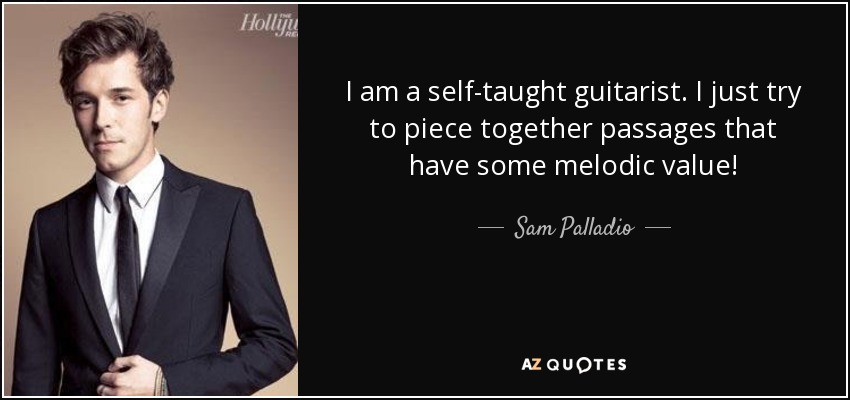
I am a self-taught guitarist. I just try to piece together passages that have some melodic value!
Several factors besides skill are more significant in professional writers than in most amateurs. One is love of the surface level of language: the sound of it; the taste of it on the tongue; what it can be made to do in virtuosic passages that exist only for their own sake, like cadenzas in baroque concerti. Writers in love with their tools are not unlike surgeons obsessed with their scalpels, or Arctic sled racers who sleep among their dogs even when they don't have to.
Death is but a passage. It is not a house, it is only a vestibule. The grave has a door on its inner side.
How many of my basic principles were upset by this change in my attitude toward the Christian Social movement! My views with regard to anti-Semitism thus succumbed to the passage of time, and this was my greatest transformation of all.
When listening to the sound material, we metamorphose the inside into an outside. This notion of metamorphosis is one of the principles that leads the course of the musical suite, reflecting changes (fluidsolid passages: water/ice/fire) or movements (ebb/flow/wave, inspiration/expiration) or inside-outside passages (door/individual/crowd). Thus, the perceived object is not entirely what we would have liked it to be. Our music brings us closer to some while it takes us away from others: each with their own inside.
The adventure is always and everywhere a passage beyond the veil of the known into the unknown; the powers that watch at the boundary are dangerous; to deal with them is risky; yet for anyone with competence and courage the danger fades.
I discovered a version of the sinner's prayer that increased my faith far more than the one that I had said years earlier...In this version, there were no formulas, no set phrases that promised us safe passage across the abyss. There was only our tattered trust that the Spirit who had given us life would not leave us in the wilderness without offering us life again.
A Concordance of Leaves is an epic poem of the indomitable yet fragile human spirit. Philip Metres brings Palestine and Palestinians into English with rare luminosity. One feels echoes of Oppen's succinct tenderness in the depiction of the numerous characters of this work. Without other, there is no self. And that other is the stranger who must be loved. Concordance is, after all, a wedding poem-leaves and pages in search of a certain passage toward harmony.
Although I was well past my teenage troubles, our music was specifically designed to lubricate the passage from adolescence to adulthood.
If one takes a public stand against, say, most any sin you can think of, one is considered "courageous" and a "defender of the faith." Folks will quickly applaud you and tell you how much they admire you for "taking a stand" on biblical truth. Except if you quote Matt. 5:44 and invite people to apply it in any sort of meaningful, literal way. The moment one begins to talk about loving your enemies they all of a sudden become "liberals," "extremists," or are accused of completely taking an otherwise straight forward passage "out of context.
Ideas should be neutral. But man animates them with his passions and folly. Impure and turned into beliefs, they take on the appearance of reality. The passage from logic is consummated. Thus are born ideologies, doctrines, and bloody farce.
When I write, the story is always uppermost in my mind, and I feel that everything must be sacrificed to it. All elegant passages, all the curious details, all the so-called beautiful writing - if they are not truly relevant to what I am trying to say, then they have to go.
Life is a passage through a museum of beauty.
The most accomplished literary work would be reduced to nothing by carping criticism, if the author would listen to all critics and allow every one to erase the passage which pleases him the least.
And we must beg Homer and the other poets not to be angry if we strike out these and similar passages, not because they are unpoetical, or unattractive to the popular ear, but because the greater the poetical charm in them, the less are they meet for the ears of boys and men who are meant to be free, and who should fear slavery more than death.
Unnoticed, the passage has occurred; as I brood, autumn dusk dewdrops fall on my pillow. The voices of insects and the deer by the fence, as one, disturb me to tears this autumn dusk.
But if you miss it, you will next be confronted with the angry deities, ... threatening you and barring your passage ... because you turned a deaf ear to the saving truths of religion. All these forms are strange to you, ... they terrify you, ... and yet it is you who have created them. Do not give in to your fright, ... flee them not! They are but ... the contents of your own mind... If at this point you should manage to understand that, ... and you will find yourself in a paradise among the angels.
It takes the passage of time before an image of a commonplace subject can be assessed. The great difficulty of what I attempt is seeing beyond the moment; the everydayness of life gets in the way of the eternal.
Humans are animals and like all animals we leave tracks as we walk: signs of passage made in snow, sand, mud, grass, dew, earth or moss.... We easily forget that we are track-markers, through, because most of our journeys now occur on asphalt and concrete--and these are substances not easily impressed.
You are treading the path to your greatness: no one shall follow you here! Your passage has effaced the path behind you, and above that path stands written: Impossibility.
Mithridates, he died old. Housman's passage is based on the belief of the ancients that Mithridates the Great [c. 135-63 B.C.] had so saturated his body with poisons that none could injure him. When captured by the Romans he tried in vain to poison himself, then ordered a Gallic mercenary to kill him.
It has been jestingly said that the works of John Paul Richter are almost unintelligible to any but the Germans, and even to some of them. A worthy German, just before Richter's death, edited a complete edition of his works, in which one particular passage fairly puzzled him. Determined to have it explained at the source, he went to John Paul himself. The author's reply was very characteristic: "My good friend, when I wrote that passage, God and I knew what it meant; it is possible that God knows it still; but as for me, I have totally forgotten."
Sandoz turned and accepted the book, looking at the spine. "Aeschylus?" Wordlessly, Guiuliani pointed out the passage, and Emilio studied it a while, slowly translating the Greek in his mind. Finally, he said, "In our sleep, pain which cannot forget falls drop by drop upon the heart, until, in our own despair, againstour will, comes wisdom through the awful grace of God."
I didn't really had a good answer, as so often -- is me. But then somebody sent me the other day, Isaiah 49:16, and you need to go home and look it up. Before you look it up, I'll tell you what it says though. It says, hey, if it was good enough for God, scribbling on the palm of his hand, it's good enough for me, for us. He says, in that passage, 'I wrote your name on the palm of my hand to remember you,' and I'm like, 'Okay, I'm in good company.'
It was the best place to be, thought Wilbur, this warm delicious cellar, with the garrulous geese, the changing seasons, the heat of the sun, the passage of swallows, the nearness of rats, the sameness of sheep, the love of spiders, the smell of manure, and the glory of everything.
Follow AzQuotes on Facebook, Twitter and Google+. Every day we present the best quotes! Improve yourself, find your inspiration, share with friends
or simply: