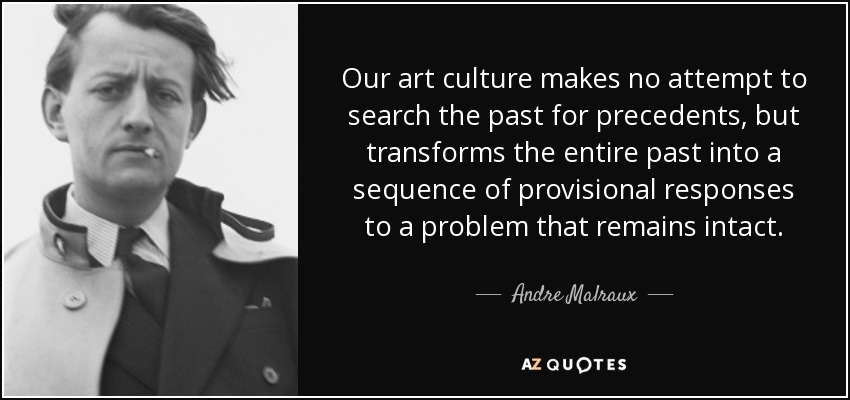
Our art culture makes no attempt to search the past for precedents, but transforms the entire past into a sequence of provisional responses to a problem that remains intact.
At one time, many philosophers held that faultless "laws of thought" were somehow inherent, a priori, in the very nature of mind. This belief was twice shaken in the past century; first when Russell and his successors showed how the logic men employ can be defective, and later when Freud and Piaget started to reveal the tortuous ways in which our minds actually develop.
The reverberation often exceeds through silence the sound that sets it off; the reaction occasionally outdoes by way of repose the event that stimulated it; and the past not uncommonly takes a while to happen, and some long time to figure out.
There is no PAST anybody can get to, to alter things or even to know what those things were but there is definitely a future, we are already in it.
Order is the law of nature, the universal trend, the cosmic direction. If time is an arrow, that arrow points toward order. The future is pattern, organization, union, intensification; the past, randomness, confusion, disintegration, dissipation.
If we assiduously cultivate our powers of exaggeration, perhaps we, too, shall obtain the Paradise of Liars. And there Raphael shall paint for us scores and scores of his manifestly impossible pictures... and Shakespeare will lie to us of fabulous islands far past 'the still-vex'd Bermoothes,' and bring us fresh tales from the coast of Bohemia. For no one will speak the truth there, and we shall all be perfectly happy.
When people can't abide things as they are, when they can't abide the present, they do one of two things ... either they ... either they turn to a contemplation of the past ... or they set about to ... alter the future. And when you want to change something ... YOU BANG! BANG! BANG! BANG!
The Present only has a being in Nature; things Past have a being in the Memory only, but things to come have no being at all; the Future but a fiction of the mind.
In a sense, sexual harassment lawsuits are just the latest version of the female selection process allowing her to select for men who care enough for her to put their career at risk; who have enough finesse to initiate without becoming a jerk and enough guts to initiate despite a potential lawsuit. In the past, though, the process of his overcoming her barriers was called 'courtship.' Now it is called either 'courtship' or 'sexual harassment'.
Reason lives on the systematization of the past, but Faith is the promise of the future.
What is the past, what is it all for? A mental sandwich?
The middle years, caught between children and parents, free of neither: the past stretches back too densely, it is too thickly populated, the future has not yet thinned out.
The internationalization of art becomes a factor contributing to the estrangement of art from the artist. The sum of works of all times and places stands against him as an entity with objectives and values of its own. In turn, since becoming aware of the organized body of artworks as the obstacle to his own aesthetic self-affirmation, the artist is pushed toward anti-intellectualism and willful dismissal of the art of the past.
Marriage is the lightning rod that absorbs anxiety and stress from all other sources, past and present. When marriage has a firm foundation of solid friendship and mutual respect, it can tolerate a fair amount of raw emotion. A good fight can clear the air, and it's nice to know we can survive conflict and even learn from it. Many couples, however, get trapped in endless rounds of fighting and blaming that they don't know how to get out of. When fights go unchecked and unrepaired, they can eventually erode love and respect, which are the bedrock of any successful relationship.
The task of the mind is to produce future, as the poet Paul Valery once put it. A mind is fundamentally an anticipator, an expectation-generator. It mines the present for clues, which it refines with the help of the materials it has saved from the past, turning them into anticipations of the future. And then it acts, rationally, on the basis of those hard-won anticipations.
If history moves forward, knowledge of it travels backwards, so that in writing of our own recent past we are continually meeting ourselves coming the other way.
The present is only understandable through the past, with which it forms a living continuity; and the past is always grasped from our own partial viewpoint within the present.
In its relation to the reality of daily life, the high culture of the past was many things opposition and adornment, outcry and resignation. But it was also the appearance of the realm of freedom: the refusal to behave.
As I looked more carefully at the listening matrix I saw that during the past twenty years we had taken a magnifying glass to the first of these four quadrants, the female experience of powerlessness. I saw I was subconsciously making a false assumption: The more deeply I understood women's experience of powerlessness, the more I assumed men had the power women did not have. In fact, what I was understanding was the female experience of male power.
You should never fall in love with your own press clippings, because it is very much the nature of the beast that the same journalists who build you up between Monday and Friday tear you down for weekend fun...My family's habit of living in the past seems to me pathological, even dangerous. If all greatness lies in the past, what is the point of the future?
I'm intensely private, and I've openly shown annoyance at the paparazzi. That's served in the past to create an image of me where I'm always frowning or looking angry.
Your desire or beliefs will literally be reaching back into time, teaching the nerves new tricks. Definite reorganizations in that past will occur in your present, allowing you to behave in entirely new fashions. Learned behavior therefore alters not only present and future but also past conduct.
We might realize that the present moment may be one of an eternal or sempiternal series of moments, all of which will resemble it because, in some ways, they are the present, and won't in other ways, because the present will be the past by that time.
The old notion that the savage is the freest of mankind is the reverse of the truth. He is a slave, not indeed to a visible master, but to the past, to the spirits of his dead forefathers, who haunt his steps from birth to death, and rule him with a rod of iron.
For the bookish, London is a book. For criminals, a map of opportunities. For unpapered immigrants, it is a nest of skinned eyes; sanctioned gunmen ready to blow your head off as you run for a train. When the city of distorting mirrors revealed itself, through its districts and discriminations, I discovered more about London's past as a reworking of my own submerged history.
Follow AzQuotes on Facebook, Twitter and Google+. Every day we present the best quotes! Improve yourself, find your inspiration, share with friends
or simply: