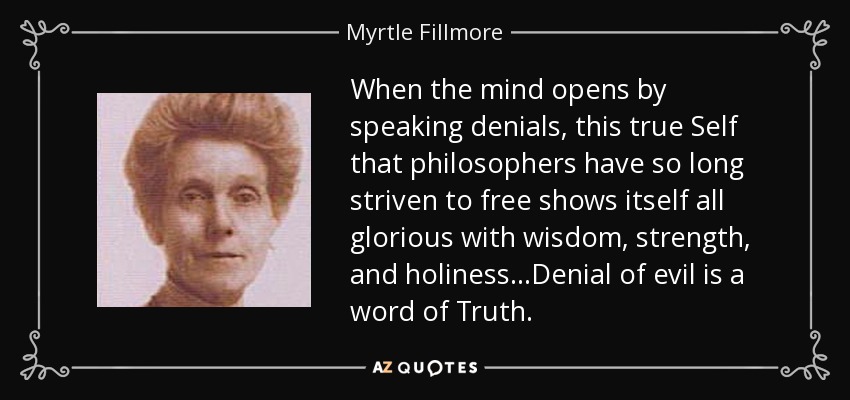
When the mind opens by speaking denials, this true Self that philosophers have so long striven to free shows itself all glorious with wisdom, strength, and holiness...Denial of evil is a word of Truth.
I know a lot of people who are philosophers and they sit by the river and talk about what that underwater world might look like. And I'll say 'Dive in, man, and go see it. Swim around. You'll be okay.
No battle is ever won ... victory is an illusion of philosophers and fools.
Jesus came into this world not as a philosopher or a general but as a carpenter. All work matters to God.
A writer must always try to have a philosophy and he should also have a psychology and a philology and many other things. Without a philosophy and a psychology and all these various other things he is not really worthy of being called a writer. I agree with Kant and Schopenhauer and Plato and Spinoza and that is quite enough to be called a philosophy. But then of course a philosophy is not the same thing as a style.
"You cannot believe what you are saying." "Well, no. Hardly ever. But the philosopher is like the poet. The latter composes ideal letters for an ideal nymph, only to plumb with his words the depths of passion. The philosopher tests the coldness of his gaze, to see how far he can undermine the fortress of bigotry."
In addition to pumping the blood of life within our bodies, we may think of the heart as a belief-to-matter translator. It converts the perceptions of our experiences, beliefs, and imagination into the coded language of waves that communicate with the world beyond our bodies. Perhaps this is what philosopher and poet John Mackenzie meant when he stated, "The distinction between what is real and what is imaginary is not one that can be finely maintained ... all existing thing are ... imaginary."
It is not unusual to hear a religious leader, a philosopher, or a poet refer to man as having a divine spark within him. Such characterizations infer that man possesses great abilities and potentials. We are frequently admonished to develop our capabilities, reach out, and set high goals for ourselves.
A delusion that encourages belief where there is no evidence is asking for trouble. Disagreements between incompatible beliefs cannot be settled by reasoned argument because reasoned argument is drummed out of those trained in religion from the cradle. Instead, disagreements are settled by other means which, in extreme cases, inevitably become violent. Scientists disagree among themselves but they never fight over their disagreements. They argue about evidence or go out and seek new evidence. Much the same is true of philosophers, historians and literary critics.
By examining the tongue of the patient, physicians find out the diseases of the body, and philosophers the diseases of the mind.
One day, a philosopher asked, "What is the purpose of creation?" "Lovemaking," said the Master. Later, to his disciples, he said, "Before creation, love was. After creation, love was made. When love is consummated, creation will cease to be, and love will be forever."
I had a friend in college who loved to say: 'If you can dream it, you can do it.' It became my mantra. I assumed it was a pearl of wisdom from some great thinker, a philosopher perhaps, like Descartes. It turned out to be Walt Disney, which in no way diminishes the wisdom of the advice. Anyone who can build a Magic Kingdom deserves to be listened to.
What shocks the virtuous philosopher, delights the chameleon poet.
MONAD, n. The ultimate, indivisible unit of matter (see Molecule). The monad has body without bulk, and mind without manifestation - containing all the powers and possibilities needful to his evolution into a German philosopher . .
Another important historical factor is the fact that this already very simple religion was further simplified and purified by the early philosophers of ancient China. Our first great philosopher was a founder of naturalism; and our second great philosopher was an agnostic.
Various accounts of Empedocle's death are given in ancient sources. His enemies said that his desire to be thought a god led him to throw himself into the crater of Mount Etna so that he might vanish from the world completely and thus lead men to believe he had achieved apotheosis. Unfortunately the volcano defeated his design by throwing out one of the philosopher's sandals.
As a German philosopher writing in the aftermath of the Nazi regime, Marcuse understood the sleep inducing force of indoctrination, its power to make people forget and forfeit their own real interests. "The fact that the vast majority of the population accepts, and is made to accept, this society does not render it less irrational and less reprehensible," he wrote. "The distinction between true and false consciousness, real and immediate interest still is meaningful."
Watching a woman make Russian pancakes, you might think that she was calling on the spirits or extracting from the batter the philosopher's stone.
To this principle of vanity, which philosophers call a mean one, and which I do not, I owe a great part of the figure which I have made in life.
Various philosophers and religious leaders tried to convince their disciples and followers that animals are nothing more than machines without a soul, without feelings. However, anyone who has ever lived with an animal-be it a dog, a bird, or even a mouse-knows that this theory is a brazen lie, invented to justify cruelty.
Uncompromising thought is the luxury of the closeted recluse. Untrammeled reasoning is the indulgence of the philosopher, of the dreamer of sweet dreams.
It has been a long time since philosophers have read men's souls. It is not their task, we are told. Perhaps. But we must not be surprised if they no longer matter much to us.
Upon the whole, I am inclined to think that the far greater part, if not all, of those difficulties which have hitherto amused philosophers, and blocked up the way to knowledge, are entirely owing to our selves. That we have first raised a dust, and then complain, we cannot see.
There is a famous formula, perhaps the most compact and famous of all formulas - developed by Euler from a discovery of de Moivre: e^(i pi) + 1 = 0... It appeals equally to the mystic, the scientist, the philosopher, the mathematician.
The surface of the Moon is not smooth, uniform, and precisely spherical as a great number of philosophers believe it to be, but is uneven, rough, and full of cavities and prominences, being not unlike the face of the Earth, relieved by chains of mountains and deep valleys.
Follow AzQuotes on Facebook, Twitter and Google+. Every day we present the best quotes! Improve yourself, find your inspiration, share with friends
or simply: