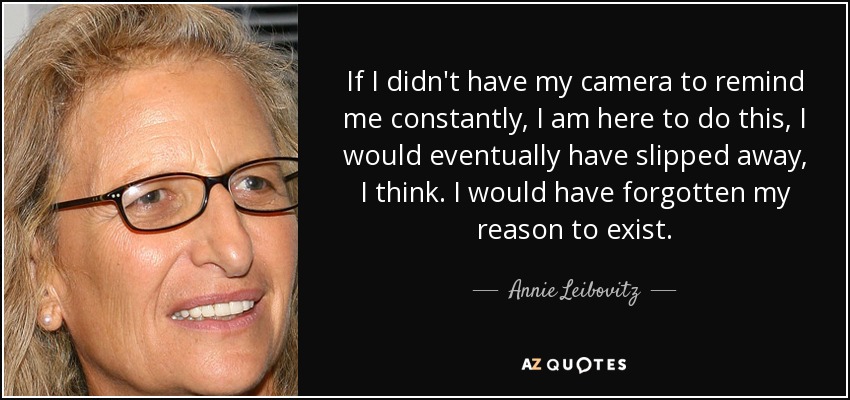
If I didn't have my camera to remind me constantly, I am here to do this, I would eventually have slipped away, I think. I would have forgotten my reason to exist.
The unary Photograph has every reason to be banal, 'unity' of composition being the first rule of vulgar (and notably, of academic) rhetoric: 'The subject,' says one handbook for amateur photographers, 'must be simple, free of useless accessories; this is called the Search for Unity.
Photographers are victims of paradox, tracking the impermanent to make it permanent.
I have been a photographer all my life....and have made photographs of many things and for many reasons. But one thing that becomes more and more apparent is that I am simply only as good as my next photograph. That's the one that counts the most....For this reason I find it a delight to face a new day, and to develop that new roll of film. It's a great way to live.
People have been reading photography as a true document, at the same time they are now getting suspicious. I am basically an honest person, so I let the camera capture whatever it captures whether you believe it or not is up to you; it’s not my responsibility, blame my camera, not me.
Art is technique: a means by which to materialize the invisible realm of the mind.
When people call me a photographer, I always feel like something of a charlatan—at least in Japanese. The word shashin, for photograph, combines the characters sha, meaning to reflect or copy, and shin, meaning truth, hence the photographer seems to entertain grand delusions of portraying truth.
If I already have a vision, my work is almost done. The rest is a technical problem.
Fossils work almost the same way as photography as a record of history. The accumulation of time and history becomes a negative of the image. And this negative comes off, and the fossil is the positive side. This is the same as the action of photography.
Photography is like a found object. A photographer never makes an actual subject; they just steal the image from the world... Photography is a system of saving memories. It's a time machine, in a way, to preserve the memory, to preserve time.
Few photographers have ever considered the photography of wild animals, as distinctly opposed to the genre of Wildlife Photography, as an art form. The emphasis has generally been on capturing the drama of wild animals IN ACTION, on capturing that dramatic single moment, as opposed to simply animals in the state of being.
I want to get a real sense of intimate connection with each of the animals - with that particular lion or elephant in front of me. I believe that being that close to the animal makes a huge difference in the photographers ability to reveal its personality. You wouldn't take a portrait of a human being from a hundred feet away and expect to capture their spirit; you'd move in close.
Photographers should follow their own judgment, and not the fads and dictates of others.
The photographer has almost as much control over his subject matter as a painter. He can control light and shade, form and space, pattern and texture, motion and mood, everything except composition.
Photography has an amazing ability to capture the fine detail of surface textures. But far too often these intricate patterns are loved by the photographer for their own sake. The richness of texture fascinates the eye and the photographer falls easy prey to such quickly-caught complexities. The designs mean nothing in themselves and are merely pictorially attractive abstractions. A central problem in contemporary photography is to bring about a wider significance in purely textural imagery.
For me N.M.E. was a very big thing. When I first came to the United Kingdom I started taking pictures for them and I became their main photographer for five years, and that's really been the basis of everything I've been doing since.
I'm a photographer and retoucher from Sweden. I use photography as a way of collecting material to realize the ideas in my mind.
I was coming to realize that the real magician was light itself.
It is an error common to many artists, who strive merely to avoid mistakes, when all our efforts should be to create positive and important work. Better positive and important with mistakes and failures than perfect mediocrity.
A photograph is worth a thousand words, provided it is accompanied by only ten words.
Some day there may be... machinery that needs but to be wound up and sent roaming o'er hill and dale, through fields and meadows, by babbling brooks and shady woods - in short, a machine that will discriminately select its subject and, by means of a skillful arrangement of springs and screws, compose its motif, expose the plate, develop, print, and even mount and frame the result of its excursion, so that there will be nothing for us to do but to send it to the Royal Photographic Society's exhibition and gratefully to receive the 'Royal Medal'.
It's important to understand it's OK to control the subject. If most editorial stories were photographed just as they are, editors would end up throwing most in the waste basket. You have to work hard at making an editorial picture. You need to re-stage things, rearrange things so that they work for the story, with truth and without lying.
I seldom think when I take a picture. My eyes and fingers react - click. But first, it's most important to decide on the angle at which your photograph is to be taken.
Photography is art when it's used by an artist.
I do have strong convictions and political opinions, but I don't think it's necessary to imbue my photographic work with them. I use photography as a vessel for visual material to flow through, to encourage conversation with the viewer. I try to present a catalyst and invite viewers to tell their own stories.
Follow AzQuotes on Facebook, Twitter and Google+. Every day we present the best quotes! Improve yourself, find your inspiration, share with friends
or simply: