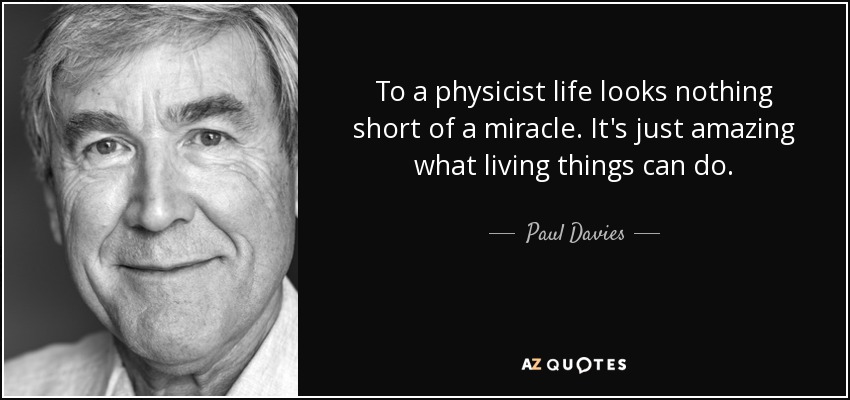
To a physicist life looks nothing short of a miracle. It's just amazing what living things can do.
When I was young, Stephen Hawking wasn't the world's most famous physicist. The fame didn't arrive until the publication of "A Brief History of Time," by which time I was in my late teens. When I was a child, he was well known among physicists, but they are a fairly select, serious bunch, not much given to celebrity idolizing.
Physics has entered a remarkable era. Ideas that were once the realm of science fiction are now entering our theoretical and maybe even experimental grasp. Brand-new theoretical discoveries about extra dimensions have irreversibly changed how particle physicists, astrophysicists, and cosmologists now think about the world. The sheer number and pace of discoveries tells us that we've most likely only scratched the surface of the wondrous possibilities that lie in store. Ideas have taken on a life of their own.
At any one time there is a natural tendency among physicists to believe that we already know the essential ingredients of a comprehensive theory . But each time a new frontier of observation is broached we inevitably discover new phenomena which force us to modify substantially our previous conceptions. I believe this process to be unending, that the delights and challenges of unexpected discovery will continue always.
If physics is too difficult for the physicists, the nonphysicist may wonder whether he should try at all to grasp its complexities and ambiguities. It is undeniably an effort, but probably one worth making, for the basic questions are important and the new experimental results are often fascinating. And if the layman runs into serious perplexities, he can be consoled with the thought that the points which baffle him are more than likely the ones for which the professionals have not found satisfactory answers.
In reality, as any physicist will tell you, the physical world is made up of moving energy. All matter is energy.
I've never heard a person say, 'I had a rotten mother, but she's such a great physicist.
We have to give up the idea of realism to a far greater extent than most physicists believe today.
Physics admits of a lovely unification, not just at the level of fundamental forces, but when considering its extent and implications. Classifications like "optics" or "thermodynamics" are just straitjackets, preventing physicists from seeing countless intersections.
The development of quantum mechanics early in the twentieth century obliged physicists to change radically the concepts they used to describe the world.
I have a theory that evolutionary biologists are more vain than particle physicists.
I have an abiding interest in how ordinary people produce knowledge, and what it means for individuals to know the world. I thought I'd be a theoretical physicist because I love physicists' views of the world - I find general relativity and quantum theory thrilling - but I have always felt uneasy with the idea of an Ultimate Truth. One of the functions of science is to help us instrumentally; it helps us to build things like microchips and GPS satellites. But another function of science in the modern world is to help us feel "at home in the universe".
Does it mean, if you don't understand something, and the community of physicists don't understand it, that means God did it? Is that how you want to play this game? Because if it is, here's a list of things in the past that the physicists at the time didn't understand [and now we do understand] [...]. If that's how you want to invoke your evidence for God, then God is an ever-receding pocket of scientific ignorance that's getting smaller and smaller and smaller as time moves on - so just be ready for that to happen, if that's how you want to come at the problem
Follow AzQuotes on Facebook, Twitter and Google+. Every day we present the best quotes! Improve yourself, find your inspiration, share with friends
or simply: