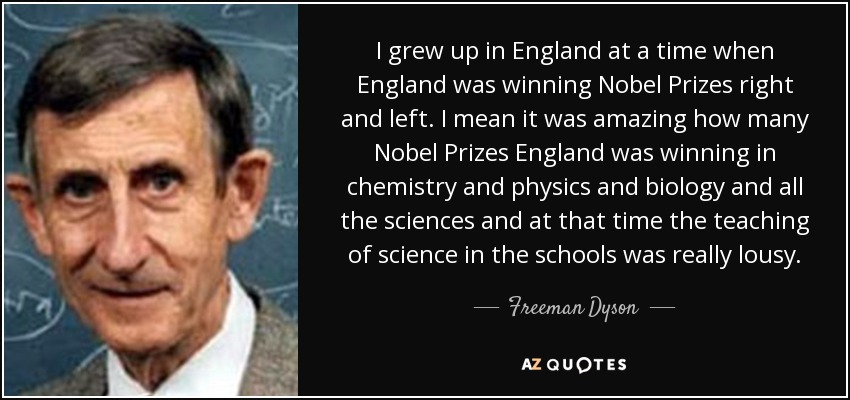
I grew up in England at a time when England was winning Nobel Prizes right and left. I mean it was amazing how many Nobel Prizes England was winning in chemistry and physics and biology and all the sciences and at that time the teaching of science in the schools was really lousy.
The ability to name poetry's gestures and rhetorics isn't required to write or read them, any more than a painter needs to know the physics of color to bring forward a landscape. The eye and hand and ear know what they need to know. Some of us want to know more, because knowing pleases.
There has never been, and never will be, anyone who sees, thinks, or responds exactly the way you do. Whether you’re revolutionizing physics or making a quilt, you must display your differences to make a difference.
I have this amateur side attraction to, and interest in, the sciences and biology and physics and evolution. Paleontology is of interest to me. I'm interested in the way these fields have helped us understand how we are human and why we are human. I'm also from the area that is considered to be the cradle of mankind.
Woe be to him who tries to isolate one department of knowledge from the rest. All science is one: language, literature and history, physics, mathematics and philosophy; subjects which seem the most remote from one another are in reality connected, or rather they all form a single system.
A consistent pursuit of classical physics forces a transformation in the very heart of that physics.
Don't waste your time on beaming people up or down. Instead, consider gravity waves as advanced physics of the universe that could be used to travel interstellar distances.
When World War II came along, which was when I was a teenager, we all expected we would have anthrax bombs and this kind of stuff. We thought it would be a biological war. Fortunately it wasn't and, but it's because the danger is still there and by some miracle we escaped all that, so you never can tell what it going to happen, but biology certainly could be even worse than physics and chemistry.
A popular feel for scientific endeavors should, if possible, be restored given the needs of the twenty-first century. This does not mean that every literature major should take a watered-down physics course or that a corporate lawyer should stay abreast of quantum mechanics. Rather, it means that an appreciation for the methods of science is a useful asset for a responsible citizenry. What science teaches us, very significantly, is the correlation between factual evidence and general theories, something well illustrated in Einstein's life.
So great a contribution to physics was Two New Sciences that scholars have long maintained that the book anticipated Isaac Newton's laws of motion.
I was trying to run something to ground that had come to my attention when I was working on the Baroque Cycle. That series, of course, was about the conflict between Newton and Leibniz. Leibniz developed a system of metaphysics called monadology, which looked pretty weird at the time and was promptly buried by Newtonian-style physics.
The development of physics in the twentieth century already has transformed the consciousness of those involved with it. The study (of modern physics) produces insights into the nature of reality very similar to those produced by the study of eastern philosophy.
Food, like anything else, lives in the physical world and obeys the laws of physics. When you whisk together some oil and a little bit of lemon juice - or, in other words, make mayonnaise - you are using the principles of physics and chemistry. Understanding how those principles affect cooking lets you cook better.
The chief philosophical value of physics is that it gives the mind something distinct to lay hold of, which, if you don't, Nature at once tells you you are wrong.
Physics has found no straight lines. Instead, the physical universe consists of only waves undulating back and forth allowing for corrections and balance.
I am fascinated by quantum physics.
Invention and entrepreneurship isn't about pure technology. Most people take whatever they see in front of them and relate it to something they understand. For at least ten years after Ford started building cars, people called them horseless carriages. It wasn't obvious to call it a car. They used to call the radio 'the wireless.' Innovation is much more about changing people and their perceptions and their attitudes and their willingness to accept change than it is about physics and engineering.
The only reason psychology students don't have to do more and harder mathematics than physics students is because the mathematicians haven't yet discovered ways of dealing with problems as hard as those in psychology.
It's not nuclear physics. You always remember that. But if you write about sports long enough, you're constantly coming back to the point that something buoys people; something makes you feel better for having been there. Something of value is at work there...Something is hallowed here. I think that something is excellence.
The importance of infinite processes for the practical exigencies of technical life can hardly be overemphasized. Practically all applications of arithmetic to geometry, mechanics, physics and even statistics involve these processes directly and indirectly.
The difference between physics and metaphysics is not that the practitioners of one are smarter than the practitioners of the other. The difference is that the metaphysicist has no laboratory.
Computer science needs to be part of the core curriculum - like algebra, biology, physics, or chemistry. We need all schools to teach it, not just 10%.
The world of physics is essentially the real world construed by mathematical abstractions, and the world of sense is the real world construed by the abstractions which the sense-organs immediately furnish. To suppose that the "material mode" is a primitive and groping attempt at physical conception is a fatal error in epistemology.
Science fiction - and the correct shortcut is 'sf' - uses actual scientific facts or theories for the source ideas or framework of the story. It has some scientific content, however speculative. If it breaks a law of physics, it knows it's doing so and follows up the consequences. If it invents a society of aliens, it does so with some respect for and knowledge of the social sciences and what you might call social probabilities. And some of it is literarily self-aware enough to treat its metaphors as metaphors.
Galileo - the father of modern physics - indeed of modern science.
Follow AzQuotes on Facebook, Twitter and Google+. Every day we present the best quotes! Improve yourself, find your inspiration, share with friends
or simply: