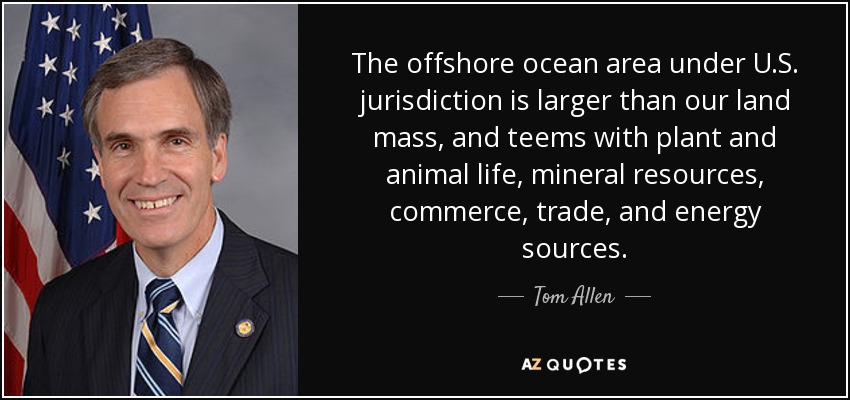
The offshore ocean area under U.S. jurisdiction is larger than our land mass, and teems with plant and animal life, mineral resources, commerce, trade, and energy sources.
In learning to pay respectful attention to one another and plants and animals, we relearn the acts of empathy, and thus humility and compassion - ways of proceeding that grow more and more necessary as the world crowds in.
Humans are a great survivor species but our survival will be pretty grim if all of the plants and animals we depend on die out. That's why any human survival strategy has to include a plan to maintain our environment roughly in the state that it's in now.
Left alone, the earth maintains its own fertility, in accordance with the orderly cycle of plant and animal life.
Artificial selection turned the wolf into the shepherd, and the wild grasses into wheat and corn. In fact, almost every plant and animal that we eat today was bred from a wild, less edible ancestor. If artificial selection can work such profound changes in only ten or fifteen thousand years, what can natural selection do operating over billions of years? The answer is all the beauty and diversity of life.
Agriculture probably required a far greater discipline than did any form of food collecting. Seeds had to be planted at certain seasons, some protection had to be given to the growing plants and animals, harvests had to be reaped, stored and divided. Thus, we might argue that it was neither leisure time nor a sedentary existence but the more rigorous demands associated with an agricultural way of life that led to great cultural changes.
There have only been about a half dozen genuinely important events in the four-billion-year saga of life on Earth: single-celled life, multicelled life, differentiation into plants and animals, movement of animals from water to land, and the advent of mammals and consciousness.
When I go back to the Quran I see that the context of Revelation is creation in its entirety. The universe is a Revelation and this of course includes nature, plants and animals. In other words, what is coming from the Quran as rules and objectives are set within the larger scheme of the universe and nature as part of Creation.
Will the things that are being lost - the wilderness, the plants and animals, the skills, and all the others - leave too vast a gap in the human spirit? This is the unanswerable question. In the meantime, we must live in our century and wait, enduring somehow the unavoidable sadness.
Every soul on earth is equally precious, even those of plants and animals. If you see love in one area and not another, then you are not reflecting true love for all creatures on earth, only a deficiency in your senses. The light of love sees no walls.
You will die but the carbon will not; its career does not end with you. It will return to the soil, and there a plant may take it up again in time, sending it once more on a cycle of plant and animal life.
How did we get into this funny-looking body that has a hole at one end in which we regularly stuff dead plants and animals? It's bizarre that we got here, incarnated into this world with these bodies.
People didn't make life, so they can't destroy it. Even if we were to wipe out every bit of life in the world, we can't touch the place life comes from. Whatever made the plants and animals and people spring up in the first place will always be there, and life will spring up again.
We're losing biodiversity globally at an alarming rate, and we need a cornucopia of different plants and animals, for the planet's health and our own.
The human family has invaluable friends and irreplaceable allies in the plant and animal worlds. We cannot continue to tug at the web of life without tearing a hole in the very fabric of our earthly existence - and eventually falling through that hole ourselves.
If we are looking for insurance against want and oppression, we will find it only in our neighbors' prosperity and goodwill and, beyond that, in the good health of our worldly places, our homelands. If we were sincerely looking for a place of safety, for real security and success, then we would begin to turn to our communities - and not the communities simply of our human neighbors but also of the water, earth, and air, the plants and animals, all the creatures with whom our local life is shared. (pg. 59, "Racism and the Economy")
Colombia has a huge variety of plant and animal species, and we have enormous potential. Small and mid-sized companies should come to Colombia. From here, they have access to the entire Latin American market.
In the Gaia theory air, water, and soil are major components of one central organism, planet Earth. What we typically think of as life - the plants and animals that inhabit the earth - has evolved merely to regulate the chemistry of the biosphere. Humans are insignificant participants, far less important to the life cycle than termites. Even the imbalance that we have created by adding massive quantities of carbon dioxide to the atmosphere may be brought back to acceptable levels by other organisms functioning in their capacity to correct excesses.
Permaculture is a design system for creating sustainable human environments...Permaculture uses the inherent qualities of plants and animals combined with the natural characteristics of landscapes and structures to produce a life supporting system for city and country, using the smallest practical area.
A large animal needs a large area. If you protect that area, you're also protecting thousands of other plants and animals. You're saving all these species that future generations will want - you're saving the world for your children and your children's children. . . . The destruction of species is final. If you lose a species, you lose the genes, you lose all the potential drugs and potential foods that could be useful to the next generations. The ecosystems will not function as they have.
One road to happiness is to cultivate curiosity about everything. Not only about people but about subjects, not only about the arts but about history and foreign customs. Not only about countries and cities, but about plants and animals. Not only about lichened rocks and curious markings on the bark of trees, but about stars and atoms. Not only about your friends but about that strange labyrinth we inhabit which we call ourselves. Then, if we do that, we will never suffer a moment's boredom.
There are about 250,000 different species of fossil plants and animals known . . In spite of this large quantity of information, it is but a tiny fraction of the diversity that [according to the theory] actually lived in the past. There are well over a million species living today and . . [it is] possible to predict how many species ought to be in our fossil record. That number is at least 100 times the number we have found.
Probe the universe in a myriad of points. ... He is a wise man who has taken many views; to whom stones and plants and animals and a myriad of objects have each suggesting something, contributed something.
(The animal rights movement) should be supported by all Christians. In an ecological universe, every created entity has intrinsic value because all are subjects as well as objects. As we cover more and more of the earth with our factories/ highways/ towns/parking lots, we annihilate more and more plants and animals.
You begin paying more attention to what you're seeing when you know the names... If you don't know the names of plant and animal species that share your neighbourhood, you don't care about them and can't protect biodiversity.
Follow AzQuotes on Facebook, Twitter and Google+. Every day we present the best quotes! Improve yourself, find your inspiration, share with friends
or simply: