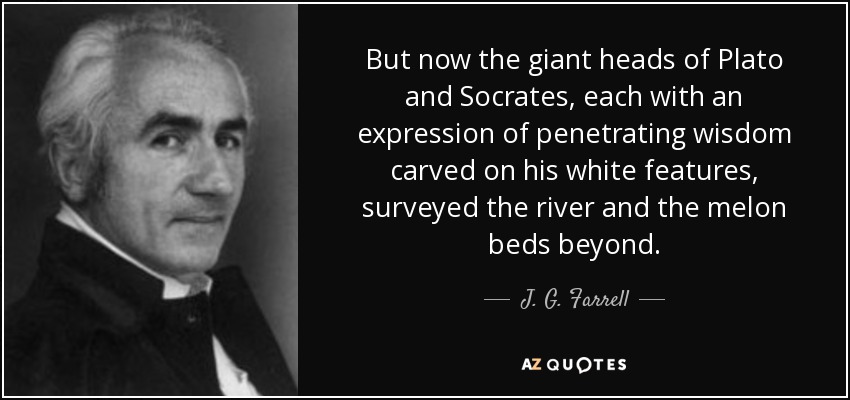
But now the giant heads of Plato and Socrates, each with an expression of penetrating wisdom carved on his white features, surveyed the river and the melon beds beyond.
Socrates: Have you noticed on our journey how often the citizens of this new land remind each other it is a free country? Plato: I have, and think it odd they do this.Socrates: How so, Plato?Plato: It is like reminding a baker he is a baker, or a sculptor he is asculptor.Socrates: You mean to say if someone is convinced of their trade, they haveno need to be reminded.Plato: That is correct.Socrates: I agree. If these citizens were convinced of their freedom, they would not need reminders.
Plato's philosophy is a dignified preface to future religion.
We know only what we do, what we make, what we construct; and all that we make, all that we construct, are realities. I call them images, not in Plato's sense (namely that they are only reflections of reality), but I hold that these images are the reality itself and that there is no reality beyond this reality except when in our creative process we change the images: then we have created new realities.
The man who lives in contact with what he believes to be a living Church is a man always expecting to meet Plato and Shakespeare tomorrow at breakfast. He is always expecting to see some truth that he has never seen before.
There are not in the world at any one time more than a dozen persons who read and understand Plato:-never enough to pay for an edition of his works; yet to every generation these come duly down, for the sake of those few persons, as if God brought them written in his hand.
The generation is unceasing. Beauty, as both Plato’s Symposium and everyday life confirm, prompts the begetting of children: when the eye sees someone beautiful, the whole body wants to reproduce the person.
The great spiritual geniuses, whether it was Moses, Buddha, Plato, Socrates, Jesus, or Emerson..... have taught man to look within himself to find God.
When something goes wrong, accuse yourself first. Even the wisdom of Plato or Solomon can wobble and go blind
Socrates called beauty a short-lived tyranny; Plato, a privilege of nature; Theophrastus, a silent cheat; Theocritus, a delightful prejudice; Carneades, a solitary kingdom; Aristotle, that it was better than all the letters of recommendation in the world; Homer, that it was a glorious gift of nature; and Ovid, that it was favor bestowed by the gods.
In those days it was possible for a Greek to flee from an over-abundant reality as though it were but the tricky scheming off the imagination-and to flee, not like Plato into the land of eternal ideas, into the workshop off the world-creator, feasting one's eyes on the unblemished unbreakable archetypes, but into the rigor mortis off the coldest emptiest concept off all, the concept of being.
Plato described ordinary life as unthinking, lived in a dim cave of shadowy reflections, but said that it is possible to leave the cave and see things in sunlit clarity as they actually are.
Ornate rhetorick taught out of the rule of Plato.... To which poetry would be made subsequent, or indeed rather precedent, as being less suttle and fine, but more simple, sensuous, and passionate.
Once Ptolemy and Plato, yesterday Newton, today Einstein, and tomorrow new faiths, new beliefs, and new dimensions.
Out of Plato come all things that are still written and debated about among men of thought.
Do not expect Plato's ideal republic; be satisfied with even the smallest step forward, and consider this no small achievement.
Plato is my friend, but truth is a better friend.
In 'The Republic' he [Plato] states that the enjoyment of food is not a true pleasure because the purpose of eating is to relieve pain - hunger.
The Christian priesthood, finding the doctrines of Christ leveled to every understanding, and too plain to need explanation, saw, in the mysticism of Plato, materials with which they might build up an artificial system which might, from it's indistinctness, admit everlasting controversy, give employment for their order, and introduce it to profit, power and pre-eminence.
How is the soul profited by the strife of Hector, the arguments of Plato, the poems of Virgil, or the elegies of Ovid, who, with others like them, are now gnashing their teeth in the prison of the infernal Babylon, under the cruet tyranny of Pluto?
The power of Christianity lies in its revelation in act, of that which Plato divined in theory.
To his [ Plato's ] great disappointment, he found Anaxagoras adducing simple physical reasons, instead of the teleological reasons, which he had expected. Such a teacher could no longer allure him.
Plato had defined Man as an animal, biped and featherless, and was applauded. Diogenes plucked a fowl and brought it into the lecture-room with the words, "Behold Plato's man!"
Plato defined a slave as one who accepts from another the purposes which control his conduct. This condition obtains even where there is no slavery in the legal sense. It is found wherever men are engaged in activity which is socially serviceable, but whose service they do not understand and have no personal interest in.
For me music is central, so when one's talking about poetry, for the most part Plato's talking primarily about words, where I talk about notes, I talk about tone, I talk about timbre, I talk about rhythms.
Follow AzQuotes on Facebook, Twitter and Google+. Every day we present the best quotes! Improve yourself, find your inspiration, share with friends
or simply: