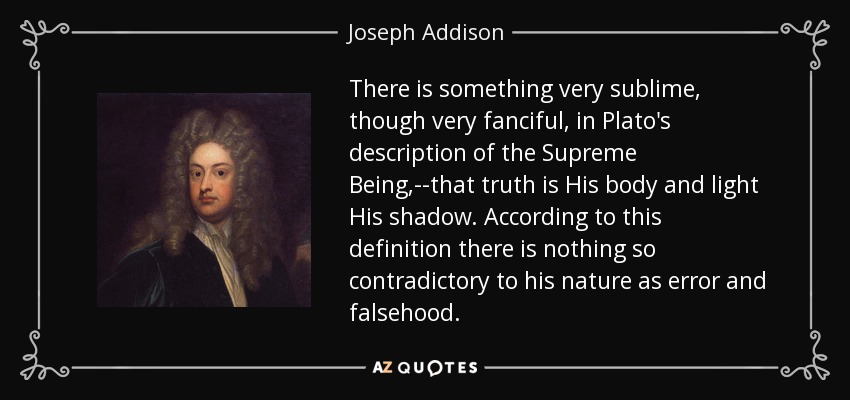
There is something very sublime, though very fanciful, in Plato's description of the Supreme Being,--that truth is His body and light His shadow. According to this definition there is nothing so contradictory to his nature as error and falsehood.
Xenophon wrote with a swan's quill, Plato with a pen of gold, and Thucydides with a brazen stylus.
Creation is the production of order. What a simple, but, at the same time, comprehensive and pregnant principle is here! Plato could tell his disciples no ultimate truth of more pervading significance. Order is the law of all intelligible existence.
Music does affect your opinions. Plato is supposed to have said "It's very dangerous to allow the wrong kind of music into the republic."
Scholars may quote Plato in studies, but the hearts of millions shall quote the Bible at their daily toil, and draw strength from its inspiration, as the meadows draw it from the brook.
Plato, the first true pope of philosophy (sorry, Socrates), argued for a World of Forms above the reality-a transcendent plane of perfect essences, pure and lovely, where nothing ever gets muddy (including the essence of mud.)
It is in the stomach of plants that development begins, and ends in the circles of the universe. 'Tis a long scale from the gorilla to the gentleman,--from the gorilla to Plato, Newton, Shakespeare,--to the sanctities of religion, the refinements of legislation, the summit of science, art, and poetry. The beginnings are slow and infirm, but it is an always accelerated march.
Through Plato, Aristotle came to believe in God; but Plato never attempted to prove His reality. Aristotle had to do so. Plato contemplated Him; Aristotle produced arguments to demonstrate Him. Plato never defined Him; but Aristotle thought God through logically, and concluded with entire satisfaction to himself that He was the Unmoved Mover.
Plato found fault that the poets of his time filled the world with wrong opinions of the gods, making light tales of that unspotted essence, and therefore would not have the youth depraved with such opinions.
In all the good Greek of Plato I lack my roastbeef and potato. A better man was Aristotle, Pulling steady on the bottle.
I like people who like Plato.
He that makes himself famous by his eloquence, justice or arms illustrates his extraction, let it be never so mean; and gives inestimable reputation to his parents. We should never have heard of Sophroniscus, but for his son, Socrates; nor of Ariosto and Gryllus, if it had not been for Xenophon and Plato.
Plato says that the punishment which the wise suffer who refuse to take part in the government, is, to live under the government of worse men; and the like regret is suggested to all the auditors, as the penalty of abstaining to speak,--that they shall hear worse orators than themselves.
Aristotle wore many rings and expensive clothes. ... Plato found this off-putting and unsuited for a philosopher.
It is ... possible to read Plato as if he were only discussing reason and not mystical intuition in his writings but ... in that case he seems naively over-impressed by rather ordinary thought processes.
Many students of dreams, from Plato to [Sigmund] Freud, hold that the sleeping person,deprived of contact with the outside world, regresses temporarily to an irrational primitive mental state.
Plotinus is usually called the Founder of Neo Platonism and what that means is that in this philosophical circle, he was founding a kind of renewed attempt to understand the thought of Plato which however they were combining with the thought of other philosophers, including Aristotle, the Stoics and Pythagoreans and so on.
Plotinus is a neo-Platonist, so he would encourage us to go back to Plato.
Plato in his dialogue The Phaedo says that whereas sticks and stones are both equal and unequal, (so maybe what that means is that each stick is going to be equal to some other sticks and unequal to some other sticks, so equal to the stick on the left maybe but shorter than the stick on its right) the form of equal is going to be just equal, and it won't partake of inequality at all. And it will be the cause of equality in things that are equal, for example, equal sticks and stones.
If Christianity cannot present evidence that the soul is immortal, then they have nothing to offer the masses, eternity in heaven with God or hold over their heads suffering forever in hell. They need the immortality of the soul. I did my research, it's not in the Bible, so what do they do? They relied on Judaism, which has always believed in the immortality of the soul. I start checking on that and I look in the Judaica Encyclopedia and what do I find? Their remark that Judaism probably got the immortality of the soul from the Greeks, so I go back further, where it all started with Plato.
Paraphrasing Plato's Republic: "Only people who have allowed themselves to be reformed by reality have it in themselves to reform their polis for the better."
Plato dramatically puts the detachment of the philosopher from his time this way: to philosophize is to prepare to die.
Plato worried that philosophical writing would take the place of living conversations for which, in philosophy, there is no substitute.
What impressed me about Plato and Sartre was their conviction that we should live our lives in the light of big truths about reality and human existence.
Even before Plato, techne was conceived as knowledge of a determinate field that could be mastered by "the expert". Such a person becomes an authority to whom laypersons should, in their dealings with that field, defer. Techne typically results in a useful result.
Follow AzQuotes on Facebook, Twitter and Google+. Every day we present the best quotes! Improve yourself, find your inspiration, share with friends
or simply: